





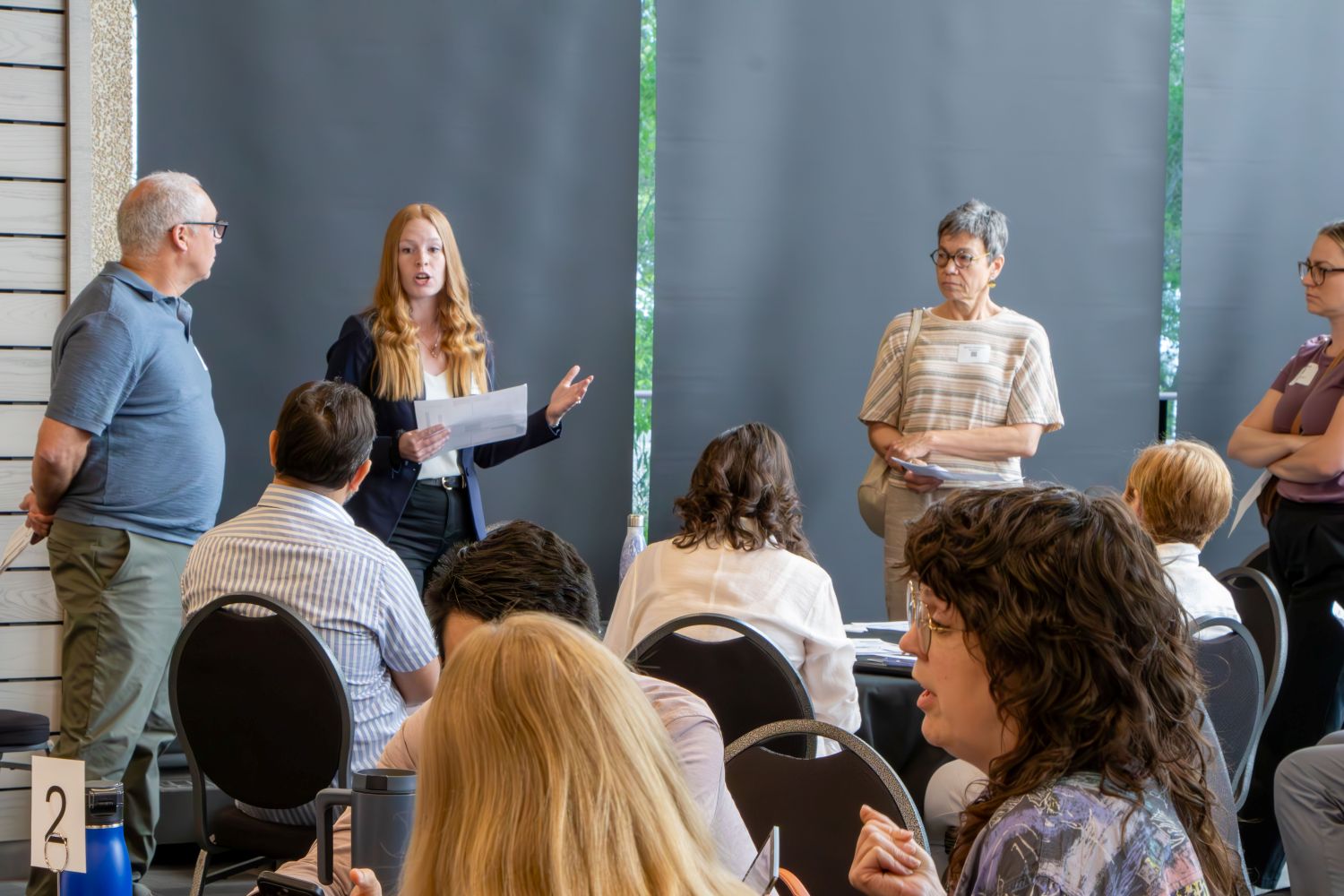
Faculty and instructors share insights during the 2025 Scholarship of Teaching and Learning Symposium.
Building a culture of teaching innovation
Faculty-led SoTL projects elevate student learning across disciplines
UM is pleased to announce the funding of five innovative projects through the Scholarship of Teaching and Learning (SoTL) Support Fund. This fund provides opportunities for professors, instructors, and librarians to engage in SoTL research that increases knowledge in teaching pedagogy and learning.
Guided by MomentUM: Leading Change Together, UM is committed to empowering learners through dynamic learning experiences that meet the needs of an increasingly diverse student body. Investing in SoTL enables instructors and faculty members to examine their teaching practices, incorporate evidence-based findings, and ultimately, improve student success.
The 2025 SoTL Support Fund has awarded five Seed projects, a stream within the scaffolded-funding program which supports time-limited and innovative new teaching and learning research ideas with a budget of up to $6000. These projects span a range of disciplines, each offering an innovative approach to advancing research-based teaching and learning at UM.
Empowering Statistical Minds: Data Exploration for Student Engagement
Project lead: Hina Shaheen, Department of Statistics, Faculty of Science

Bridging the gap between theoretical statistical concepts and real-world applications can be challenging for many Statistics students. Traditional lecture-based approaches often encourage rote memorization of formulas rather than deep understanding. This project will introduce small-group, collaborative experiments using real-world databases, promoting active learning through data exploration and statistical decision-making. The hands-on problem-solving activities aim to strengthen students’ analytical reasoning, decision-making, and statistical interpretation skills. Analysis of students’ behavioural, emotional, and social engagement outcomes will inform and support ongoing initiatives aimed at enhancing student success and career readiness.
Live Podcasting in Teacher Education: Amplifying Engagement, Dialogue, and Multimodal Literacies
Project lead: Amir Michalovich, Department of Curriculum, Teaching and Learning, Faculty of Education

This project examines the extent to which live podcasting in class can cultivate engaging, dialogic, and multimodal classroom discussions for students in teacher education. Given the rapid advancement of generative AI, it is increasingly important to explore classroom-based assignments involving students co-developing and demonstrating their knowledge. While some research has explored the use of pre-recorded or edited podcasts in post-secondary education, it has rarely examined digital multimodal assignments conducted live in class. This study addresses that gap by exploring how these tools can impact student engagement with course content, participation in dialogic learning, and development of communicative skills across multimodal literacies (e.g., speaking, listening, writing, viewing, and representing).
Team-based collaborative learning from the head to the toes to better health for all
Project lead: Dr. Laura MacDonald, Dental Hygiene, Dr. Gerald Niznick College of Dentistry, Rady Faculty of Health Sciences

This project pilots an interprofessional team-based collaborative experiential learning program aimed at facilitating the integration of oral health within comprehensive health care. It will examine students’ perspectives of a novel interprofessional education (IPE) initiative delivered in a dental clinic setting. Both existing research and the outcomes of a recent Rady Faculty of Health Sciences interprofessional simulation indicate a persistent gap in incorporating oral health within comprehensive health-care practice. Situating this intervention within a dental clinic is intended to help health professional students connect oral health with overall health and roles and responsibilities to ensure comprehensive health care. Findings will offer curriculum IPE developers valuable insights into the key traits students believe support interprofessional collaboration competencies, specifically relationship-focused care, clearly defined roles and responsibilities, and collaborative leadership.
Case-Based Learning in Landscape Architecture and Environmental Design
Project co-leads: Yuhao Lu, Department of Landscape Architecture and Mark Meagher, Environmental Design Program


In landscape architecture and design education, students often struggle to build and apply an accurate vocabulary for describing spatial patterns. Relying solely on memorized definitions limits students’ abilities to recognize or articulate design intensions in new contexts. Applying case-based learning principles, which emphasize that deeper understanding emerges from exposure to concrete examples, this project will give students access to real-world cases in the form of project drawings and photographs. A curated collection of design patterns and vocabulary will be developed from an extensive database of precedents and enhanced through state-of-the-art machine learning. Students will submit their own sketches, which the system will analyze to generate key vocabulary terms to describe the patterns and examples of related patterns across multiple design disciplines. Pre- and post-project surveys will assess the tool’s impact on students’ design literacy, pattern recognition, and communicative competence.
Collaborative Proof Writing: Enhancing Mathematical Understanding and Communication Skills Through Group-Based Learning
Project lead: Jamie de Jong, Department of Mathematics, Faculty of Science

Writing mathematical proofs can be a significant challenge for undergraduate students, who must shift from the computational problem-solving emphasized in high school to the formal reasoning required in university mathematics. This project will evaluate the effectiveness of targeted in-class group activities designed to strengthen both mathematical understanding and communication. The activities will focus on analyzing and writing mathematical proofs, with opportunities for immediate feedback from both instructors and peers. While peer feedback is well-established in writing-intensive fields, its application in proof-based mathematics is limited. Surveys and assessments of student performance will be used to measure the effectiveness of this teaching approach.
Learn more about how UM is supporting teaching excellence.