







Photo: Terje Sollie
Top newsmakers of 2025
Throughout 2025, University of Manitoba experts and researchers made headlines across local, national, and global media.
From groundbreaking discoveries to timely commentary on pressing issues, their voices shaped conversations on health, climate, technology, and more.
This list highlights the most influential stories of the year, compiled from trending searches and UM Media Relations data sources.
The Arctic & Antarctica: Ice, oceans, wildlife, shipping, and sovereignty
Churchill as Canada’s Arctic gateway — Dr. Feiyue Wang & Dr. Mario Pinto: As Hudson Bay become accessible to ships for longer periods, Dr. Wang, Canada Research Chair in Arctic Environmental Chemistry explained why Churchill is re-emerging as a strategic Arctic gateway, and why more research is needed as we look to expand the Port of Churchill, while Dr. Pinto, Vice-President (Research & International) discussed shipping opportunities to environmental risk and sovereignty questions. Their insights reached national and international audiences via The New York Times and The Globe and Mail.
Belugas and port expansion impacts — Dr. Marianne Marcoux: As discussions continues around the expansion of the Port of Churchill, Dr. Marcoux, Adjunct Professor, Biological Sciences, discussed how industrial expansion and vessel noise can affect beluga behaviour and what mitigation could look like. Dr. Marcoux was feature both on CTV & CBC .
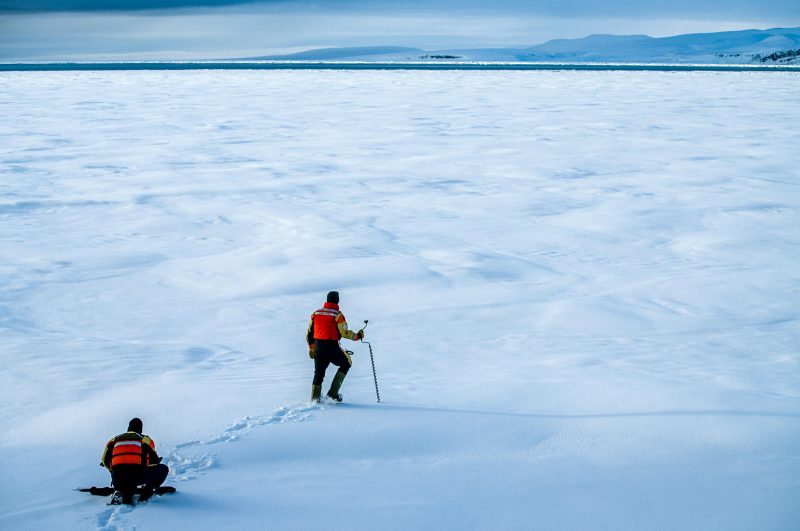
David Babb, lead scientist on Amundsen ship, walking in snow.
Arctic field reporting — Dr. David Babb and the CCGS Amundsen: Reporting live from Arctic fieldwork station, David Babb, Research Associate, Centre for Earth Observation Science and Chief Scientist on the CCGS Amundsen ship , brought audiences into the science, linking sea ice measurement and sampling to wider climate impacts. Featured by CJOB, CTV and CBC.
Polar bears as food-web drivers — Holly Gamblin: Gamblin, PhD candidate with Biological Sciences in the Faculty of Science, helped reframe polar bears as critical carnivores and active drivers of Arctic food webs, explaining how kills and carrion can sustain a network of scavengers. Featured on CBC’s As It Happens, CTV News, Oceanographic Magazine and Science News.
Arctic foxes and connected food webs — Sean Bice-Johnson, another PhD candidate in Biological Sciences, also had complementary research around how Arctic foxes connect land and sea-ice food webs and was featured on the national radio program, CBC’s Quirks & Quarks.
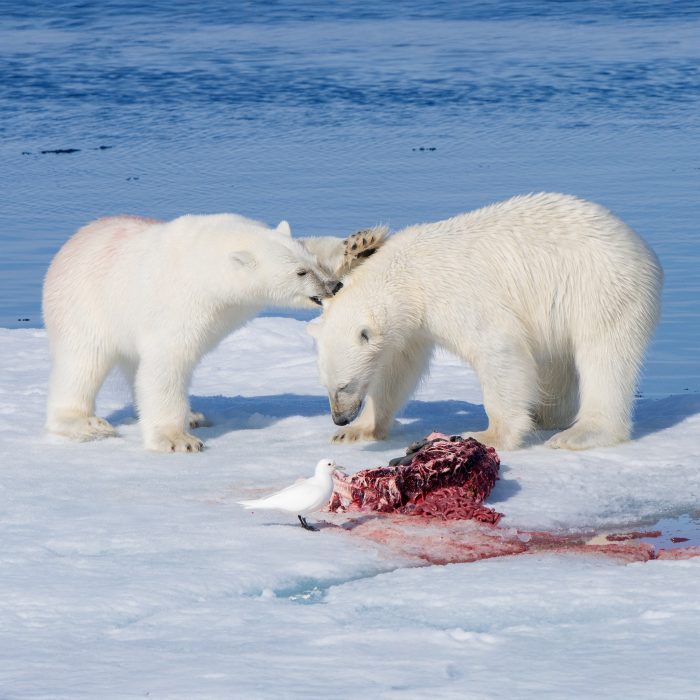
Two-year-old polar bear cubs on a bearded seal carcass with a scavenging ivory gull, Svalbard. Photo by Wayne Lynch.
Cryosphere and climate interventions — Dr. Julienne Stroeve: Stroeve, Professor, Centre for Earth Observation Science, provided evidence-based context on polar change and climate interventions, helping audiences weigh urgency and tradeoffs—featured on the nationally syndicated program CBC Quirks & Quarks
Antarctica’s deep-time climate archive — Dr. Dorthe Dahl-Jensen: Dahl-Jensen is a Canada Excellence Research Chair for Earth Observation Science, and was recently elected as an International Fellow by the Royal Society of Canada. She and her team brought attention to a landmark Antarctic ice-core breakthrough, featured in local and international media, and follow up stories around the ice core offering a longer window into Earth’s climate history and what it suggests about future warming.
Climate tipping points — Dr. Alex Crawford: Crawford, assistant professor, Department of Environment and Geography helped audiences interpret what a climate “tipping point” really means in real-world terms and the impacts we may all be facing in the future. Featured by CBC Manitoba, CTV Winnipeg, and national outlets.
Global health and medical innovation
Mpox — Dr. Jason Kindrachuk: As Mpox surged in the Democratic Republic of Congo, Dr. Jason Kindrachuk, associate professor in Medical Microbiology and Infectious Diseases at UM and V.P. National Microbiology Lab, became a leading voice explaining the shift to urban transmission, a new variant, and risks for adults and pregnant individuals. His expertise, from a Lancet cover feature to CBC Manitoba and SciTechDaily, highlighted Canada and UM’s global health leadership.

Cellular look at the Mpox virus.
Kidney screening innovation — Dr. Claudio Rigatto: A kidney screening in under seven minutes? Dr. Claudio Rigatto’s portable uCR-Chip is revolutionizing diagnostics for remote and low-resource communities. Dr. Rigatto, professor, Max Rady College of Medicine received media coverage in CTV Winnipeg, Medical Xpress, and LabMedica, which spotlighted this innovation.
Space, robotics, and made-in-Manitoba tech
Manitoba part of the next frontier — Dr. Philip Ferguson: Ferguson, a space systems engineer and Associate Professor of Aerospace in Engineering, is leading a CubeSat project connected to NASA’s Artemis-era missions. Ferguson and his team put UM in the spotlight, illustrating how university-built technology can contribute to major international space efforts. Featured on CTV National, CBC News, CJOB Radio and Winnipeg Free Press.
Deep History: Fossils, ancient fish, and human survival
Ancient fish sheds light on evolution — Dr. Melina Jobbins: A Manitoba fossil discovery helped illuminate key evolutionary transitions tied to jaws and teeth, capturing attention across mainstream and science outlets. Dr. Melina Jobbins, a postdoctoral fellow at the PaleoSed+ lab in the Department of earth sciences, find sheds light on the origins of jaws and teeth, earning coverage from CBC News, UM Today, Phys.org, CTV, and CityNews Winnipeg.
Human adaptability — Dr. Paul Durkin: Durkin, assistant professor in the Department of Earth Science and his work on Homo erectus survival strategies offered a fresh look at early human adaptability, generating wide media pickup. Durkin’s research revealed their reliance on freshwater and specialized tools, making waves in CTV Winnipeg, Phys.org, The Manitoban, ScienceDaily, and Genetic Literacy Project.
Canada’s Policy Pressures: Economy, law, defence, and higher education
The shifting trade dynamics and tariff uncertainty — Dr. Barry Prentice and Dr. Fletcher Baragar: 2025 was a year rife with real implications for costs, and competitiveness for Manitoba and Canadian industries. Barry Prentice, head of UM’s Transport Institute, helped translate how global trade tensions and northern infrastructure changes could reshape costs, competitiveness, and Canada’s long-term logistics strategy in the The Globe and Mail, CBC Manitoba, and other national outlets. Fletcher Baragar, Associate Head in the Department of Economics was on Global Winnipeg and other local outlets breaking down which Manitoba sectors are most vulnerable to new tariffs, translating global trade disputes into clear implications for jobs, prices, and regional industries.
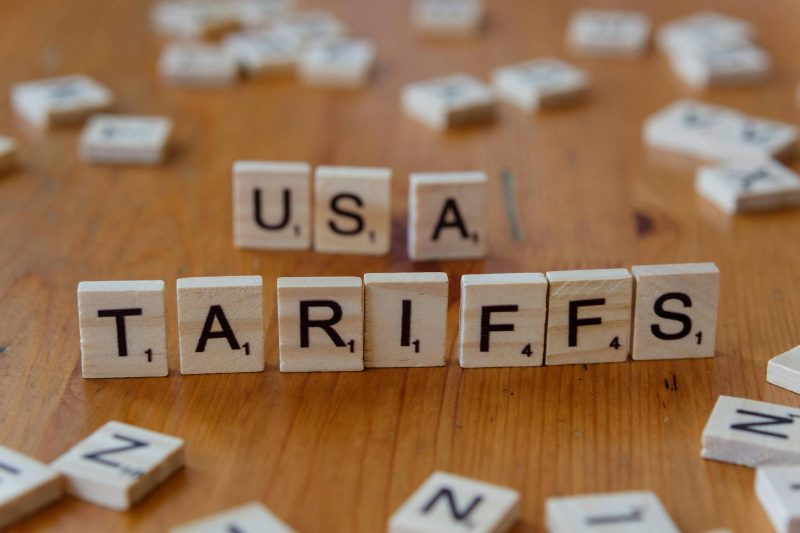
Photo credit: Markus Winkler
Justice, Public Safety and the Charter — Brandon Trask: On CTV News, Global News, CBC and Globe and Mail, law professor Brandon Trask added essential legal clarity to debates over federal bail reform. By questioning whether expanded “reverse-onus” rules could clash with the Canadian Charter of Rights and Freedoms, he pushed the national conversation toward evidence, rights, and balance in the justice system.
Defence Policy, Strategy & Arctic/Northern Security — Dr. Andrea Charron: In The Globe and Mail, Charron, Director, Centre for Defence and Security Studies, argued Canada’s defence commitments must be backed by a coherent, long-term operational plan. She called for practical priorities including a quick-reaction fighter facility in Greenland. Her analysis reframed from defence spending as a strategy problem, not just a budget issue.
Higher Education Policy, Immigration & Research Capacity — President and Vice Chancellor, Dr. Michael Benarroch: Federal caps on international students could reshape Canadian universities. UM President and Vice-Chancellor, Dr. Michael Benarroch warned of impacts on finances, diversity, and research productivity, sparking debate in CBC, The Manitoban, and The Globe and Mail.
Manitoba Politics, Governance & Institutions — Dr. Christopher Adams: On CTV Winnipeg, Adams, Adjunct professor of Political Science, unpacked themes from The Keystone Province, helping viewers navigate Manitoba’s political traditions, institutions, and fiscal debates. His CBC Manitoba commentary cemented him as a definitive voice on provincial governance.

Winnipeg, Manitoba, Canada: historic Provincial Law Courts. Photo by M.Torres
Law, Evidence & Proceeds of Crime — Dr. Michelle Gallant: Gallant, professor at Robson Hall Faculty of Law contributed to CNN coverage of a Canadian case involving a hidden million-dollar stash, explaining why courts treat unexplained large cash holdings with heightened scrutiny.
AI & Society: UM experts decode artificial intelligence
AI, Education & Digital Safety – Dr. David Gerhard (Head of Computer Science) joined CBC Radio’s Cross Country Checkup to tackle a question on many minds: Is AI creating a generation of “cheaters,” or new kinds of achievers? He also appeared regularly on CTV Winnipeg and other outlets, explaining how AI tools are being used in scams and misinformation campaigns, and what people should watch for as the technology becomes more accessible.
AI, Ethics & Human Relationships – Dr. Neil McArthur, Director of the Centre for Professional and Applied Ethics, sparked global discussion on the human side of AI, especially how technology intersects with intimacy, meaning, and connection. His commentary on AI relationships was picked up by The Breaker, The Week, and Grazia, offering a thoughtful look at how machines may influence the way humans relate.
AI, Law & Public Trust – Dr. Katie Szilagyi, Assistant Professor, Faculty of Law) became a go-to expert on the legal and ethical implications of AI, helping audiences think through real-world impacts beyond hype. She explained on CBC why AI isn’t a fix for systemic problems like call-centre inefficiencies at the Canada Revenue Agency, pointing out limitations in generative systems. Szilagyi also spoke to The Canadian Press about how generative tools are already being used in law offices to streamline tasks.
These highlights represent just a fraction of UM’s impact on the world in 2025.
Over the past year, more than 200 experts contributed to 364 unique media stories, showcasing the university’s depth of knowledge, research excellence, and leadership in tackling the world’s most urgent challenges.
We are so grateful for the time our experts gave media this year, their expertise helped make complex ideas/issues understandable and in 2025 these strong voices were so important.
And finally, thank you to our media partners who were great to work with all year, see you in 2026.