






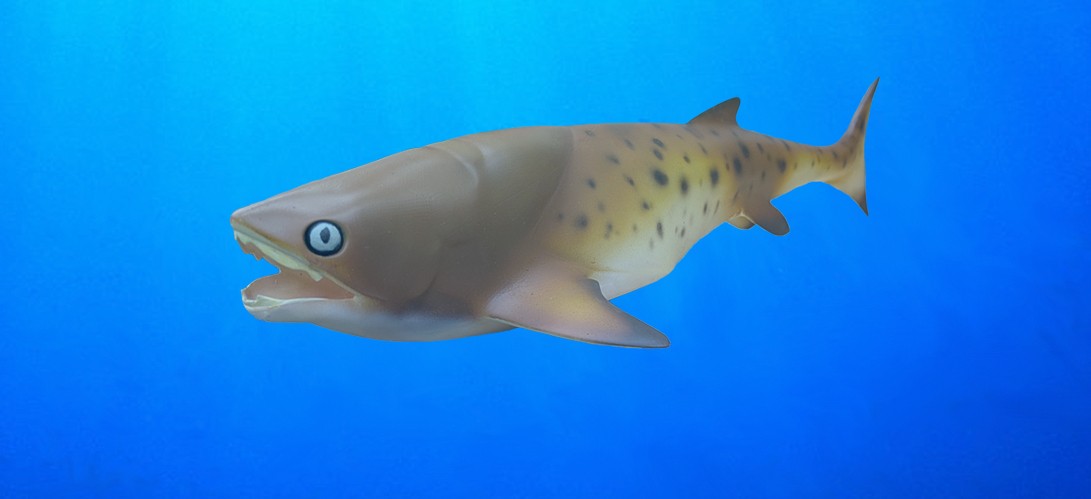
Reconstruction of Elmosteus, a new fossil fish from Manitoba. Artwork by Mitchell Baker, Adam Isaak and Melina Jobbins, with a model based on that of ©eggeater (Thingiverse).
New ancient fish swims into the UM’s Geological Sciences Museum
A University of Manitoba led research project introduces a 390-million-year-old fish from Manitoba.
Manitoba is well-known for its fossil record, including the fossil-filled world famous Ordovician-aged Tyndall Stone and the world’s largest mosasaurs, or marine reptiles, from the Cretaceous period. However, there are other animals that lived deep in Manitoba’s past that are crucial for understanding the history of life in our province.
A research team led by Dr. Melina Jobbins, a postdoctoral fellow at the PaleoSed+ lab in the Department of Earth Sciences of the Clayton H. Riddell Faculty of Environment, Earth, and Resources, have named a new genus of placoderm fish, named Elmosteus lundarensis. Placoderms are one of our oldest ancestors with jaws and are pivotal to understand the origin of jaws and teeth in the evolution of life. This new research is published in the Journal of Systematic Palaeontology.
Elmosteus lundarensis lived just under 390 million years ago in Manitoba. Its head and thorax are known from fossils and made of a dermal bony armour while the rest of the skeleton is made mainly of cartilage, like in sharks, which is not well-preserved in the fossil record. Fossil remains were found in quarries along the east side of Lake Manitoba.
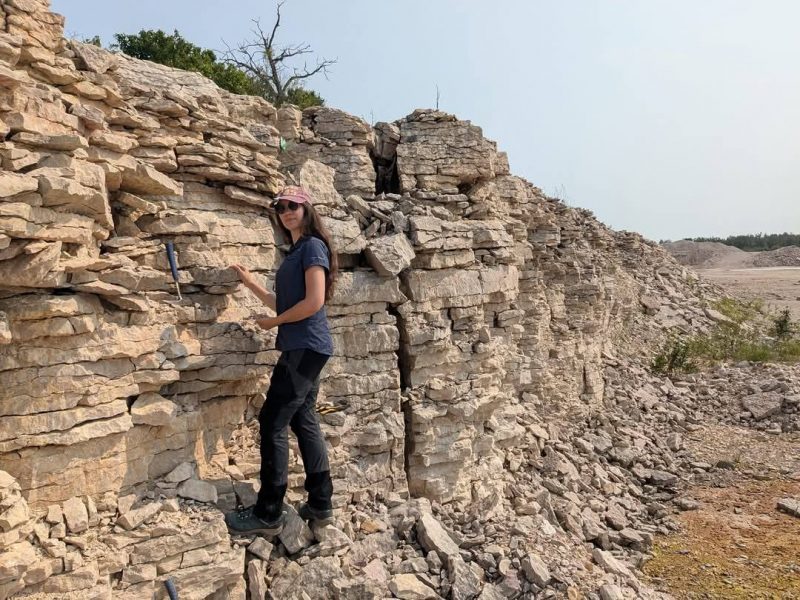
One of the quarries near Lake Manitoba, where Elmosteus was found. Fossils were collected from the layer where the hammer is placed. Dr Jobbins for scale.
Elmosteus was first described by a UM graduate student back in 1996, under another name. Since then, additional material has been found both in the collections of the Manitoba Museum and from new discoveries in the field, which allowed for a better understanding of the animal and the introduction of Elmosteus, named after the Elm Point Formation, the rock formation it was found in.
You can see fossils of this new fish in the Geological Sciences Museum, next to the Ed Leith Cretaceous Menagerie, in the Wallace Building on the Fort Gary Campus. The museum is open 8:30-4:30 on weekdays.
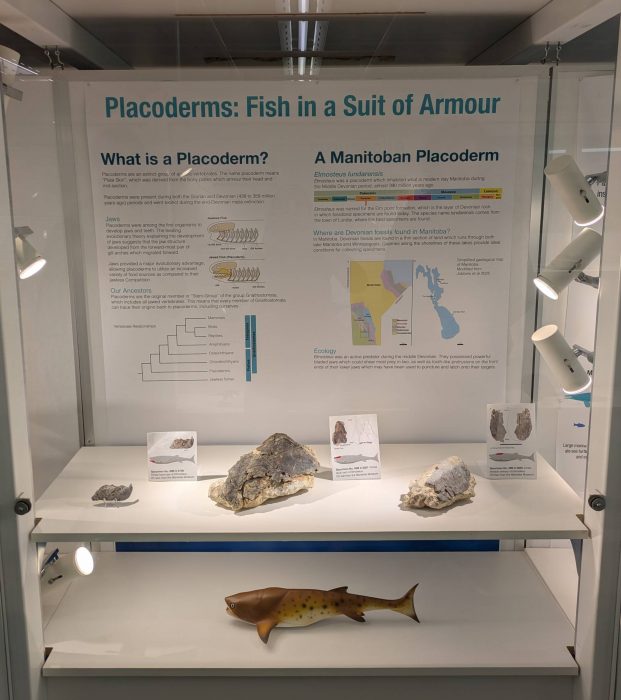
The new exhibit as displayed in the Geological Sciences Museum.
Check out the coverage for this story from the following outlets: