






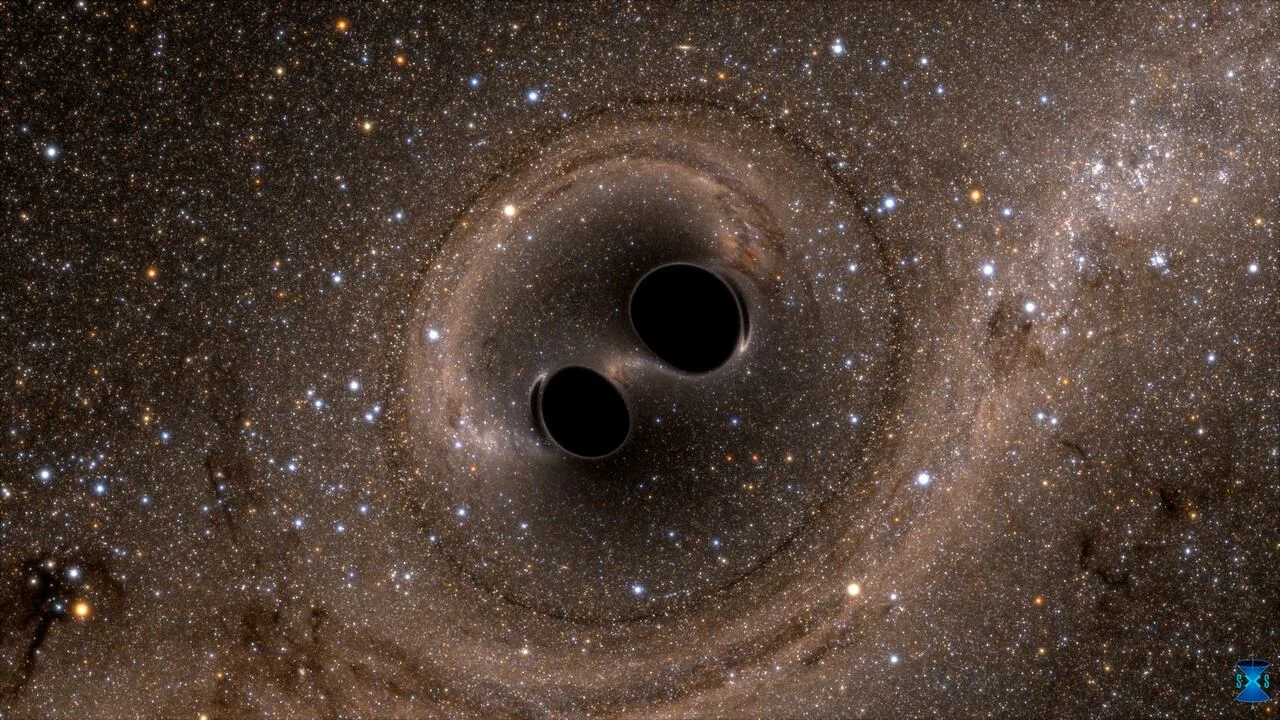
Visual rendering of what two black holes merging might appear like. Photo: the Simulating eXtreme Spacetimes (SXS) project
Media Release: UM researchers part of major black hole discovery
The collision of two black holes will transform our understanding of our origin story
A team of UM researchers, led by Samar Safi-Harb, Astrophysicist and Canada Research Chair in Extreme Astrophysics, is part of the international LIGO-Virgo-KAGRA collaboration that recently announced a major discovery; the collision of two black holes. This event, known as GW231123, could transform our understanding of black holes and the origin of the Universe.
“These black hole pairs are located throughout the Universe and essentially act as tracers of its evolution. Their activity allows us to chart the distances at which they form, ultimately informing our understanding of our comic origins, the origin of galaxies and the Universe itself,” says Samar Safi-Harb, who is also Professor of Physics and Astronomy at UM.
Traditionally, black holes were detected indirectly by light and observing their effects on surrounding matter and radiation. LIGO uses a pair of innovative instruments located in Livingston, Louisiana, and Hanford, Washington to listen to black hole collisions through gravitational wave signals, a revolutionary new messenger probing the extreme Universe.
“To date, these are the most massive black holes observed yet by the LIGO detectors, and possibly the ones with the highest rotation spin. Mass and spin are the main characteristics we use to understand the black holes, and importantly, to trace their origin from astrophysical processes acting across cosmic time. This is because the astrophysical processes leave imprints on the emitted gravitational waves,” says Nathan Steinle, UM Postdoctoral Fellow, Physics and Astronomy, whose expertise is in modelling colliding black holes and gravitational wave sources.
The origin of such black holes is uncertain, with multiple formation models depending on various astrophysical processes and environments. One tantalizing possibility is that one or both of these black holes may have formed as a result of previous black hole mergers. This event will push the boundaries of what we know about massive black holes—now and in the future.
These black holes are more massive than the typical black holes observed by LIGO, and fall within the elusive class of ‘intermediate mass black holes’. “We have had strong evidence (from electromagnetic observations) that these kinds of intermediate black holes exist in the Universe, but not definitively. LIGO has now provided direct detection of merging black holes in this mass range, signaling stronger evidence for this enigmatic class,” says Labani Mallick, UM postdoctoral and CITA National Fellow.
As higher-mass binaries merge at lower frequencies, GW231123 was detected in LIGO’s low-frequency range, which is limited by Earth’s seismic noise. This underscores the need for future detectors which will require advanced noise mitigation technologies, a focus of UM PhD student Neil Doerksen. This low frequency range of LIGO is also expected to harbor a different type of gravitational waves from other exotic sources, such as highly magnetized neutron stars – a subject being studied by UM PhD student, Lucas da Conceição.
Discoveries like GW231123 chart our path toward the bright future of gravitational wave astronomy and its unique power to help uncover our cosmic origins, an area of strategic priority for UM’s Faculty of Science.
For more information: mediarelations@umanitoba.ca