






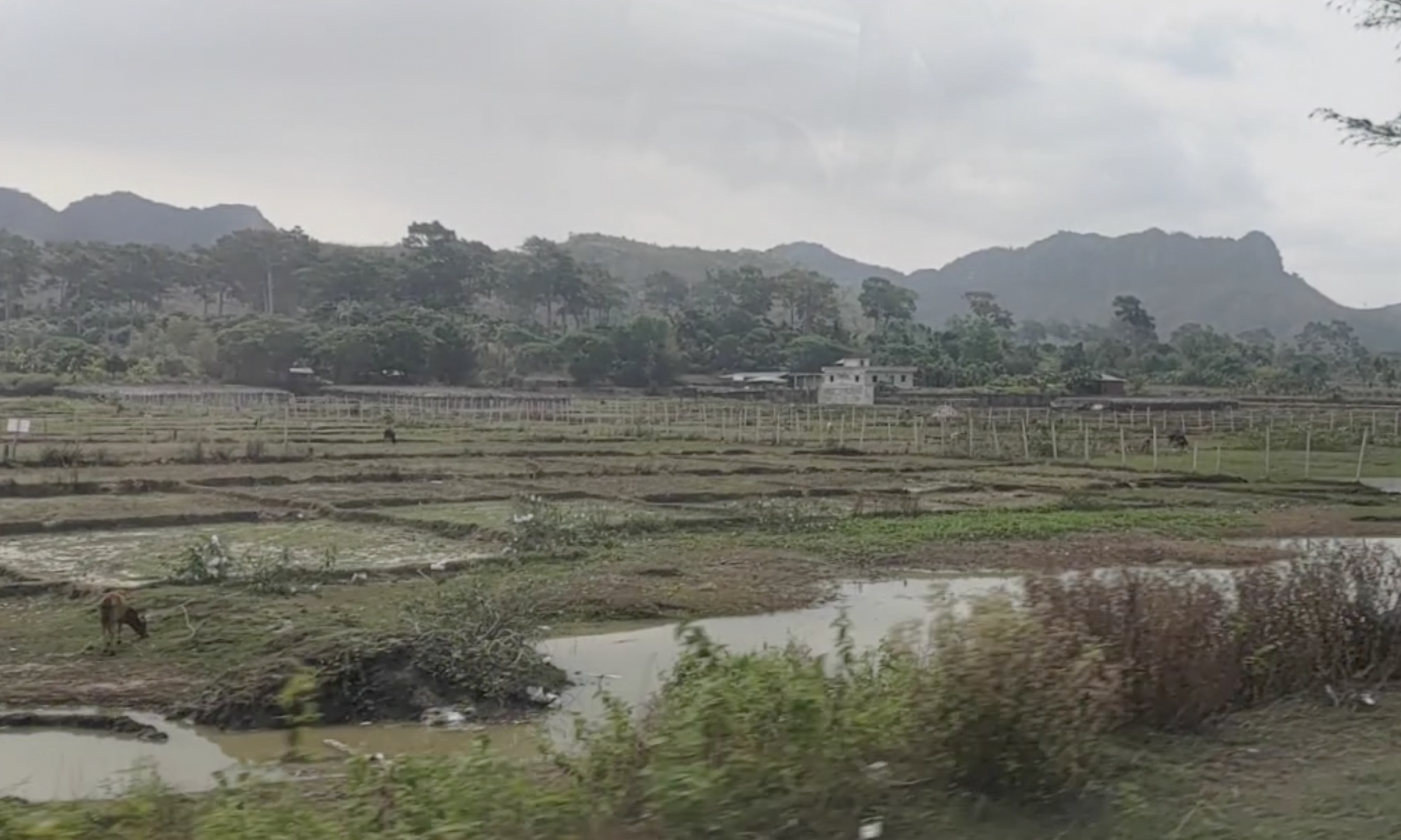
The countryside around Teknaf, Bangladesh.. Photo by Dr. Kjell Anderson.
Voices from the Naf River
* This piece includes discussion of sensitive topics such as Islamophobia and violence, including sexual violence.
I watched a boatload of refugees arrive, fleeing the Arakan Army in search of safety. As they stepped onto land, several women in niqabs crumpled to the ground, overcome with emotion, gripping the rough concrete pier as tears streamed down their faces. After a few moments, they gathered themselves and pressed forward, while others discreetly diverted the attention of the Border Guard Bangladesh—who, despite the subterfuge, were surely aware that new arrivals were slipping ashore.
I recently spent a day in Teknaf, Bangladesh, speaking with locals about their experiences of the Rohingya Genocide. Teknaf, in the far southeastern corner of Bangladesh, is separated from Myanmar’s Rakhine State by the Naf River, which empties into the Bay of Bengal.
Rakhine has been the epicenter of genocidal violence, first perpetrated by the Government of Myanmar between 2016 and 2017, and later by the ethnic militia known as the Arakan Army (AA) since 2024. Nearly the entire Rohingya population of Myanmar has been forced to flee due to systematic and brutal persecution: entire villages burned to the ground, widespread sexual violence, torture, and the mass killing of tens of thousands of people.
As a Muslim minority in a predominantly Buddhist state, the Rohingya have endured decades of relentless oppression, dating back to the 1940s. They have been subjected to systemic discrimination— denied citizenship, extorted by the Myanmar Army and Arakan civilians, bullied in school, prohibited from practicing their faith, denied access to education, and conscripted for forced labor and military service. Those who resist or even voice their grievances face imprisonment, torture, or death.
I will recount what I learned on that sweltering day about this unfolding humanitarian crisis.
I chose not to approach the newly arrived refugees, knowing that the last thing they needed in that moment was an inquisitive professor. Instead, I sought out the fishermen who plied the brackish waters of the Naf River—the front lines of this unfolding genocide. I found them seated on concrete beams beneath the pier, and they agreed to speak with me.
The Fisherman
A slight, sun-wizened fisherman of 72 sat beside me in my minivan, its doors open to the heavy air. My research assistant, Shakila, leaned back in the driver’s seat, listening.
The fisherman remembers 2017 vividly. Across the Naf, he watched flames devour villages and heard the crack of gunfire. Then came the thick smoke, rising from homes reduced to ash in a single day. And finally, the bodies—drifting onto the shore in distressing numbers. He saw “hundreds,” many of them women and children.
His voice catches, as he recalls, “I stayed here the whole day. The Myanmar military killed them and threw their bodies into the river. There were a lot of dead bodies on the riverside, and gunfire was going on over there. I came here to see what was happening.”
The shoreline there was a treacherous expanse of deep, silty mud flats, where thousands of Rohingya struggled to reach solid ground. Some arrived by boat, while younger refugees braved the low tide, swimming with desperate determination, clinging to plastic jerrycans if they had the strength.
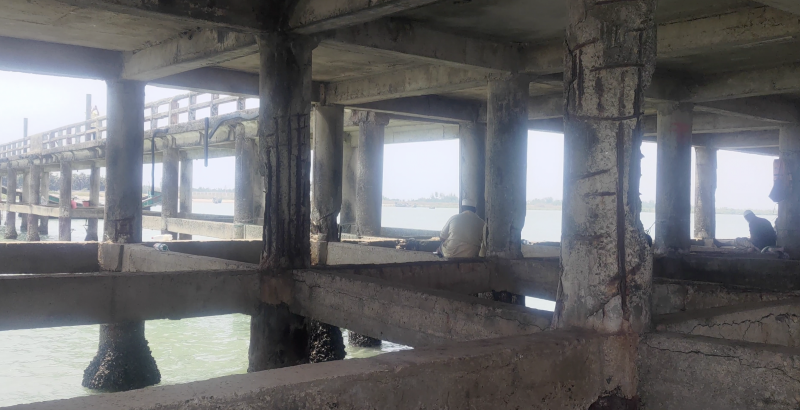
Fishermen under the pier at Teknaf, Bangladesh. Photo by Dr. Kjell Anderson.
Local Bangladeshis could not stand by in silence—they “couldn’t tolerate seeing the condition these people were in.” Women arrived unclothed, and he offered his own wife’s clothing to restore their dignity. In the months that followed, he gathered food from neighbors and cooked for the refugees. People lined the roadside, “full of hunger,” waiting for sustenance. The need was immense, and locals rushed to help, drawn by the distant, harrowing sounds of gunfire and bombing.
The sheer number of bodies washing ashore was overwhelming, so he enlisted around 300 students from the madrasa (Muslim religious school) to assist. He remembers the toll it took: “After collecting the bodies, I became senseless. I prepared the funerals and gathered clothing for them. Sometimes, we had to find funeral garments for 8–10 bodies at once. Every day, we discovered 5–6 dead.”
They worked tirelessly to provide proper Islamic burials whenever possible, but the scale of loss was staggering. Many were laid to rest in mass graves. “One day, I performed funerals for 30 people.”
His voice trembled as he spoke of the many pregnant and unclothed women who arrived in those desperate days. “We found a woman who had been raped and later became pregnant,” he recalled. “She gave birth to a baby boy, and now he is seven years old. We admitted him to an Islamic orphan school here.”
The violence against the Rohingya has not stopped. He tells me, “I saw fire a few days ago, when they burned the whole village… they have been burning villages for the past month.” Just a week before our conversation, thousands more had arrived in the area. “They survived for 18 days in the hills of Myanmar, eating tree leaves, before finally managing to reach Bangladesh.”
The Driver
A local driver told me a similar story. Many of the Rohingya that arrived in 2017 had no clothes, many “had not eaten for three days. Some had food, some were sick, and some were injured by sharp knives or gunshots. I supported them by transporting them with my jeep.”
He continues, “they told us that Arakan people beat and slaughtered them. They said their fathers and brothers were killed. When we saw their condition, we realized how much these Muslim people had suffered. They asked for our help, saying, ‘We are Muslims, and you are also Muslims. Please help and support us.’” The stories he heard about sexual violence were “unbearable.”
He saw countless bodies floating in the water, a grim testament to the scale of the tragedy. He documented what he witnessed with his phone but later deleted the photos—too painful to revisit. Yet, he remained determined to help recover and restore dignity to the dead.
“I personally put the bodies into the graves,” he said. “I collected 5, 6, or 7 bodies at a time from the riverside—young girls, children, women, and elderly people’s dead bodies, which were swollen and smelled bad. I brought them in my jeep. No one was ready to collect the bodies except me and some madrasa students. Together, we prepared the graves.”
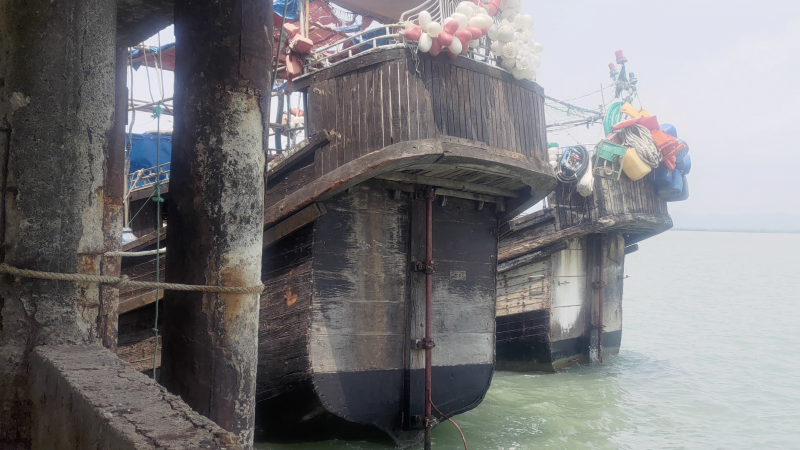
Fishing boats at the pier at Teknaf, Bangladesh with Maungdaw (Myanmar) in the distance. Photo by Dr. Kjell Anderson.
Alongside local fishermen and others, he helped bring food and water to the refugees, most of whom had gone days without sustenance. “Alhamdulillah [praise be to God], I also took financial support from my brother who lives abroad to help the Rohingya people.”
It has become harder for the Rohingya to cross the Naf River, but they continue to flee persecution—now from the Arakan Army. Recent accounts suggest the AA is even more brutal than the Myanmar military. Those who attempt to cross do so “secretly,” as Bangladesh’s government enforces tighter restrictions.
Days prior to our interview, a boat carrying 50-60 people sank and 30 people died, including a Border Guard of Bangladesh officer who drowned while trying to save them.
The driver’s children are sometimes woken in the night by “booming sounds from Myanmar. Our land shook like an earthquake. We could see they were burning the houses from here.”
After our interview ends, he tells me “If you had seen them in that condition, you would cry also.”
These are the stories of the Naf River—of struggle, death, courage, and compassion. Ordinary people, driven by humanity, feeding and clothing desperate refugees. Children laying the dead to rest because no one else is there to do it.
As I spoke with these shaken, elderly men, black smoke coiled into the sky from a burning village across the river.
Dr. Kjell Anderson’s areas of research focus include genocide, human rights, mass atrocities, and international criminal law. He has also written about and taught research methods in dangerous or sensitive political contexts, and qualitative interview methods. He co-wrote the book Approaching Perpetrators: Insights on Ethics, Methods, and Theory, with Dr. Erin Jessee (University of Wisconsin Press), which outlines a code of best practice when conducting research in genocide studies, transitional justice, and related fields. For past projects, he has done qualitative interviews with victims and perpetrators of mass atrocities in Rwanda, Burundi, Uganda, Bosnia, Cambodia, India, and Iraq. Currently conducting research for his next book in Bangladesh, Dr. Anderson has shared this story to provide insights into what this kind of research entails.