







Dr. Kendra Nixon, Professor, Faculty of Social Work
Thousands of women suffer brain injury from intimate partner violence
A UM team is working on new care pathways to help survivors
For every concussion experienced by a professional hockey player, an estimated 7,000 traumatic brain injuries (TBI) occur from intimate partner violence (IPV). Experts suggest that traumatic brain injury happens in 75% of IPV cases, yet few survivors receive the care they need.
Survivors face unique barriers to care. An IPV survivor requires access to services from many agencies, yet these services often operate in silos and lack coordination. Social services, law enforcement, healthcare and the justice system do not currently coordinate care. This creates significant challenges for survivors, forcing them to navigate fragmented and overly complex care plans, attend numerous appointments and complete complicated paperwork without help. Survivors are frequently overwhelmed while living with the physical and psychological aftermath of abuse.
Solutions guided by Indigenous wisdom
A team of researchers led by UM professor Dr. Kendra Nixon (Faculty of Social Work) and guided by Indigenous Elder, Marilyn Hart Murdock is creating a model for more integrated and trauma-informed care pathways, tailored to survivors with traumatic brain injury. This initiative has the potential to reshape policies and practices, bringing attention to a critical yet often overlooked issue.
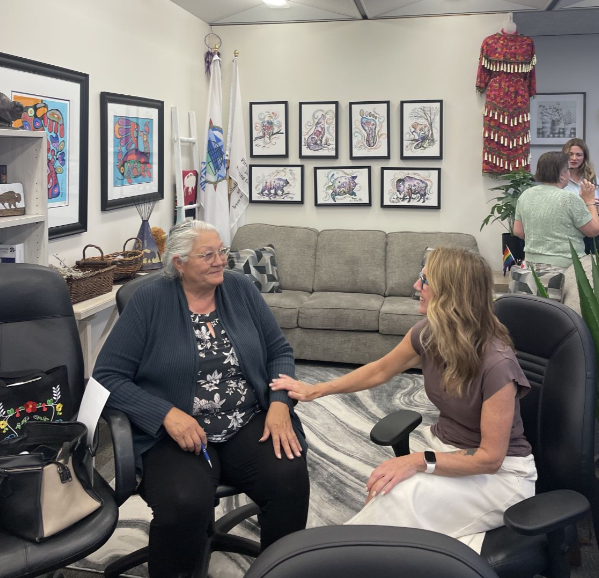
Elder Marilyn Hart Murdock and Kendra Nixon
Clinical pathways currently rely on a Western care framework that overlooks the unique and varied psychosocial needs of survivors, including Indigenous women.
“Survivors’ varied experiences and needs underscore the need for multi-sector collaboration and broader access pathways, beyond traditional Western healthcare settings,” says Nixon.
This work seeks to:
- foster exchange of knowledge to create a network in Manitoba to address the gaps in care.
- design holistic, integrated and trauma-informed care pathways for survivors.
- develop implementation and evaluation plans for the new care pathways that ensure the best possible outcomes.
A push for change
In Manitoba, 15% of women experience intimate partner violence, with higher rates of abuse reported among Indigenous and racialized women. Most experts agree that the reason for this stems from a legacy of colonization that systematically disrupted the traditional values and culture of Indigenous people in Canada.
“IPV is complicated because it is often intertwined with poverty, mental health, substance use and housing instability,” says Nixon. “We know that IPV survivors, especially when faced with a traumatic brain injury, find it difficult to attend multiple appointments or follow complex medical instructions.”
For many, the consequences are severe. Women with untreated TBIs may lose the ability to work, care for their children or advocate for themselves in legal custody battles. With a new coordinated approach to care that is efficient and centered on the survivors’ individual needs, victims will be able to focus on recovery and get the help they need at the right time.
This research partnership is supported by funding from a SSHRC Partnership Development Grant and benefits from the expertise of representatives from different community agencies and government sectors, including:
- Circling Buffalo Inc.
- General CFS Authority
- Klinic Community Health
- Manitoba Association of Women’s Shelters Inc.
- Manitoba Justice – Victim Services Branch
- Women and Gender Equity Manitoba
- The Saskatchewan Brain Injury Association

The inaugural meeting of the partnership team, June 2025.
The partnership promises to integrate academic research with the expertise and experience of community-based organizations, Indigenous groups, social services, healthcare providers and individuals with lived experience.
“From the front line of health care, we know that we need better supports for survivors,” says Ashley Stewart, Klinic Community Health. “This work will bring real change and allow us to bring service providers together so we can deliver more timely access to the care that survivors need.”
There is clear discontinuity in the system and survivors deserve more than the current disjointed offering of inadequate and fragmented care pathways. Through this partnership research, IPV survivors with TBI will be offered better futures for themselves and their families.