







Summer work highlights
Skills, growth and success for engineering students
What happens when sharp, driven engineering students step out of the classroom and into the industry? They deliver real results, make an immediate impact and drive meaningful progress.
This summer, engineering students from every department in the Price Faculty of Engineering put their skills to work in a variety of professional settings. Many were part of the faculty’s Co-operative Education and Industrial Internship Program (Co-op/IIP), while others found summer positions independently through networking, career fairs or direct applications. From aerospace facilities to construction sites, from energy systems to medical technology, these future engineers didn’t just shadow professionals, they rolled up their sleeves and got to work.
Across Winnipeg and beyond, students tackled complex challenges, collaborated with industry experts and introduced new perspectives that shaped the work around them. What they gained wasn’t just practical experience — it was clarity, confidence and a stronger sense of where their careers can go.
Here’s how a group of standout engineering students took on the real world and proved they are ready for it.
Building Communities and Shaping Infrastructure
Two students found themselves in the field this summer, working directly on infrastructure and construction projects.
Keegan Sum, a third-year Civil Engineering student, joined Stantec, one of North America’s leading engineering and design firms, as a Water/Wastewater Intern. Working primarily in the field, he assisted with lot grading, drainage assessments and rod and level surveys on a variety of project sites across Manitoba. “This opportunity has allowed me to apply knowledge from the courses I’ve taken and build on those skills,” he said. “I have also learned a lot about water infrastructure that I haven’t been taught yet at UM, which will help accelerate my learning when the time comes later in my degree.”
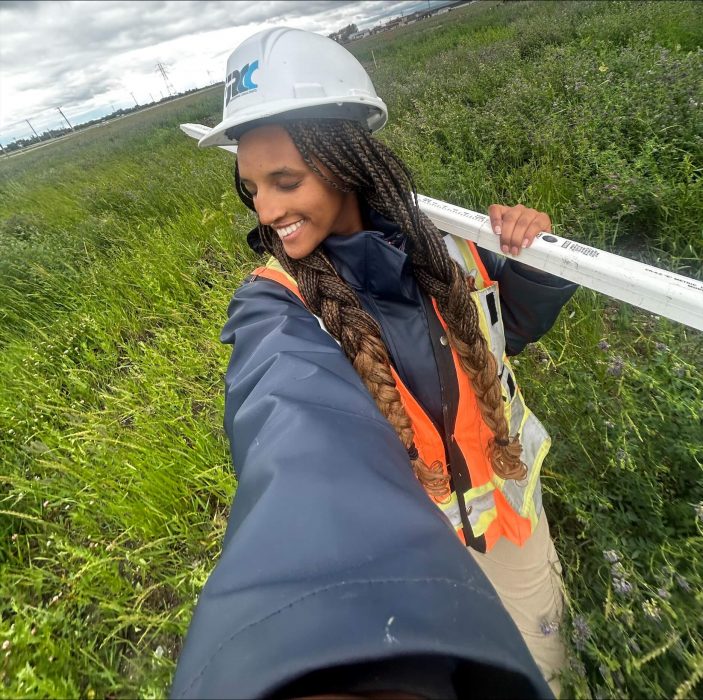
Messe Geddert, entering her fifth year in Biosystems Engineering, spent the summer as a Project Supervisor with JR Cousin Consultants Ltd., a Manitoba-based engineering firm known for its work in municipal infrastructure and environmental projects. Based out of Winnipeg, she visited construction sites, documented work progress and conducted field inspections. “No days are exactly the same — it really depends on the site and what kind of work is happening,” she said. “It’s been incredibly rewarding to be part of projects that go from plans on paper to something real you can walk through. There’s a sense of pride that comes with seeing the progress and knowing you had a hand in it.”
Designing Systems and Exploring Aerospace
Samantha O’Shea, a fourth-year Electrical Engineering student, worked as a Junior Electrical Designer at Smith and Andersen, a nationally respected consulting engineering firm specializing in building systems. She reviewed floor plans, helped prepare drawing sets and contributed to lighting and power layouts for commercial, residential and community buildings. “Becoming familiar with AutoCAD and understanding the reasoning behind electrical design decisions has been extremely beneficial,” she said. “It’s given me more clarity on where I want to take my career and which areas I want to specialize in.”
Brandon Dreger, a fourth-year Mechanical Engineering student, took on a summer role at StandardAero, a global leader in aircraft engine maintenance and aerospace solutions. There, he supported jet engine service engineers in their inspections and problem-solving. His work included automating tasks and developing software tools to streamline operations. “This experience has shown me how engineers often do not have a clear path to getting something done,” he said. “Instead, they find smaller solutions to the larger picture along the way, which is a side of engineering you don’t always see in textbooks.”
Programming Solutions and Powering Systems
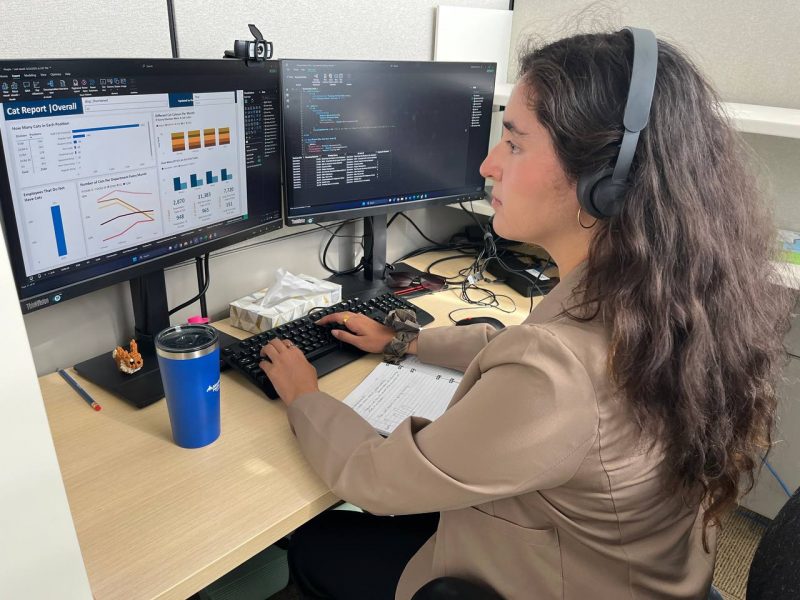
Sydney Povey, a third-year Computer Engineering student, held a position as a Business Systems Analyst at Manitoba Hydro, the province’s largest and most influential energy utility. Her work combined programming, graphic design and communications to build data-driven tools for operational teams. From developing dynamic Power BI dashboards to optimizing physical office spaces using lean process improvement methods, Sydney explored how technology can drive efficiency in a large-scale organization. “I like to think of co-op positions like trial subscriptions,” she said. “They let you figure out what you like before you graduate and help you find the type of work and workplace you enjoy most.”
Olumide Ayeni, a fourth-year Electrical Engineering student, worked as a Simulation Intern at RTDS Technologies, a world leader in real-time power system simulation and testing. He developed and tested control systems in RSCAD, supported debugging efforts and modeled system controllers for the company’s simulation platform. “The co-op experience has been beneficial in connecting classroom and lab knowledge to real-life projects,” he said. “It has given me insight into industry expectations and has shown me how the skills I gain here are transferable to my academics and future career.”
Engineering in Medicine and Sport
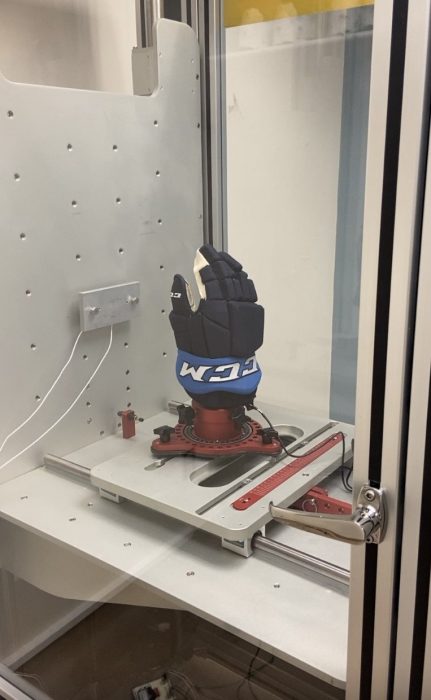
Abigail Harris, a fifth-year Biosystems Engineering student with a biomedical specialization, spent the summer as a Research Assistant at the Pan Am Clinic Foundation, a leading institution in sports medicine research and innovation. She led experiments for a hockey puck impact study aimed at improving athlete safety, combining sensors, coding and data analysis to better understand injury risks in high-impact sports. “My confidence and research skills have improved through opportunities to assist in experiments, literature reviews and technical writing,” she said. “Industry experience allows you to connect classroom knowledge to real-world applications and learning is always a good idea.”
Advice for Future Students
When asked what they would say to students just starting out, the message was clear: stay open-minded, be proactive and embrace every opportunity as a chance to grow. For many of this year’s participants, success wasn’t just about landing the “perfect” placement, it was about showing up with curiosity and making the most of wherever they landed.
“Some of the best jobs come from simply being curious and starting a conversation,” said Messe. “Go to events, introduce yourself and follow up — you never know who might be looking for a student or who might remember your name later.” Her own summer placement started with a spontaneous chat at a mentorship event, proof that building connections can open unexpected doors.
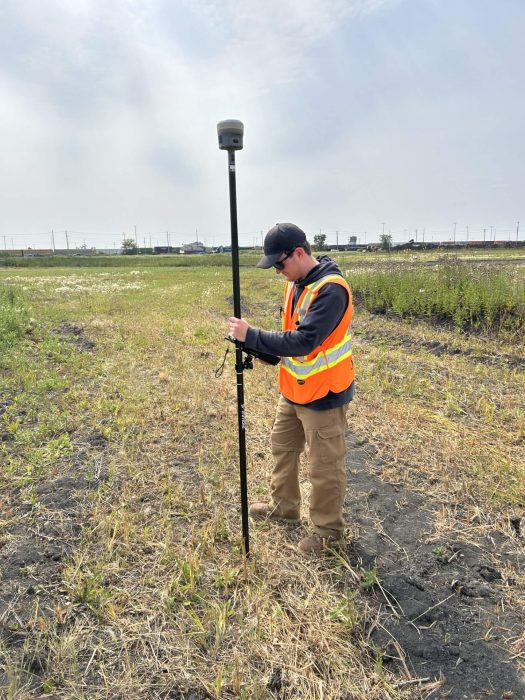
Keegan agreed that mindset matters just as much as the job title. “Be open to any opportunities, especially for your first placement,” he said. “Longer work terms can give you more time to learn and build your skills and every experience helps you grow.”
Their advice reflects a shared truth among students: industry placements aren’t just about ticking boxes, it is about discovery. From building confidence and communication skills to finding the kind of work you enjoy, every placement offers something unique and valuable. Often, the lessons you did not expect are the ones that shape you the most.
To learn more about the Price Faculty of Engineering’s Co-operative Education and Industrial Internship Program or to explore how you can get involved and make use of their resources — visit the Co-op/IIP webpage or stop by their office on the third floor of the Stanley Pauley Engineering Building.