






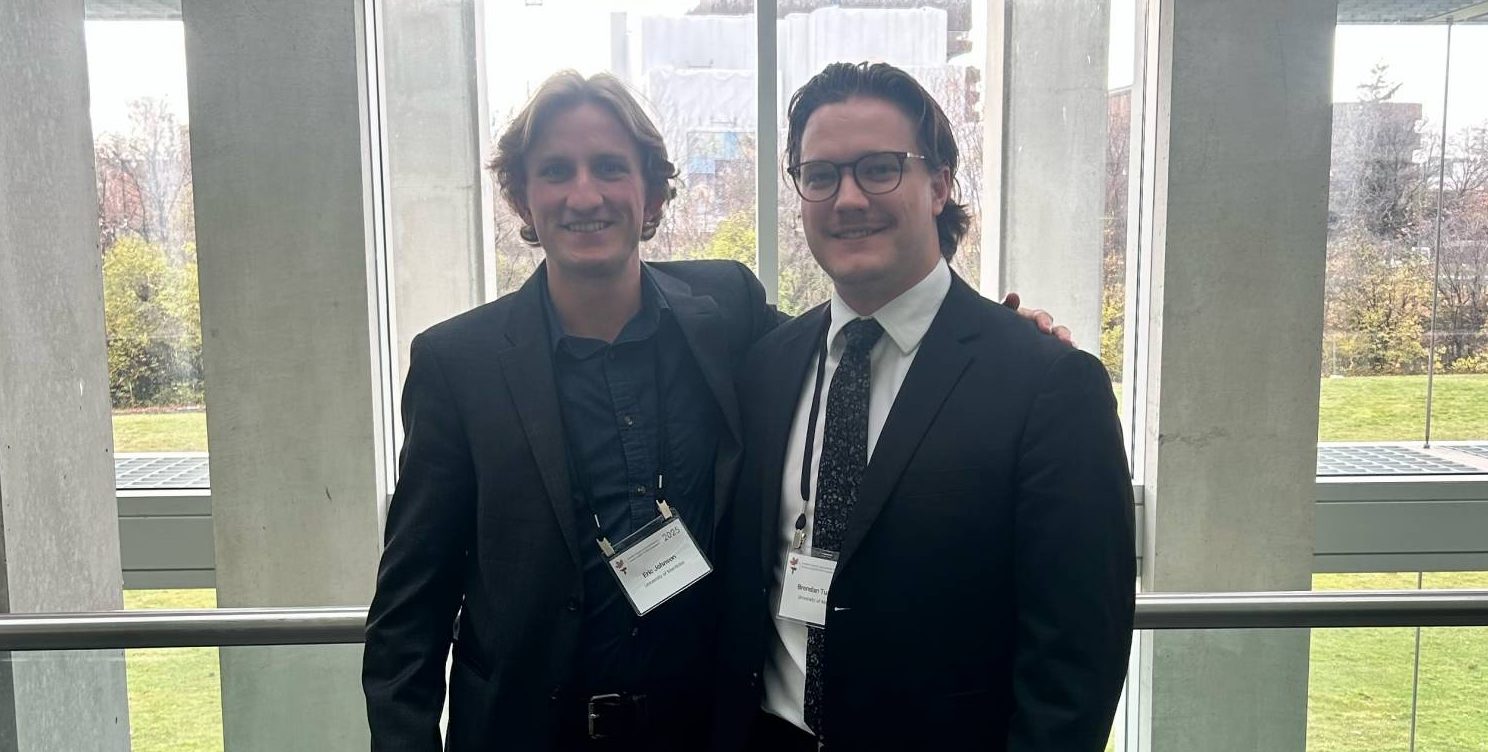
Left to right: Eric Johnson (2L) and Brendan Turnbull (2L) attended the 54th Annual Canadian Council on International Law Conference in Ottawa this November.
Manitoba law students attend Canadian Conference on International Law
Opportunity deepens understanding of international law, opens networking doors
Enterprising second-year law students Eric Johnson (2L) and Brendan Turnbull (2L) attended the Canadian Council on International Law’s 54th Annual Conference this past November 13 and 14, 2025 in Ottawa. The two took it upon themselves to go, both being intrigued about what International Law would look like to pursue as a career, and hoping to learn more about it. With support from the Faculty of Law’s Associate Dean Juris Doctor program’s office, they returned with deepened interest and understanding in the field.
“The CCIL Annual Conference was beneficial to me for several reasons,” Turnbull reflected. “It provided an invaluable opportunity to deepen my understanding of international law and to hear directly from leading experts on topics that I would not otherwise encounter in Manitoba or at my stage as a 2L student. It also allowed me to reconnect with colleagues and form new relationships with students and practitioners working in areas of law that closely align with my interests.”
Turnbull came to law school already with an interest in international relations and foreign policy, having taken an international law course during his undergraduate political science degree at the University of Manitoba. Since then, he has looked for opportunities in international studies and was ultimately able to participate in the Queen’s International Law Program last summer, finding it a very formative experience. “While I find all areas of international law compelling, my primary career interest lies in international criminal justice,” he said. “Criminal law is my main academic interest at Robson Hall, and this area offers a meaningful opportunity to apply those interests on a global scale. As I learned through the Queen’s program, entry into the field is highly competitive, and gaining three to five years of relevant experience along with an LLM is often essential.”
Further, he said, “More broadly, my interest in international law is deeply rooted in my love of politics. As a middle power, Canada relies heavily on a rules-based international order and on free trade, and I am drawn to the role that international law plays in sustaining those systems, particularly at a time when these global principles appear to be in decline.”
At November’s conference, Turnbull gained meaningful insight into the challenges facing Canada and the international community, as well as the realities of entering a field that he noted is expected to undergo significant cutbacks in the coming years, right when he is hoping to join it. “Although some of my peers view international law as a field of limited value due to its imperfections, being surrounded by individuals committed to strengthening and improving the discipline reaffirmed for me that it remains an area of law worth engaging with,” he said, undaunted.
Rather than choosing a practice area solely based on practicality, he is determined to follow one that he is genuinely interested in. “Despite many sessions addressing issues without clear or immediate solutions, the optimism and passion of those working to improve the international sphere and the lives affected by it were deeply motivating,” he observed. “The idea of contributing to progress, even when it is incremental or appears to move backward, feels like a meaningful and worthwhile pursuit.”
Similarly, Johnson shared that as a second-year law student, he is also starting to explore what areas of legal practice interest him. “As someone who has always had a keen interest in areas like history, politics, and geography, it is exciting to learn more about an area of law that addresses truly global themes like human rights and international law of armed conflicts,” he said.
“The highlight of the conference for me was the panel that focused on international law within the context of the Israel-Palestine conflict,” said Johnson. “It was a powerful discussion that brought together a former IDF (Israel Defence Forces) member who negotiated on behalf of Israel during the Oslo Accords, a Palestinian woman who grew up in the West Bank and now works in the non-profit humanitarian space, and other international lawyers to talk about the complex legal dynamics of the conflict. It showed the overlap of the often-intense emotions associated with humanitarian crises and the technical legal components of sorting out the legality of armed conflict.”
Both Turnbull and Johnson left Ottawa having found the conference extremely rewarding and a tremendous learning opportunity.