




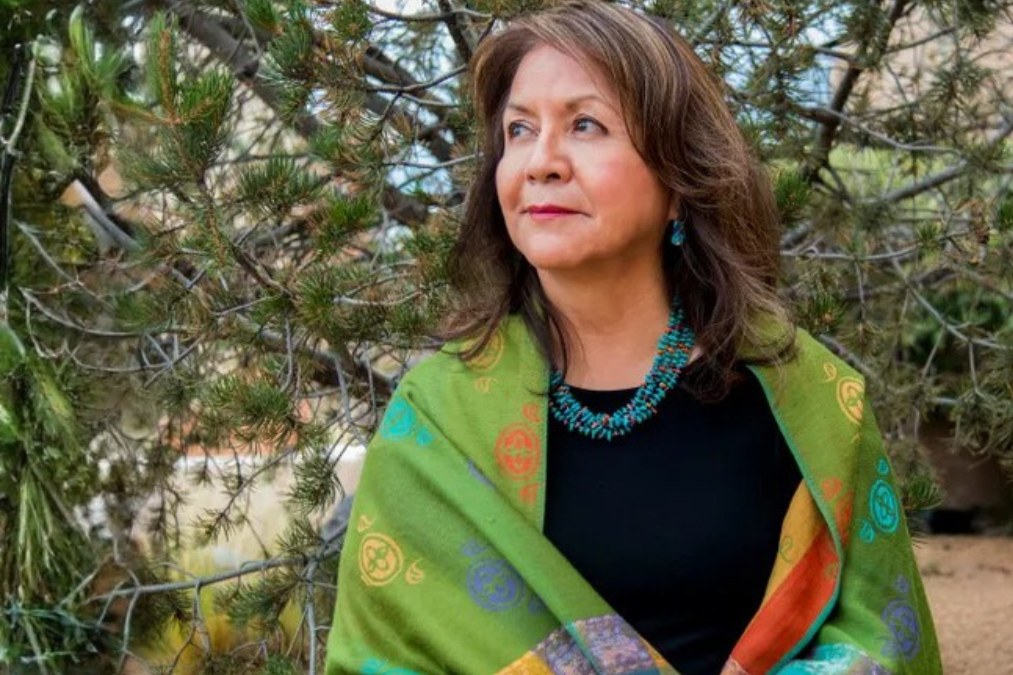
Dr. Laura Tohe will offer a poetry reading and talk for the UM community, sharing from her works Code Talker Stories and the libretto Enemy Slayer: A Navajo Oratorio.
“Language is fragile; it can be forgotten if it’s not passed on or spoken”
Navajo Poet Laureate Emerita Laura Tohe to visit UM | The endurance of Indigenous languages and the power of poetry
Hosted by the Canada Research Chair in Miyo We’citowin & Digital Sovereignties, the Department of Women’s and Gender Studies (Faculty of Arts), and the Faculty of Architecture, Navajo Nation Poet Laureate Emerita Laura Tohe has been invited to the University of Manitoba.
She will give a lecture and poetry reading — a conversation about language, memory and presence — marking her first visit to Winnipeg. The event will take place on Thursday, October 16 at 4:00 p.m. in the John A. Russell Atrium.
Professor Christine Stewart from the Faculty of Arts, Department of Women’s and Gender Studies, who helped organize the event, says she hopes the UM community will discover what has inspired her for years in Tohe’s work —
“the blend of beauty, heartache and grit that her poetry carries.”
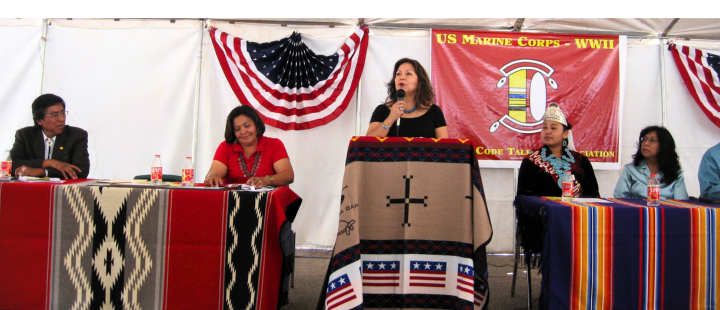
Laura Tohe reciting poem at Navajo Code Talker Day in Window Rock, AZ.
Poetry and decoding
Dr. Laura Tohe is a poet, scholar and the Poet Laureate Emerita of the Navajo Nation (2015–2025). Her father was among the Navajo Code Talkers of World War II—those who used their language to transmit military intelligence that the enemy could never decipher.
Tohe believes that reading and appreciating poetry is, at its heart, a process of decoding. The beauty of a poem lies in how imagery, metaphor, musicality and context weave together — much like the Navajo Code Talkers who used familiar words to carry meanings far beyond the literal.
In one story, Tohe recalls a coded message that read “horses were dying.” Japanese cryptographers took it at face value, unaware that its real meaning had nothing to do with horses.
“Indigenous writers, including myself, use metaphorical testimonies and cultural memories to carry the context of a painful and complicated history.”
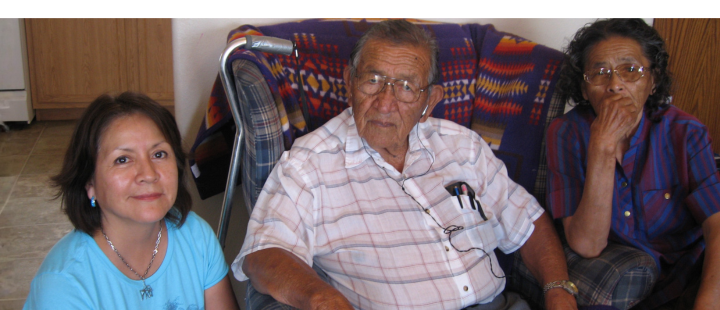
Laura Tohe interview with Sam Akee, Navajo Code Talker and his wife.
Language as weapon, language as memory
The story of the Code Talkers deepened Tohe’s understanding of language’s power. Those men turned their mother tongue into a code that saved lives — a language reborn in the military, one that “was never deciphered by enemy combatants.”
Yet in peacetime, that same language was silenced. In residential schools it was forbidden, shamed and nearly erased from classrooms and memory. Tohe notes that the U.S. Department of Defense recently removed the names of the Code Talkers from its website in the name of “diversity, equity and inclusion” — erasing once more those who had defended the nation through their own words.
“Language is fragile; it can be forgotten if it’s not passed on or spoken,” Tohe said.
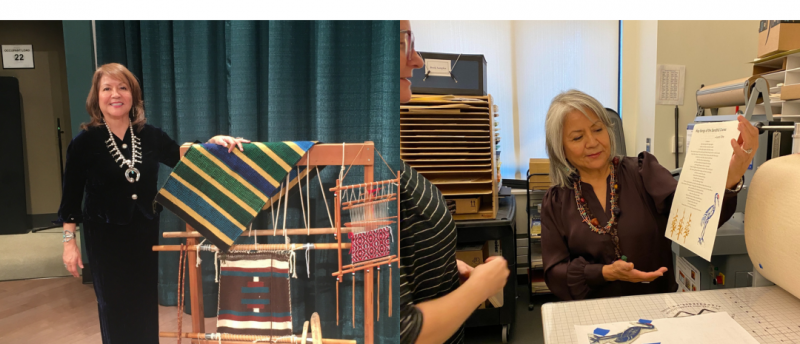
Left: Laura Tohe at the 2019 American Indian Festival of Words & Writers Award.
Right: Laura Tohe printing her poem “Map Songs of the Sandhill Cranes.“
From individual to collective renewal
In Tohe’s work, language is constantly reborn — from page to score, from line to stage. She calls this transformation a “rebirthing” of words and images, allowing poetry to live on through sound, movement and performance.
Her librettos Enemy Slayer and Nahasdzáán in the Glittering World have invited many Indigenous students and audiences to experience opera for the first time. Nahasdzáán in the Glittering World was later performed in several cities across France, drawing audiences who were perhaps familiar with poetry but not with Indigenous works rooted in Navajo storytelling.
Through these collaborations, Indigenous storytelling finds new spaces to be heard and felt. At the close of the interview, Tohe reflected,
“Contemporary Indigenous writers are revitalizing endangered tribal languages through initiatives such as the Language Back movement and other creative programs, making visible once again the languages and arts that sustain Indigenous lives and communities.”
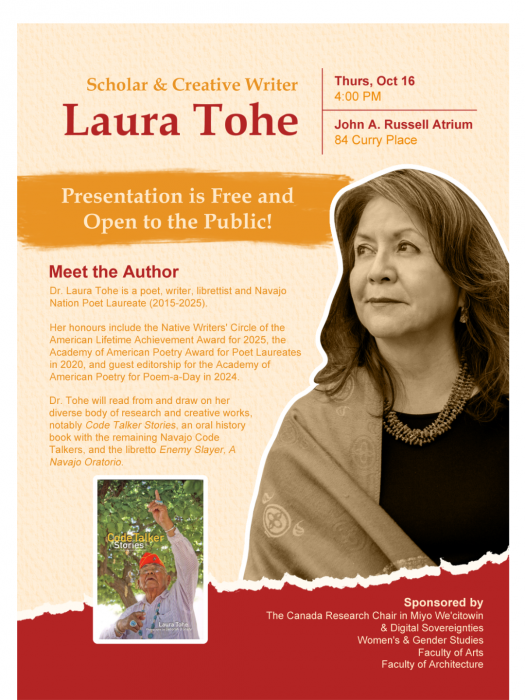
Event information
Come experience Laura Tohe’s poetry in person on October 16 at 4:00 p.m. and witness how language continues to carry memory and meaning across generations. Add to your calendar!
- Date: Thursday, October 16, 2025, 4:00 p.m.
- Location: John A. Russell Atrium (84 Curry Place)
- Format: Free and open to the public
For more information, please contact Christine Stewart (christine.stewart@umanitoba.ca).