






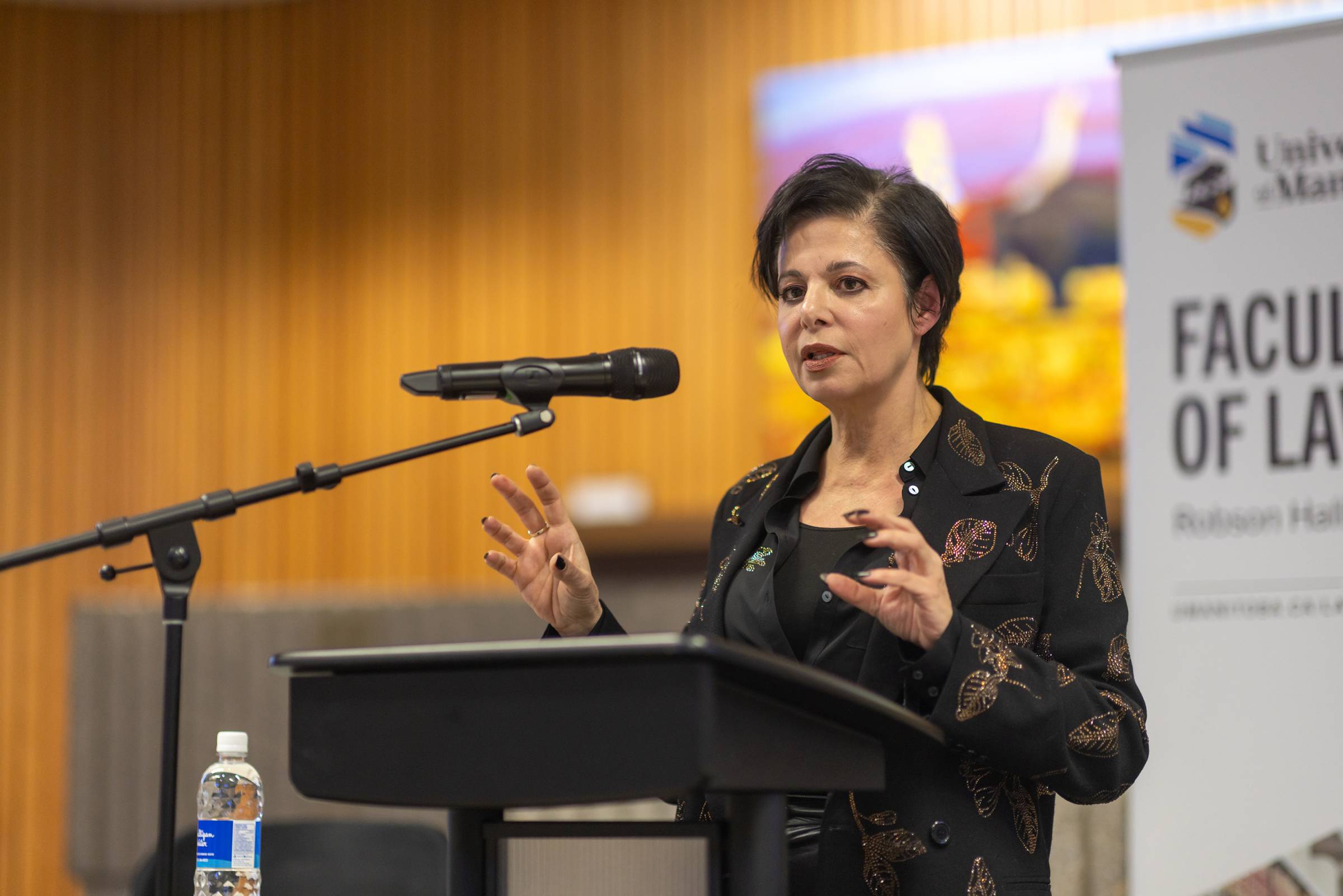
Renowned Canadian lawyer Marie Henein was the guest speaker at an event commemorating the legacy of Harry Walsh, O.C., LL.D., Q.C.. Photo by Adam Dolman.
From one legendary Canadian advocate to another
The impact of Harry Walsh’s legacy was recognized this year in his namesake Moot Courtroom with a lecture by Marie Henein
During one of the Faculty of Law’s busiest Winter Terms on record, one of the most exciting, and prestigious events held in Robson Hall’s largest lecture theatre, the Harry Walsh O.C., Q.C. Moot Courtroom, was the Harry Walsh Lecture featuring renowned Canadian lawyer Marie Henein.
The Winter Term of 2025 saw numerous guest speakers, panel discussions and educational events including an actual Federal Court hearing pass through the recently renovated moot courtroom which can be divided into two separate classrooms. The space was named in honour of Harry Walsh, O.C., LL.D., Q.C., a Faculty of Law Class of 1937 alum, to acknowledge his legacy following the extensive renovations which were made possible thanks to a generous gift from Walsh’s nephew, Ron Stern.
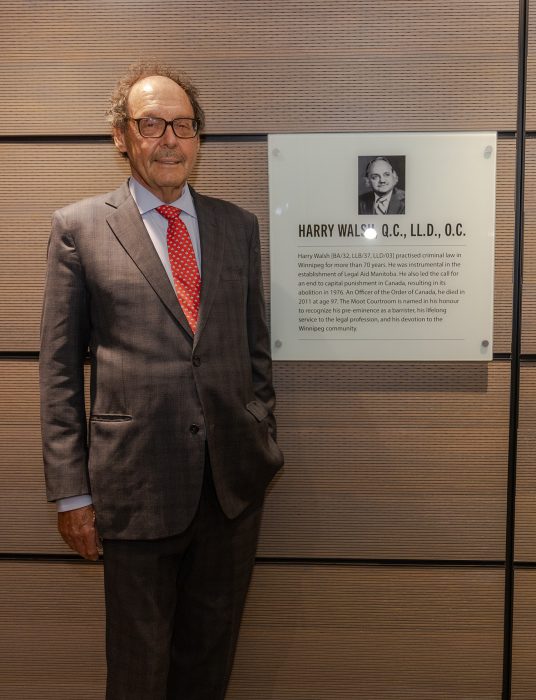
Ron Stern, nephew of Harry Walsh, stands beside the plaque dedicating the Faculty of Law’s Moot Courtroom to his uncle. Photo by Adam Dolman.
Harry Walsh was a legendary criminal defence lawyer who practiced law into his 90’s and who passed away in 2011 after a lifetime of advocating for underserved populations, defending human rights, and fighting to abolish capital punishment in Canada. A comprehensive story about Walsh titled “Honouring Advocacy” can be found on UM Today.
To acknowledge and officially recognize the legacy of Harry Walsh, the Faculty of Law could find no more fitting a Canadian lawyer than Marie Henein, an extraordinary criminal defence lawyer herself, to deliver the Harry Walsh Lecture in his namesake moot courtroom.
Marie Henein is a founding partner of Henein Hutchison Robitaille LLP and is recognized as one of the country’s top litigators. Her practice focuses on civil litigation, criminal litigation, commercial litigation, mediation, and arbitration. She has been interviewed repeatedly by the media written for the Globe and Mail, and is a sought after public speaker. In 2003 Ms. Henein was a recipient of the Laura Legge, award from the Law Society of Upper Canada, and the Law Society of Upper Canada Medal. In 2017 she received the Law Society Medal for outstanding service to the administration of justice.
In 2023 Ms. Henein was the chosen recipient of the G. Arthur Martin medal, most recently in 2024. She was awarded a doctorate of laws by the Law Society of Upper Canada. Marie Henein authored her best-selling memoir, Nothing but the Truth, and was co-editor of Martin’s Criminal Code, Martin’s Annual Criminal Practice, and Martin’s related Criminal Statute and the associate editor of the Canadian Criminal Cases.
The Harry Walsh Lecture began with Dr. Richard Jochelson, Dean of Law, sharing a word from former Dean and former University of Manitoba Chancellor, Harvey Secter, who had initially recognized the need for upgrades to be made to the law school’s Moot Courtroom. “With Ron Stern’s support the Faculty of Law was able to memorialize one of Manitoba’s most distinguished advocates and create a facility designed for the realities of the 21st century,” he said in an email.
Next, the audience was treated to a special visit from Winnipeg criminal defence lawyer, Richard Wolson via Zoom (live from California), who had been mentored by Walsh and practiced law with him for 22 years after having intended to stay at his firm of Walsh Micay for only one year. “What made Harry so great?”, Wolson asked the nearly 100 guests filling the room. “He was gifted with the innate ability to question witnesses just far enough, and was gifted at cross-examination.”
“Anything that has gone well in court has been because of Harry,” Wolson said of his own successful career. “Anything that was a mistake was my own fault.”
Walsh’s son Paul Walsh, KC, who had practiced law for many years with his dad, shared a glimpse of his father with the audience and his own enthusiasm to see Walsh’s legacy so appropriately recognized. “Thank you, Ron, for your fabulous gift to Robson Hall,” he said addressing his cousin. “Your gift is regarded by all who all related, all of those who are acquainted, as well as those who retained my dad and your uncle Harry, as the perfect gift – it is the perfect gift – to memorialize both his career and his contributions to the legal community.”
Henein started her remarks by recognizing Walsh as “a lawyer’s lawyer” who valued the true nature of the legal profession. “Law is an inconvenient profession,” she acknowledged. “Over time, it changes the landscape of who you are.”
Henein unflinchingly addressed current issues the legal profession faces today with media and government constantly challenging the legitimacy of what lawyers and the judiciary do. “We know everyone’s entitled to a defence,” she said. “We know our own ethics and morals.”
She warned that an attack on the justice system was more of an attack on democracy itself, pointing to historical examples of times when politicians waged so-called wars on crime or drugs or other excuses to remove democratic rights from communities. “There is no greater obstruction to an autocracy than an independent bar and an independent judiciary,” she said.
Example after example of incidents in other countries illustrated her point that “democracies around the world have tolerated the erosion of civil liberties and embraced anti-democratic values.”
Henein cautioned against disparaging lawyers for doing their jobs, noting that democracy doesn’t die with a few large blows but with a series of small steps.
Henein noted that Harry Walsh took steps throughout his life that were fundamental to the protection of democracy including helping to found Legal Aid Manitoba and fighting for the abolishment of capital punishment in Canada. “Not once did he question his own ethics and integrity,” she said, concluding that lawyers are “defenders of democracy.”
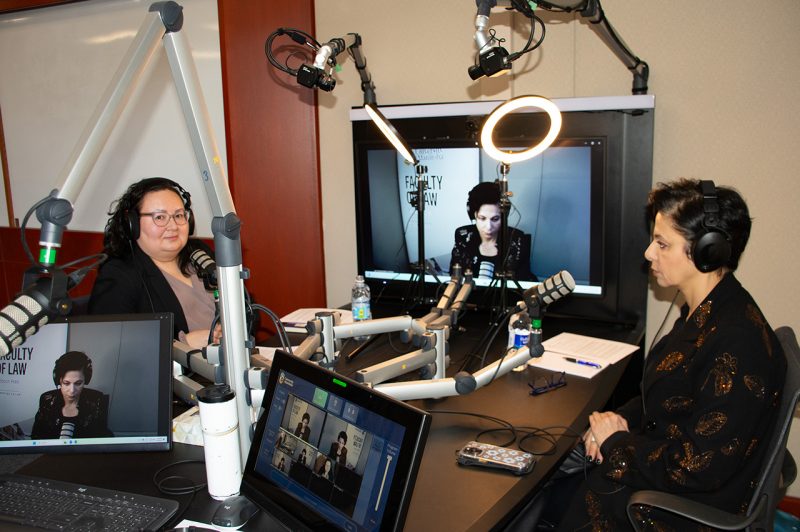
Manitoba lawyer Stacey Soldier records an episode of the Robson Radio podcast with Marie Henein. Photo by Christine Mazur.
After speaking, Henein welcomed questions from the audience, at the end of which, Stern rose to especially thank her and express hope that all law students could follow in Harry Walsh’s and Marie Henein’s footsteps.
Earlier in the day, Henein spent some time in conversation with Manitoba lawyer Stacey Soldier, a senior associate lawyer at Cochrane Sinclair LLP, class of 2007 alum, and a practicing professional instructor at Robson Hall. Soldier, who hails from the Gaabiskigamaag community, (Swan Lake First Nation), practices criminal law and child protection law, and connected with Henein about the perceptions of criminal defence lawyers in Canadian society today, over-policing, capital punishment, mental health and the legal profession, practicing law as women, and the importance of mentorship and diversity in the legal profession. Their conversation was recorded and can be heard as an episode of the Robson Radio Podcast.