




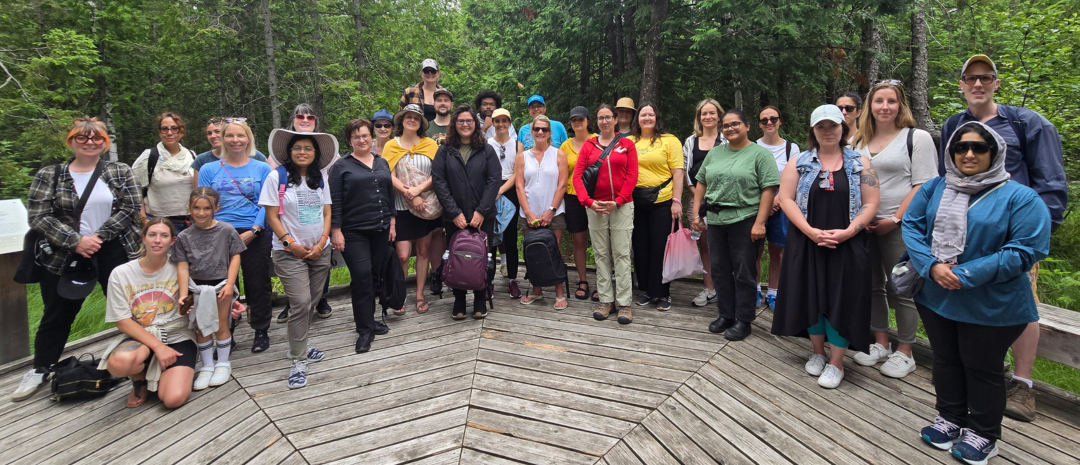
2025 The Summer Institute for Indigenous Content Literacy members at the Brokenhead Wetland Interpretive Trail, engaging in land-based learning and dialogue with community leaders.
From awareness to action: UM’s Institute for Indigenous Content Literacy advances campus Reconciliation
Answering the TRC’s Calls to Action, 12-week program prepares faculty and staff to integrate Indigenous content and lead change.
“This program made me significantly more comfortable talking about Indigenous issues and, most importantly, how to ask questions respectfully,” said Robert Biscontri, Associate Dean at the Asper School of Business, who took part in the Institute two years ago.
For many University of Manitoba (UM) faculty and staff, this summer’s Tuesday mornings were not ordinary workdays but a journey of deep learning and reflection. They were participants in UM’s Institute for Indigenous Content Literacy — a 12-week training program created in response to the Truth and Reconciliation Commission of Canada’s (TRC) Calls to Action.
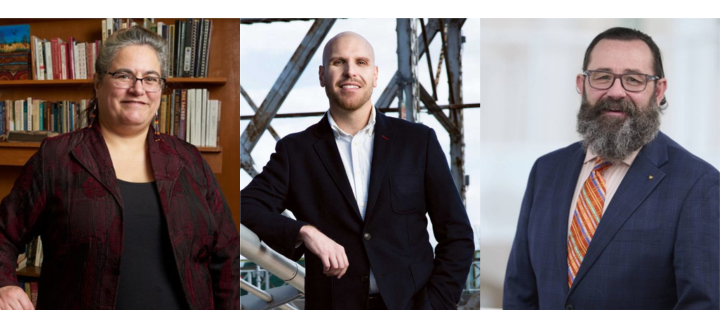
From left to right: Dr. Cary Miller, Dr. Sean Carleton and Robert Biscontri. Building on this momentum, UM employees who would like to explore the next offering can access course details through the intranet.
Biscontri’s reflections echo the vision of Institute Director and initiator Dr. Cary Miller, Associate Professor in the Department of Indigenous Studies. Miller hopes the program will help participants recognize the limits of their own knowledge, dismantle long-standing historical myths and build confidence in bringing Indigenous content into their classrooms.
“I hope that the U of M will become a central partner in building the capacity of our reserve and off-reserve Indigenous communities rather than a place of suspicion,” Dr. Miller said.
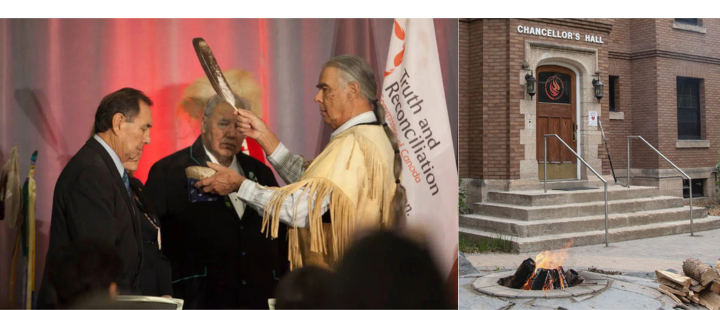
The National Centre for Truth and Reconciliation, located at the University of Manitoba, has been the home of the TRC’s archives since 2015.
Rooted in commitment: responding to TRC Call to Action #57
The Institute was established directly in response to TRC Call to Action #57, which urges public servants to receive education on the history and legacy of residential schools, UNDRIP, Treaties and Aboriginal rights, as well as intercultural skills such as conflict resolution and anti-racism. It also advances UM’s strategic plan commitment to embed Indigenous content and perspectives across teaching and research.
Although Call 57 is not directed specifically at universities, Dr. Miller emphasizes that faculty and staff are public servants and that many UM graduates in education, law, social work and health will also serve in the public sector. For her, Call 57 is not only about educating today’s employees, but also about preparing tomorrow’s workforce.
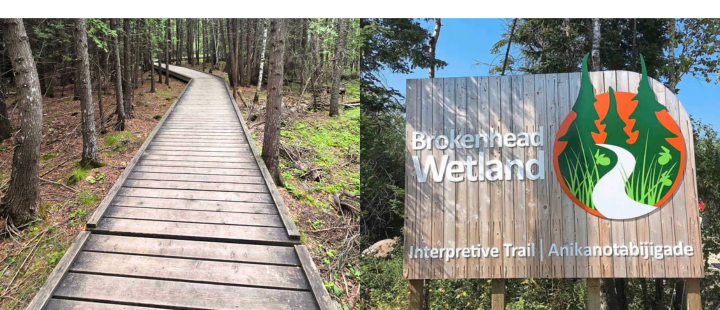
Each year, the Institute features a field trip on an Indigenous reserve—one of the participants’ favorite parts of the program.
A 12-week journey beyond “crash courses”
Unlike typical one-day workshops, the 2025 Summer Institute uses a 12-week format for deeper, sustained learning. Research shows that spreading training over time helps with reflection and retention, while short “crash courses” can dilute results and feel like token efforts. This approach also aligns with UM’s Truth and Reconciliation Framework, which emphasizes reconciliation as a long-term commitment requiring ongoing investment and action.
The curriculum progresses step by step — from cultural awareness and Indigenous epistemologies to the distinct histories of Inuit, Métis and First Nations, to the legacy of residential schools, and only later to tools for conflict resolution and anti-racism. Among the most memorable elements was a field trip to the Brokenhead Wetland Interpretive Trail, where participants engaged in land-based learning and conversations with community leaders.
“I really enjoyed each session, especially the variety of facilitators who brought unique perspectives and teaching styles. One highlight for me was the field trip to the Brokenhead Wetland Interpretive Trail – it was a memorable and enriching experience that deepened my connection to the course content.” — Frances Dang, Administrative Coordinator in the Rady Faculty of Health Sciences
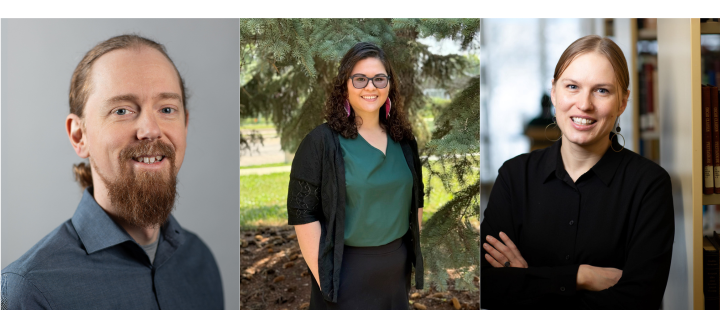
From left to right: Andy Kerr, Frances Dang and Janice Winkler.
Real impact: from reflection to professional practice
The impact is both tangible and far-reaching. Now in its fifth year, the Institute has empowered 529 faculty and staff members across more than 40 faculties and offices.
Institute instructor Dr. Sean Carleton, Associate Professor in the Faculty of Arts, observed that while many participants initially believed they were well informed about current events, they quickly discovered how limited their understanding of residential school history actually was.
This underscores the importance of initiatives like the Summer Institute and challenges the assumption — common on campus and in society — that people already possess the background knowledge needed for reconciliation. – Dr. Carleton
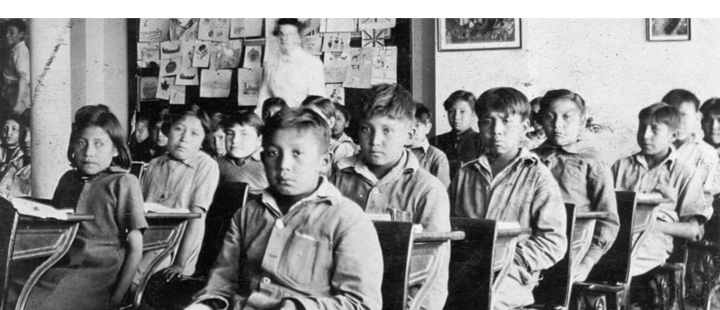
Dr. Carleton taught Week 7 of the Summer Institute, focusing on the history and legacy of residential schools.
Participants also highlight how the program is shaping their professional practice. Janice Winkler, Social Sciences Librarian, connected course readings to a workshop she was preparing and, through personalized feedback from Dr. Miller, discovered a new perspective from the work of Emma LaRocque. That insight has since reshaped the workshop she will deliver this fall.
For Andy Kerr, Instructor in the Faculty of Arts, the Institute was a chance to achieve clear goals: deepening his knowledge of Indigenous histories and epistemologies, better understanding contemporary Indigenous issues, and addressing teaching challenges through reflective journals.
“I can confidently say that my aims were achieved. I am leaving the Summer Institute with renewed commitment and strengthened skills to meaningfully contribute to the work of Truth and Reconciliation, knowing that I have an important role to play in this work alongside my colleagues.” – Andy Kerr
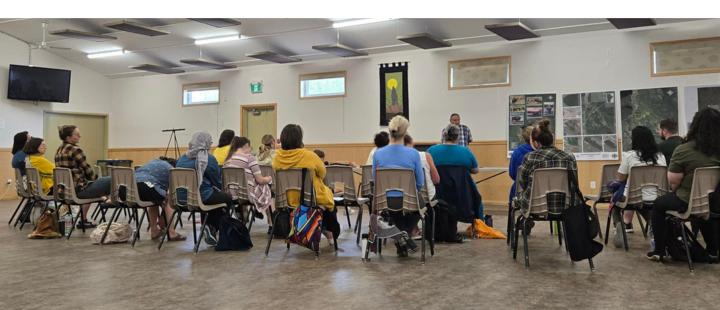
During the field trip to Brokenhead, Elder Carl Stone also led a workshop for participants.
Looking Ahead: Extending the Flame of Reconciliation
Building on this success and strong demand, UM will launch an academic-year Institute this September. Running asynchronously from fall to spring, the program pairs pre-recorded lectures with discussion sessions, ensuring faculty and staff who dedicate summers to research can participate fully.
As former TRC Chair and UM alum Murray Sinclair [LLB/79, LLD/02] has said, “Education is what got us into this mess, and education will get us out.” UM is demonstrating through action that deep institutional self-education is essential to reconciliation.
Looking ahead, Dr. Miller hopes that Indigenous students will feel seen and experience the sense of belonging that UM’s Truth and Reconciliation Framework strives for.
“I hope that Indigenous knowledge will be normalized within the academy. I hope that we will continue to strive to step back from colonial relationships and lean into co-developed research with Indigenous communities in a way that recognizes the importance of developing positive ongoing relationships through reciprocity,” – Dr. Miller
The Institute For Indigenous Content Literacy is made possible through the generous support of the Office of the Vice-President (Indigenous) and contributions from the Faculty of Arts.
UM employees can access course information through the intranet or register right away.
The Institute For Indigenous Content Literacy (academic year program) runs from September 15, 2025, to April 10, 2026. Open to UM faculty and staff, the program includes 12 sessions with self-study, monthly discussions, and a field trip, leading to a certificate of completion.
We invite you to join us in this transformative journey. Together with your support, UM can continue to transform reconciliation from words into action across our campus and beyond.