






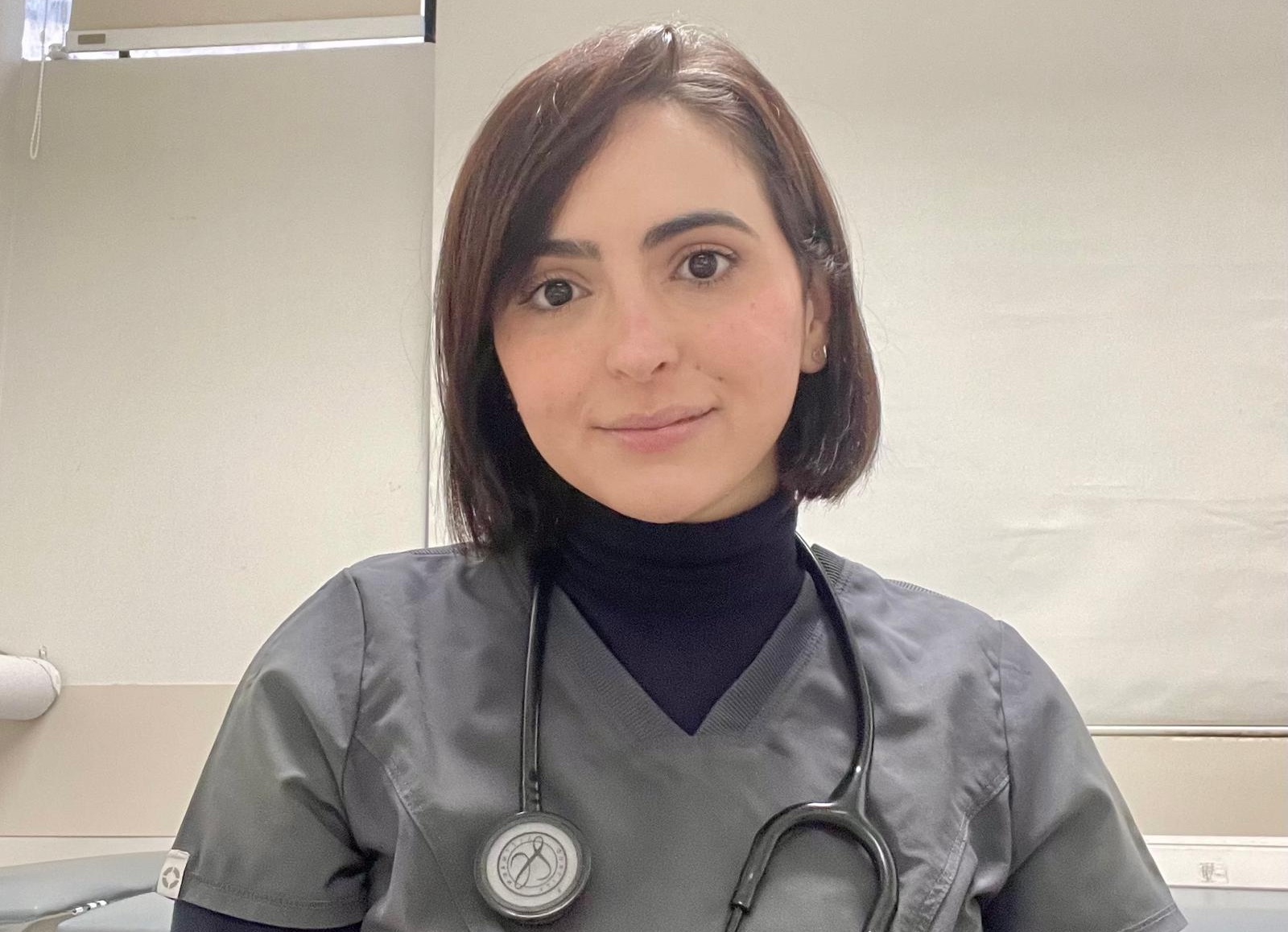
Priscila Werton Alves is the first physician to graduate from the University of Manitoba’s Master of Human Rights program.
Convocation 2025: Master of Human Rights student Priscila Werton Alves
Brazilian physician focused on right to health, empathy, storytelling and information disorder in practicum at CMHR
Brazilian medical doctor Priscila Werton Alves was one of six Master of Human Rights students to graduate in June, 2025. She completed the Practicum stream with a placement at the Canadian Museum for Human Rights and was the first physician in the program. Her intention in taking the degree was to learn how to become a Human Rights advocate after witnessing the loss of democratic rights in Brazil during the pandemic. Through much of her time in the program, she held a research assistant position working for Dr. Kjell Anderson, who also advised her major research paper. Werton shared some of her experiences in the program with us after her graduation.
What was your thesis/practicum placement and major research paper on and who was your advisor?
For my practicum, I was placed at the Canadian Museum for Human Rights, where I focused on the right to health, empathy, storytelling and information disorder. I also worked at the Manitoba Human Rights Commission through the STEP program, where I participated in investigations. My major research paper, advised by Professor Dr. Kjell Anderson, examined Indigenous genocide in Brazil during the pandemic, with a particular focus on state policies, structural violence, and accountability. The paper examined how conventional frameworks of transitional justice frequently fail to adequately address the unique and ongoing harms experienced by Indigenous communities.
Why did you choose that thesis topic or practicum placement?
As a Brazilian physician who worked on the front lines of the pandemic, I witnessed firsthand how public health was politicized and how marginalized communities were disproportionately affected. My transition into human rights advocacy emerged from that experience. The practicum at the Canadian Museum for Human Rights enabled me to integrate my medical background with critical human rights reflection. My major research paper was an extension of my commitment to amplify voices often silenced by dominant narratives and legal frameworks.
What inspired you to pursue an MHR degree at the University of Manitoba?
After becoming politically engaged in Brazil during a period of democratic backsliding and misinformation, I realized the need to expand my understanding of justice and advocacy beyond clinical care. The University of Manitoba’s interdisciplinary MHR program was one of the few that offered both academic depth and practical experience. It was the perfect bridge between my medical training and my growing commitment to human rights, particularly in the areas of public health, Indigenous rights, and transitional justice.
What was your favourite / most memorable moment or experience while taking this degree?
There were many meaningful moments, but one that stands out was being part of the international partnership project between the University of Manitoba and the University of Brasília. Facilitating knowledge exchange between institutions in Canada and Brazil, especially on Indigenous justice and reconciliation, felt like a full-circle moment, bringing together my roots, my research, and my hopes for collective change.
What advice would you give to anyone considering taking an MHR at UM as to the benefits the degree will have to your career?
The MHR program at UM opens space for bold, interdisciplinary thinking and action. Whether you come from a law, social sciences, healthcare, or activist background, this program will challenge you to connect theory to practice in a deeply personal and impactful way. For me, it reshaped my career path by blending medicine, research, and advocacy, and provided me with the tools and network to pursue meaningful work at the intersection of human rights and public health.
Applications for the next cohort of the University of Manitoba’s Master of Human Rights program are due December 1.