







From Resistance to a House of Knowledge
50 Years of Indigenous Studies at the University of Manitoba
What began as a small student movement at UM in the early 1970s is now the heart of Indigenous academics and research in Western Canada.
This year marks the 50th anniversary of the Department of Indigenous Studies – a milestone born from courage, resilience and vision.
“Today, we are not only celebrating,” said Department Head Lorena Fontaine at the recently held 50th anniversary celebration. “We are also remembering a history born out of pain. This department exists because students refused to be ignored.”
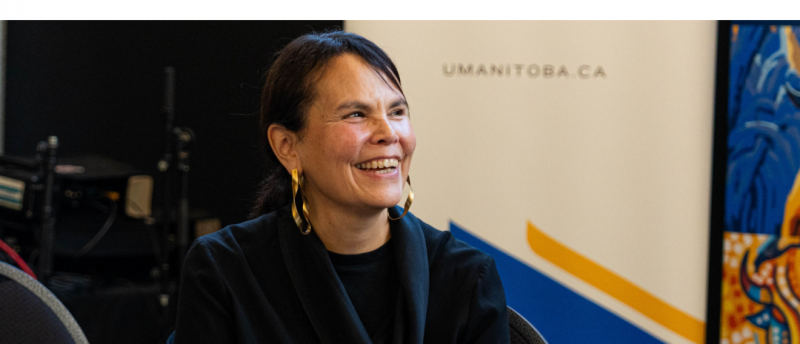
Lorena Fontaine, Head of the Department of Indigenous Studies
Her words carried the room back half a century – to the moment when a small group of Indigenous students decided that their languages, laws and histories deserved a place in the university.
Their voices would ultimately reshape the institution.
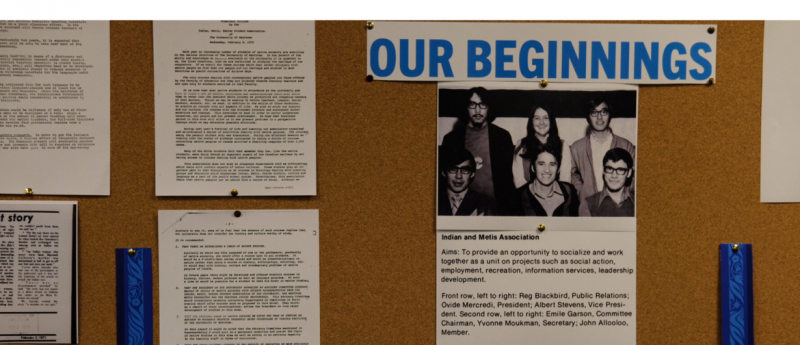
Pictured here are the founding members of the Indigenous Manitoba Engineering Student Association (IMESA). Front row, left to right: Reg Blackbird, Public Relations; Ovide Mercredi, President; Albert Stevens, Vice-President. Second row, left to right: Emile Garson, Committee Chairman; Yvonne Monkman, Secretary; John Allooloo, Member.
1970s–1980s — Carving space out of Silence
In 1970, the University of Manitoba – located on the original lands of the Anishinaabeg, Cree, Oji-Cree, Dakota and Dene peoples, and on the National Homeland of the Red River Métis – had more than 13,000 students, but fewer than 50 were Indigenous.
They learned about “exploration” and “civilization,” yet rarely did classroom lessons include Indigenous perspectives or experiences.
In 1971, a racist article published in The Cursor, the engineering student newspaper, became the catalyst. Eleven students from the Faculties of Arts and Education formed the Indian, Métis and Eskimo Student Association (IMESA), demanding accountability and change.
“We had no textbooks, no mentors, no role models,” remembered Ovide Mercredi , then IMESA president. “All we had was each other – and one belief: our voices belonged here.”
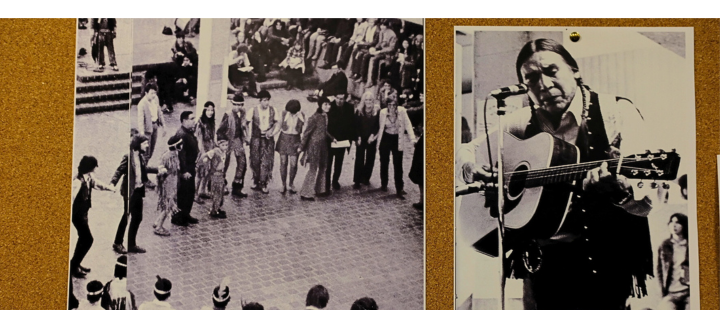
UM held its first campus pow wow in 1972. Since then, Indigenous graduates have had the opportunity each year to celebrate their academic achievements and excellence at the annual Grad Pow Wow.
In 1972, UM held its first campus pow wow. Three years later, the Department of Native Studies was formally established – the second of its kind in Canada. “That day, we were no longer guests,” said Mercredi. “We had truly come home.”
In 1982, the department faced closure due to budget cuts. It survived only because Professor Emma LaRocque, alongside students and community allies, organized petitions and public appeals.
“We had to prove, again and again, that our existence mattered. If we had stayed silent, this department would not exist today.” — Professor Emma LaRocque
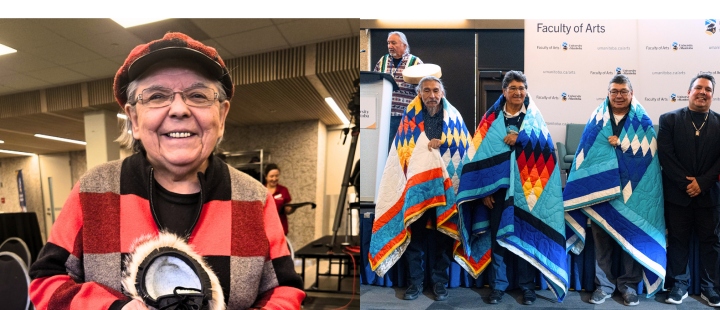
Left: Professor Emma LaRocque
1990s–2020s — From the margins to the mainstream
By the 1990s, the department launched one of the first master’s programs of its kind in Canada, later expanding to the PhD level and becoming a national leader in Indigenous graduate research and studies.
In 2021, the Faculty of Arts introduced the Indigenous content degree requirement, calling for all Arts undergraduate students to complete at least three credit hours of Indigenous course content in their studies to graduate with a Bachelor of Arts degree. Members of the Indigenous Studies department have been instrumental in developing, evaluating and delivering the courses which cover a variety of areas of study such as history, political science, sociology and women’s and gender studies.
The requirement seeks to give every future graduate an understanding of the place of Indigenous people in Manitoba’s and Canada’s history, and how that is woven into contemporary society, especially our workplaces. Since it has been introduced, other Faculties at UM have also implemented the requirement.
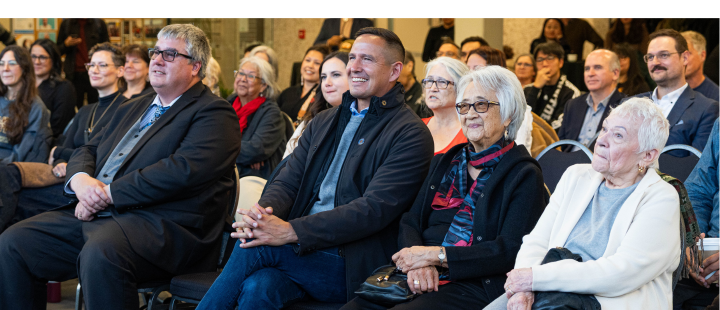
At the 50th anniversary celebration, the Department of Indigenous Studies gathered in Marshall McLuhan Hall with alumni, friends and long-time supporters.
Today, more than 3,200 Indigenous students are studying at the University of Manitoba. Across the university, 127 students – both Indigenous and non-Indigenous – are pursuing majors or minors in Indigenous Studies, Indigenous Governance or Indigenous Language programs.
The Department of Indigenous Studies has continued to expand its academic offerings. In addition to degrees in Indigenous Studies and Indigenous Governance, the department delivers a range of language courses, including two new micro-diplomas in Anishinaabemowin and Cree that support language learning and revitalization.
Regular colloquia and international conferences also create spaces for scholars, students and community members from around the world to gather, exchange ideas and learn together.
Faculty members take pride in the diverse accomplishments of their graduates, who can be found in every field – from health care, education, business and the arts to public service, law and counselling.
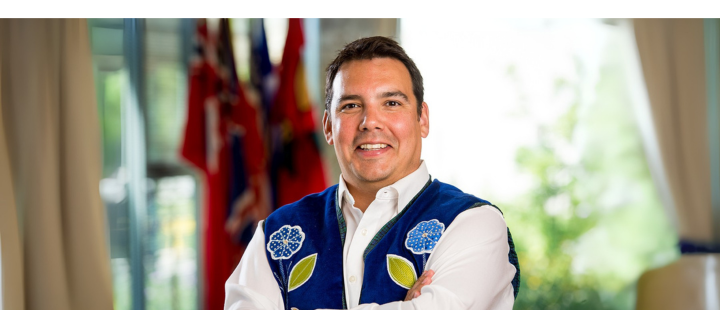
Professor Niigaan Sinclair
“Without the Department of Indigenous Studies, none of what exists today would have been possible – not the Indigenous Student Centre, not the Vice-President (Indigenous), not the National Centre for Truth and Reconciliation,” said Professor Niigaan Sinclair. “All Indigenous progress at UM has grown from here.”
He also spoke about the deeper purpose behind studying Indigenous Studies.
“Don’t let fear guide your life; let love guide it. Taking Indigenous Studies is an act of love – not just for Indigenous peoples, but for this country.”
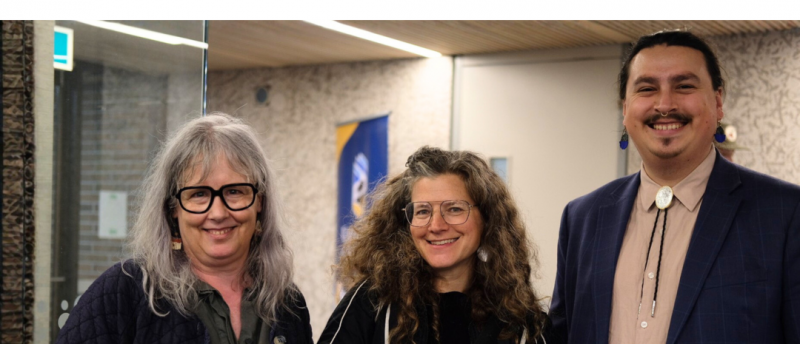
Alumni, faculty and friends reunited to honour five decades of Indigenous scholarship—some embraced after years apart, while the new generation carried the spirit forward.
The future — The drum continues
Today, generations of Indigenous scholars are following the paths their mentors cleared – continuing to learn, research and create on their own land and in their own classrooms.
Sarah Hourie, Métis scholar, Assistant Professor in City Planning and PhD candidate in Indigenous Studies, said: “I was very excited to take my own language… through the Indigenous Studies department, through a lot of hard work through people who came before me.”
Adrienne Huard, Anishinaabe Two-Spirit curator, writer and Instructor in the department, also a panelist at the 50th anniversary celebration, added: “Our bodies and our art are archives. Every performance is telling the world – our very existence is knowledge.”
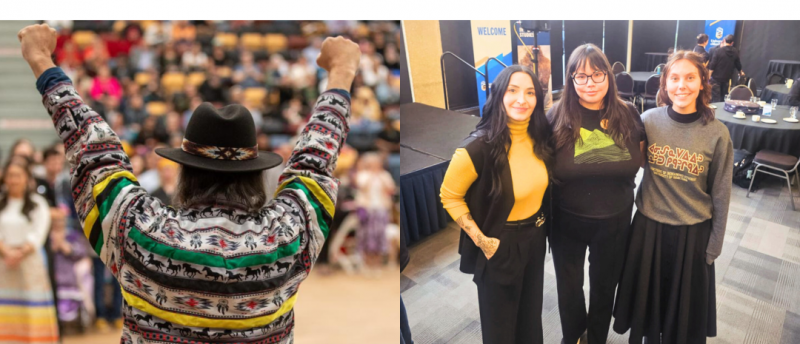
From left to right: Elder Carl Stone, Adrienne Huard, Rhianda Redhead and Sarah Hourie.
As the celebration drew to a close, Elder Carl Stone honoured Mercredi, Moses Okimaw, Edwin Jebb, LaRocque and Sinclair with a song.
“Everything that I know about me, and the love I have for myself, the knowledge I have about my people and the love that I have for my people, came from my own people,” he said, pausing as his eyes filled with tears.
Beyond the hall, the rhythm of the drum continued on a new platform.
First-year Indigenous Studies student Rhianda Redhead took over the UM Indigenous social-media account that day, writing in her closing post:
“It was an unforgettable afternoon – we’ve come so far from our ‘humble’ beginnings, and we’ll keep moving forward.”
In that moment, the drum and the words resonated together.
Fifty years of echoes became a new beginning. From resistance to resurgence, from the margins to the centre, the Department of Indigenous Studies continues to write its living story – a true House of Knowledge for all.