







Dr. Leslie E. Roos, Faculty of Arts Department of Psychology.
Closing the gap: Helping families access high-quality mental health services sooner
Dr. Leslie E. Roos appointed new federal Implementation Science Chair in Human Development, Child and Youth Health
Solutions for long waitlists, remote access and culturally specific care in mental health services often take many years to go from research discoveries to clinical best practice. These gaps in health services and in bringing research innovation to practice mean that many people simply go without the support they need. That’s something Dr. Leslie E. Roos wants to change.
As the new federal Implementation Science Chair, Dr. Leslie E. Roos, of the Faculty of Arts Department of Psychology and Children’s Hospital Research Institute of Manitoba is leading a national effort to get mental health solutions into the hands of families faster.
“It commonly takes over 15 years for research breakthroughs to become a part of everyday care, and I think everyone recognizes that’s a problem,” says Roos. “Our goal is to increase the public’s access to the highest quality care, that is culturally appropriate and meets their needs.”

Children’s Hospital Research Institute staff, researchers, and community knowledge partners.
The need for coordinated care
Mental health challenges have always existed but have been historically under diagnosed, under considered and under treated. This means that the data available to help researchers understand causes, scope of need and impacts is limited, making it difficult to predict needs for mental health services before they arise.
Recent research shows that more than 70% of serious mental illness starts during childhood and when parents experience unaddressed mental health challenges, the risk for their children increases. However, as awareness of the importance of receiving care increases so does demand for services, putting strain on already heavily burdened systems.
“In the early years of a child’s life around 15% of Canadian families have a parent with a significant mental health issue, but at least half of them won’t access care,” says Roos. “By addressing mental health challenges early, we can reduce the chance of hospitalization and provide ongoing benefit for future generations.”
Research driven solutions
As the Implementation Science Chair, Roos is focused on closing the gap between research and action to ensure that mental health strategies reach the people who need them. Roos hopes to complement current healthcare systems with services co-designed between families, researchers and front-line practitioners to deliver innovations to the public as they are identified.
One exciting area of work follows the new national guidelines on universal mental health screenings for new parents. By implementing new screening protocols, identifying needs early and co-designing systems of care that can offer offering support, families can get the help they need, when they need it and before they reach a crisis point.
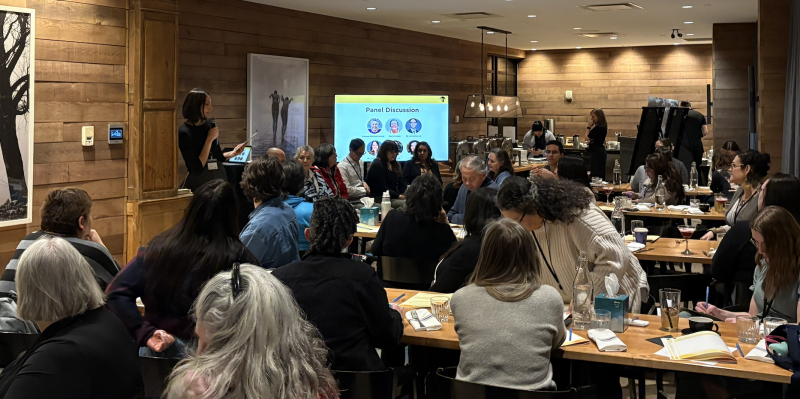
Dr. Leslie E. Roos presents to community advisory board partners at a 2025 event.
A growing network of care
Through Partnering for Research Innovation in Mental Health (PRIME), Roos and her colleague Dr. Mandy Archibald at the Children’s Hospital Research Institute of Manitoba have already connected with over 500 knowledge partners in Manitoba. The established group of community collaborators including Kids Brain Health, the United Way of Winnipeg, Family Dynamics, Child and Youth Treatment Services, Acorn Family Place and, Strengthening Families and Maternal Child Health Initiative on Pinaymootang First Nation.
“Mental health solutions are going to come from within communities,” says Roos. “Anytime a family is being pulled in multiple directions, with factors such as financial strain or the stress of parenting itself, the potential need for mental health and other tangible supports grows. The work of implementation is often really the work of building relationships to understand community needs, priorities, and appealing solutions.”
In Canada, legacies and ongoing impacts of colonization disproportionately impact Indigenous families. In addition, many newcomers communities’ face stress during the process of immigration, and they often face barriers to accessing care. Equitable approaches to mental health care will require community leadership and expertise to provide culturally appropriate high-quality care from a lens of self-determination.
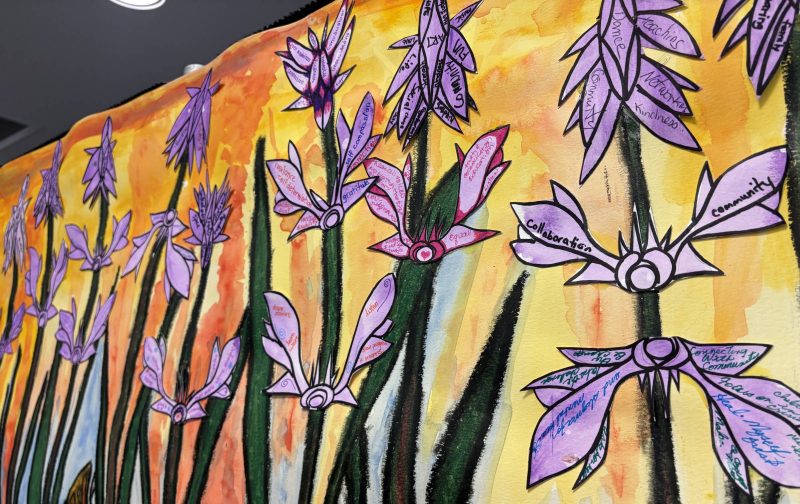
Arts-based advocacy in community mental health care visioning activity, with art creation and leadership from collaborator Aimee-Mihkokwaniy McGillis.
“I have the incredible opportunity to collaborate with organizational and student leaders who are taking on this work to bring wellness to their communities, says Roos. It takes a lot of work to change practices and there is a lot of openness to improvements to care based on the great work already being done by researchers and community health organizations across Manitoba,”
Over her five-year term Roos plans to grow this network nationally, to identify different barriers and share insights between communities facing similar challenges.
The CIHR Implementation Science Chair in Human Development, Child and Youth Health includes one million dollars in funding over five years, beginning summer 2025.
Research at the University of Manitoba is partially supported by funding from the Government of Canada Research Support Fund.