






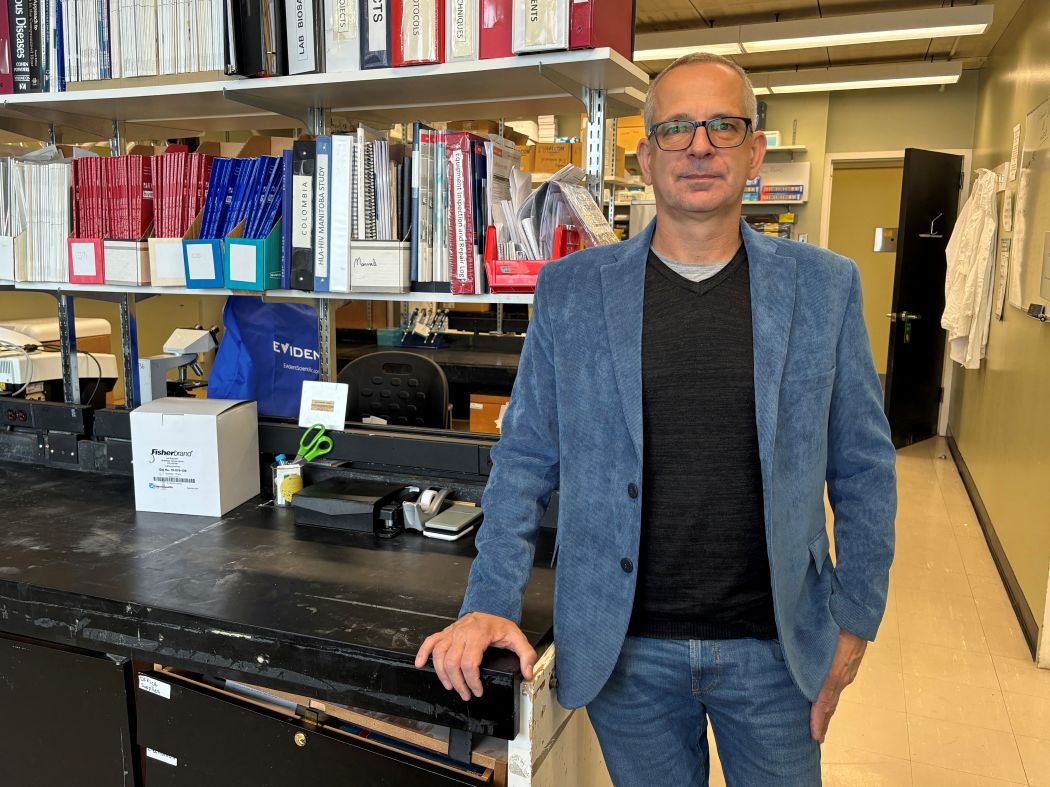
Dr. Yoav Keynan
UM project to enlist community members in improving services for patients with HIV, other infections
An innovative UM-led project will train people with lived experience from across the Prairies to work with researchers on developing clinical trials focused on HIV and sexually transmitted and bloodborne infections (STBBIs), such as gonorrhea and syphilis.
Training people with lived experience of these illnesses will help the research team to formulate questions about patients’ needs, said study leader Dr. Yoav Keynan, a professor of internal medicine and medical microbiology and infectious diseases at the Max Rady College of Medicine in the Rady Faculty of Health Sciences.
It will also give people from marginalized communities a voice in designing clinical trials that test the effectiveness of different approaches to care.
For example, Keynan said, a trial could look at improving engagement and retention in care by providing sexually transmitted infection care together with opioid agonist therapy, used to treat opioid addiction.
People with lived experience could include those with HIV, experiencing homelessness or struggling with injection drug use, Keynan said.
“This is a first-of-its-kind project in Canada, in that we are combining people with lived experience and researchers to be part of clinical trials training and co-creation,” he said.
“This project is so important right now because Manitoba has the highest rate of new HIV diagnoses in Canada. And HIV and STBBI rates in the Prairie provinces have been the highest in the country for more than a decade and show no signs of slowing down.”
The project recently received a four-year grant of $800,000 from the Canadian Institutes of Health Research (CIHR) Pan-Canadian Network for HIV/AIDS STBBI Clinical Trials Research.
Keynan said the project is building on and leveraging the success of Increasing Capacity for Maternal and Pediatric Clinical Trials (IMPaCT), a clinical trials training program funded by the CIHR.
“We are excited to partner with IMPaCT and get this project rolling,” he said. “There will be opportunities for people who are community-based researchers, front-line workers and people with lived experience to work together to define what the most important priorities are for them, and it’s bringing more people to the table.”
The funding will help train more than 12 people from Manitoba, Saskatchewan and Alberta. The one-year immersive training program will include how to develop responsive and respectful clinical research.
The trainees will form the foundation of what is being called the Strengthened Prairies Integrated Knowledge Exchange (SPIKE).
Keynan said that people with lived experience will help researchers and care providers better understand the relationship between HIV and STIBBI transmission rates and systemic factors, such as colonialism, mental health and substance dependency.
“We believe that this type of participatory research is needed to make sure that the questions asked, and the answers we receive, are meeting the needs of the community,” Keynan said.
“It grounds the research in the needs of the people that it’s supposed to serve, and it makes sure that the clinical research is relevant to those who need it most.”