







Sam Kavosh at the University of Manitoba’s Apotex Centre, Bannatyne campus.
UM pharmacy student tackles gaps in care for IBD and UTI patients
Sam Kavosh, a third-year Doctor of Pharmacy (PharmD) student at the Rady Faculty of Health Sciences, moved to Winnipeg from Iran with his family when he was 16 years old.
He completed his undergraduate degree in biological science from the University of Manitoba before entering the PharmD program.
Kavosh is the president of the UM chapter of the Network for Collaborative Oncology Development & Advancement (NCODA) — an international pharmacist-led organization that focuses on cancer care and treatment.
This summer, Kavosh took part in the undergraduate summer research program at associate professor Dr. Sherif Eltonsy’s lab, where he explored inflammatory bowel disease (IBD) treatments during pregnancy and ways to improve pharmacist support for patients with urinary tract infections (UTIs).
We sat down with Kavosh to learn more about his journey at the College of Pharmacy and his research.
What inspired you to pursue a career in health care, and what drew you specifically to pharmacy?
I’ve always had a fascination with health studies, learning about physiology and human anatomy. I like how pharmacy has a heavy emphasis on treatment and how pharmacists can impact the outcome of someone’s health.
Pursuing pharmacy also offers versatility. Pharmacists can work in diverse settings: hospitals, communities through local pharmacies, primary care and industry — which includes research and development.
There’s been a shift from when pharmacists were primarily focused on dispensing and assessing medications to now interacting, treating and diagnosing patients.
Pharmacists are the first point of contact for many Manitobans. We have a big primary care issue, and a lot of people here are struggling to see health-care providers. Having a pharmacist who’s more accessible helps ease those challenges.
Can you tell us all about your research exploring IBD medications during pregnancy?
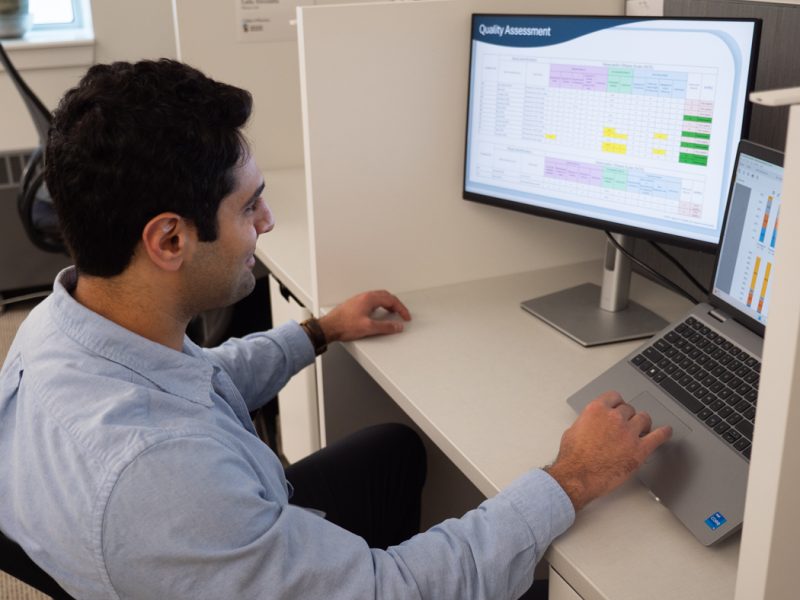
Kavosh working in Eltonsy’s lab at UM’s Apotex Centre.
The research focuses on determining the safety of vedolizumab and ustekinumab — two antibody treatment medications for IBD — during pregnancy. People with IBD may stop treatment during pregnancy due to uncertainty around medication safety.
The problem with stopping medication is that it increases the risk of flares and other complications. IBD is an autoimmune condition, and inflammation can increase risk for both mother and baby. Discontinuing treatment may not be the best option if there’s no real risk.
We hope this study will provide additional insight into the safety of these medications.
Can you tell us more about your project on how community pharmacists can better serve those with UTIs?
I’ve taken on this second project independently, with supervision from Dr. Eltonsy. I designed the study to examine how pharmacists treat uncomplicated cystitis — a common bladder infection — and explore opportunities to support patients with more complex UTIs.
During my rotation at a local pharmacy, I found the restrictions limiting in how much I could help patients with UTIs. There’s a lot more that could be done if the restrictions weren’t so tight. Criteria such as being male, under 16, or having recurring infections must be referred to a physician, even when an appropriate assessment and potential treatment could be provided more readily.
My goal is to assess whether policy changes could improve access to care. The project is currently under review and will move on to data collection if approved.
Who has mentored you in your research and what impact have they had on you?
I work alongside Dr. Eltonsy, PhD and master’s students in our lab. All of them inspire me. They guide me in areas I’m still learning, and their support inspires me to mentor others.
How is the PharmD program helping shape you into the pharmacist you’d like to be?
It’s a comprehensive program — a lot of schooling goes into becoming a pharmacist. Students complete extensive chemistry courses before entering, and once you’re in, we’re exposed to so much pharmacological and clinical knowledge.
For someone like me — who’s interested in chemistry, is passionate about helping patients get better, and enjoys both treatment and research — pursuing the PharmD program is a very rewarding path.