





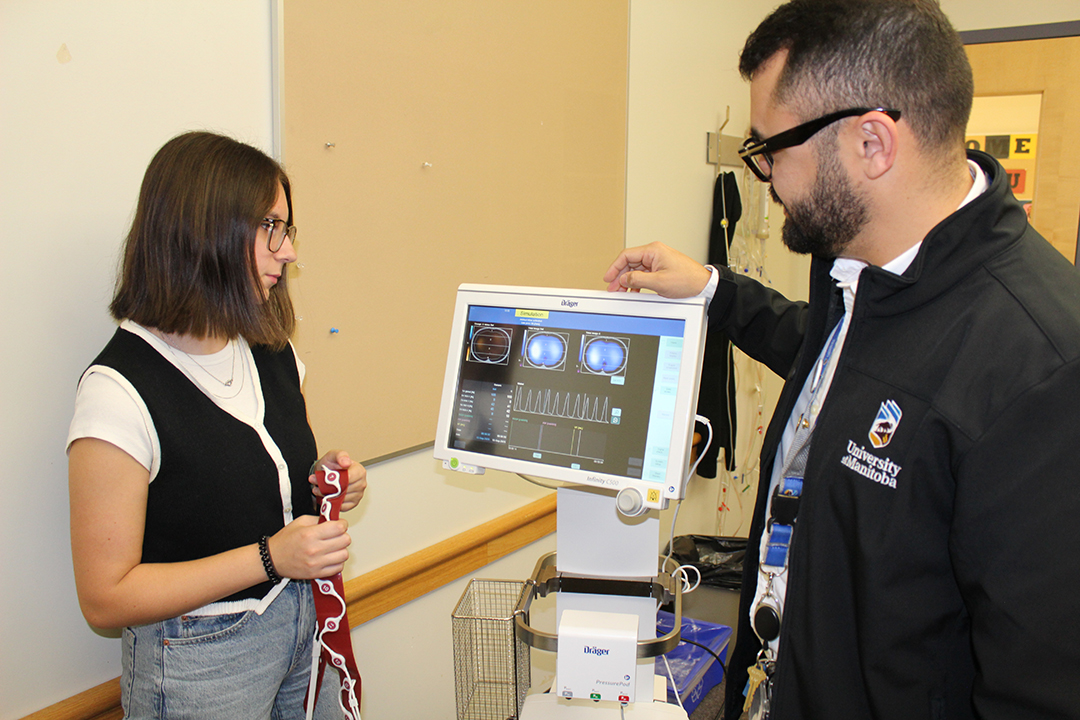
Taylor Davidson (L) and Dr. Mayson Sousa discuss the use of electrical impedance tomography in respiratory research.
Respiratory therapy student uses new technology in summer research
Taylor Davidson is a first-year UM respiratory therapy student who spent her summer working on a series of projects in respiratory physiology.
The projects, led by Dr. Mayson Sousa, assistant professor in the College of Rehabilitation Sciences, utilize electrical impedance tomography (EIT) — a radiation-free, bedside imaging technology that provides real-time visualization of lung function.
“While EIT is widely used in leading clinical and research centres worldwide, this is the first research project in Manitoba to employ it,” Sousa said.
We spoke to Davidson about her summer research experience.
Tell us about your summer research project?
We are looking at the structure and the function of extra diaphragmatic muscles. So, the muscles other than your diaphragm that are involved in breathing – often during forced breathing or breathing when you’re doing heavy exercise – like your abdominal muscles, some chest muscles and a couple of neck muscles as well.
We’re looking at the structure and function in healthy subjects, so that we can grab reference data that can be used in future studies to compare to populations of people who are critical care survivors, people who have been on mechanical ventilation for a period of time or people with respiratory diseases.
To assess structure, we’re using ultrasound and we’re measuring the mass and activity of the muscles. And to measure lung function, we’re using EIT, which is a non-invasive device that looks at lung function in real time to get a better understanding of ventilation.
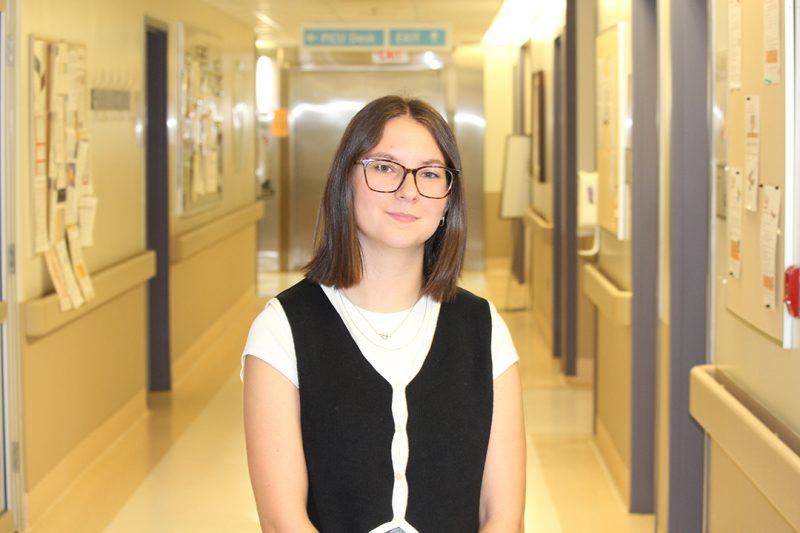
Taylor Davidson
What have you enjoyed about conducting research?
It’s been interesting to take what I’ve learned in class and be able to apply it into the real world. Early on we learned about the extra diaphragmatic muscles: what they are, if they’re involved in inspiration or expiration and things like that. Now I’m expanding my knowledge by measuring these muscles to determine if they’re strong or weak and how they contribute to breathing in times where the diaphragm may need a bit of extra help.
I’ve liked using the EIT machine because it’s a fairly new piece of technology. I have always been interested in health innovations and new things. It’s cool to see how this piece of equipment works and the best techniques to use it, and it has been really interesting to be able to use the techniques that I’ve read about on actual people.
Why do you see this research as important?
I’ve always believed that research plays a vital role in health care. It forms the foundation for advancing any type of medical knowledge, new treatment strategies or even improving patient outcomes.
In this research, we are using non-invasive bedside assessment tools that can quickly be used in several patient populations. You can use them in adults, children and neonates to quickly assess lung and respiratory muscle function. The EIT, specifically, is portable and provides continual real-time assessments and can be used to determine if specific interventions cause different reactions and if they’re intertwined.
After this experience, do you think research could be part of your career as a respiratory therapist?
I’ve started to get quite invested in this project. If an opportunity arises where I can continue working on this throughout the school year, that would be really cool.
After I finish the program, I don’t know if research is something I would want to do right away. I’d like to gain some clinical experience first, but in the future, I could definitely see myself working in both a clinical and a research setting. I believe it is important for research and clinical experience to be combined to see the best outcomes. I don’t know that I would run my own research study, but I would definitely be interested in helping colleagues out and being a part of research.