






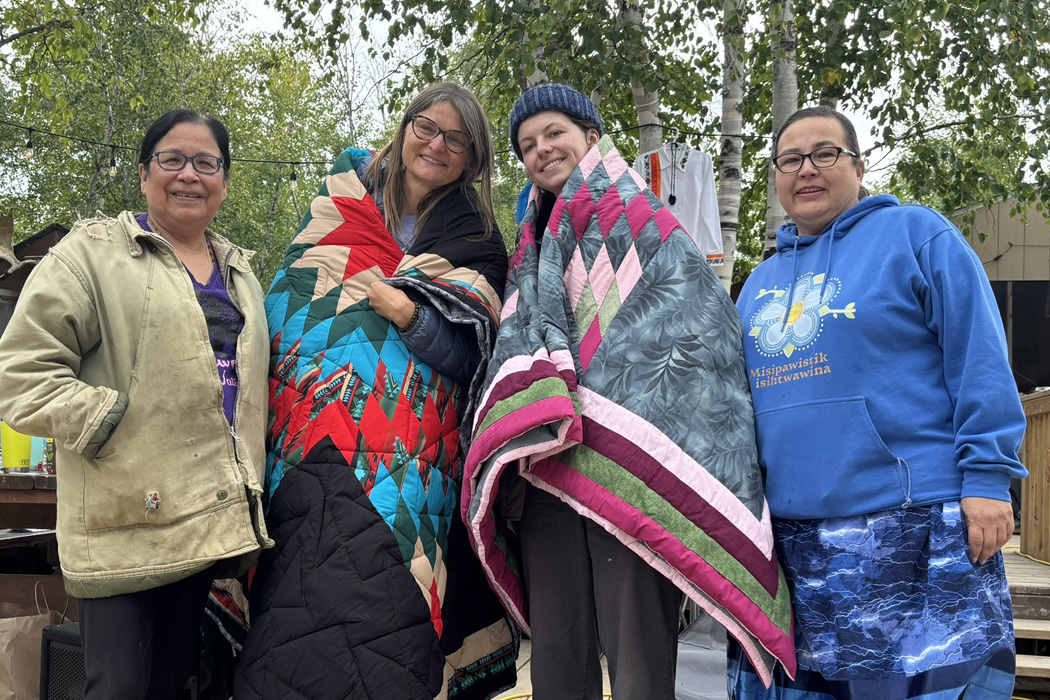
(L to R): Esther Cook, health director of the Misipawistik Cree Nation Health Authority; Lisa Mendez, collaborative health care practice lead from the Office of Interprofessional Collaboration; fourth year medical student Maura Macauly; and Margaret McGregor, a nurse from the Misipawistik Cree Nation Health Authority.
Rady educator and student honoured for dedication to First Nation community
The community of Misipawistik Cree Nation near Grand Rapids recently honoured an educator and a student from the Rady Faculty of Health Sciences for their commitment to a partnership with First Nations communities through a program at the Office of Interprofessional Collaboration (OIPC).
Lisa Mendez, OIPC collaborative health care practice lead and instructor at the College of Rehabilitation Sciences, and Maura Macaulay, a fourth-year student at the Max Rady College of Medicine, each received a star blanket at the community’s annual women’s gathering on Sept. 7.
The program – called ‘Ndinawemaaganag’ (Anishinaabemowin for ‘all my relations’) – is supported by the RBC Experiential Learning Travel Initiative.
Esther Cook, health director of the Misipawistik Cree Nation Health Authority, thanked Mendez for bringing the program to Misipawistik and continuing to bring health-care students to the community’s Sundance and women’s and men’s gatherings.
“I’m really thankful for her and that she reached out and wanted to bring this project to our community. I have a hard time trusting people, but her I trust with my heart,” Cook said. “It is important that the general population see Indigenous people as who we really are, not what negative media portrays us to be. This program does that.”
Ndinawemaaganag began in 2017 as a two-week experience for health profession students in the Rady Faculty to learn together in First Nation health centres and nursing stations. After hosting students for one year, Cook suggested that the students also attend a Sundance – a sacred ceremony that is centered in spirituality, community and nature – to better learn about health and healing in her community.
The program has now evolved to include other ceremonies and camps around the province. Among those events is the women’s gathering, a five-day event held once a year in late August or early September, around the full moon.
Mendez said she is grateful for the relationship with the community, as it has created the trust needed for the program to evolve organically in a way that is meaningful to students and the community.
“I’m so honoured to receive this blanket. It represents my connection to community and my commitment and responsibility to continue to move this work forward in a good way,” she said.
“Although I’m an instructor, the community does the teaching here. My strength is building bridges to support meaningful and authentic engagement between learners and First Nation communities. It’s a privilege to support opportunities where Sundance lodges, sweat lodges and nature are the classroom.”
Macaulay has been taking part in the program for the last four years and has attended Sundances and women’s gatherings. She said it’s important for her, as a medical student, to be exposed to Indigenous ceremonies and traditional medicine.
“One of the things I try to keep in mind as a settler and a medical student is one of the [Truth and Reconciliation Commission of Canada] calls to action, for people in the health-care system to have an understanding of the value of traditional medicine and to help people access that,” she said.
Macaulay said Ndinawemaaganag has been valuable in making connections with students in other health disciplines, including nursing, physical therapy and midwifery, as well as the traditional healers she met in the community.
“Going forward, I’ll be able to refer my patients to those people and also have a deeper understanding of what they have to offer, because hearing that there’s a benefit to traditional medicine in the classroom is one thing, but it’s another to experience it first-hand.”
The community also honoured Macaulay in a ceremony last year with the spirit name, “Medicine woman who walks with the brown grizzly bear.” Mendez said the name carries a lot of honour and responsibility.
“I feel like a proud mama bear watching Maura learn from and create connections with the community and other learners,” Mendez said.