






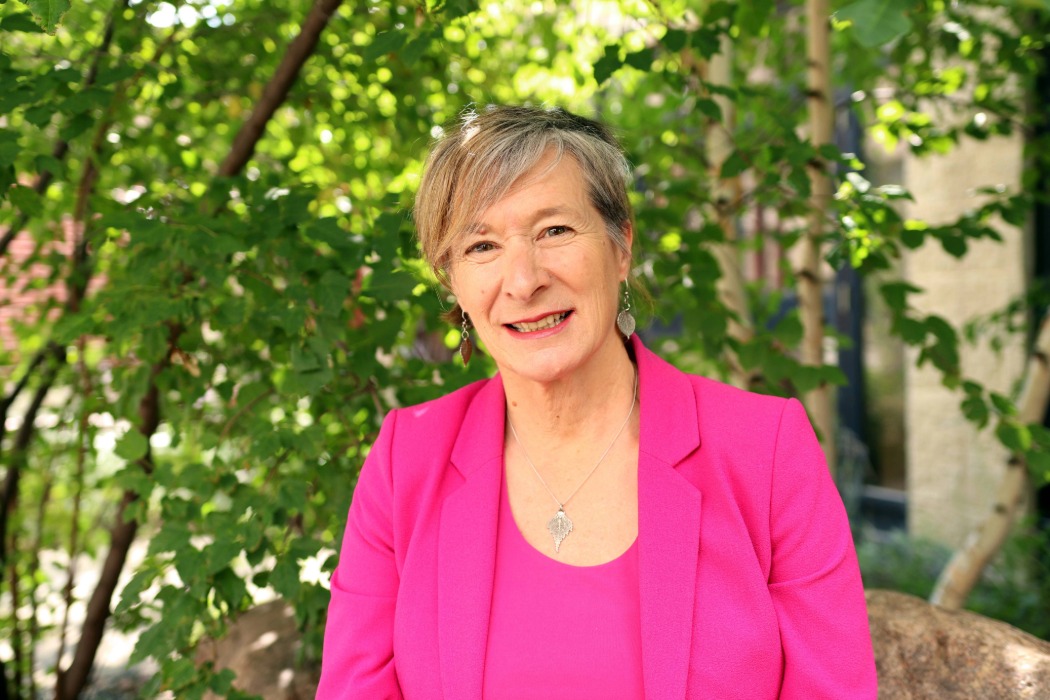
Dr. Josée Lavoie at the Medicine Garden at University of Manitoba's Bannatyne campus.
Meet Dr. Josée Lavoie, new dean at the College of Community and Global Health
Dr. Josée Lavoie, a professor of community health sciences in the University of Manitoba’s Rady Faculty of Health Sciences, has been appointed the inaugural dean of the College of Community and Global Health (CCGH). She began her five-year term on Aug. 1.
Lavoie also served as director of Ongomiizwin Research – Indigenous Institute of Health and Healing from 2014 to 2023.
We sat down with Lavoie to learn more about her journey, her vision for the college, and what students and communities can expect from CCGH.
What inspired you to pursue a career in health sciences, with a focus on community health?
I was drawn to issues of social justice and prevention at an early age. My father was a hospital administrator in small, remote communities. His job was to bring private hospitals into a publicly funded system. This was the beginning of Medicare in Quebec, in the early 1970s. I was only seven at the time. We baked bread together weekly and talked about issues he was facing, trying to advocate for the North.
It felt natural that I would go into health care for my career. I have been passionate about community health, equity and policy, especially as they impact underserved communities, for as long as I can remember.
Can you share an example of a collaborative initiative or project you were part of that made a meaningful impact?
Over the past decade, I worked on strengthening our university’s relationships with Manitoba Indigenous organizations interested in leading their own health research.
Organizations including the First Nations Health and Social Secretariat of Manitoba, Manitoba Métis Federation, Aboriginal Health and Wellness Centre of Winnipeg and the Inuit community are leading state-of-the-art research in partnership with UM researchers. Ongomiizwin supported these organizations and funded Indigenous graduate and undergraduate students to help build that infrastructure and establish a strong and unique Indigenous research ecosystem to lead studies with their own communities.
How do you see your role as dean supporting the work of others in the college?
The success of CCGH depends on the success of every single one of us — students, faculty, staff and everyone affiliated with the college.
Our college is dedicated to systems transformation — improving how health and social systems serve people, especially those denied equity. We are uniquely interdisciplinary and work together to break barriers and transform systems in health care, child and family services, social welfare and more.
My role is to promote their contributions and growth, be their steward for human and financial resources, ensure university policies support rather than hinder progress, support their pursuit of excellence, and foster a safe and stimulating environment for working and learning.
What do you value most about the CCGH community?
We are driven by our CCGH community, in partnership with the broader Manitoba and international communities. We have a long legacy of working collaboratively, listening to community feedback and saying, “We hear you. We can do better.”
We have a collective commitment to reconciliation, social justice and equity. But our work doesn’t end in Manitoba — our impact reaches international borders, with our initiatives supporting public health and social challenges in countries like Nigeria, Kenya, Pakistan, India, Colombia and beyond.
How do you envision the college growing together over the next few years?
My goal is to make CCGH a vibrant and exciting college in which to work and learn, where people come to freely engage in respectful debates. I want to see a place where our students congregate and where they find opportunities that help them grow professionally and personally.
I envision a college known internationally as a leader in systems transformation. A bachelor’s degree in community health sciences is being considered, with plans for an initial intake of 40 students and future expansion. It would help prepare students for the college’s renowned graduate programs.
What message do you have for current and future students at CCGH?
We are an incredibly vibrant environment that is broadly networked with Manitoba Health, other government departments, Indigenous and community organizations, with linkages to lower- and middle-income countries, Arctic-region countries and beyond.
When you come here, you will find a community that supports you and will integrate you into great applied discussions. We are focused on a mix of classroom learning and hands-on experience in undergraduate medical education, graduate studies, and family social sciences. We also offer a postgraduate residency program in public health and preventive medicine.
Our work here is known nationally for many important initiatives including anti-racism and reconciliation.
If you want to see your work have impact, this is the place to be.