






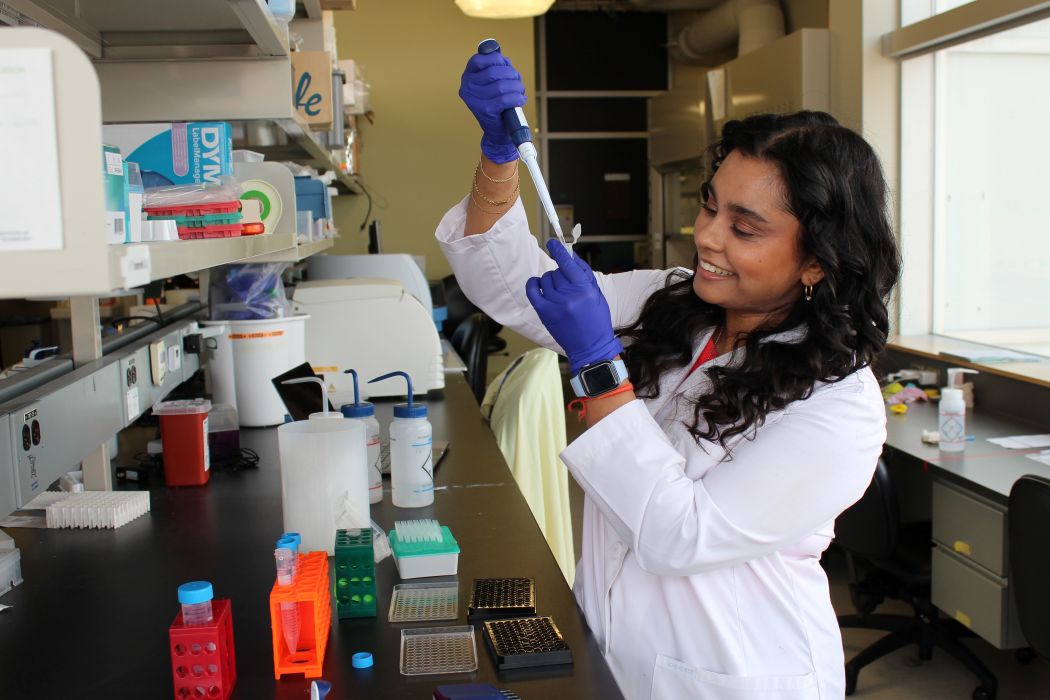
Medical student research profile: Tamarah Singh studies sex-related differences in development of rheumatoid arthritis
Tamarah Singh said it was a “no-brainer” that she enrolled in the bachelor of science in medicine (B.Sc. (Med.) program because it would allow her to work on her very own research project.
For the past two summers, Singh, a third-year medical student at the Max Rady College of Medicine, has focused on better understanding the sex-related differences in the development of rheumatoid arthritis.
The B.Sc. (Med.) program provides an opportunity for medical students to spend two summers – following their first and second years of the four-year MD program – immersed in research.
Under the guidance of her supervisors, Dr. Neeloffer Mookherjee, professor of internal medicine, and Dr. Liam O’Neil, assistant professor of internal medicine, Singh’s central hypothesis is that sex-specific immune differences shape preclinical rheumatoid arthritis and follow shared trajectories in both mice and humans.
Singh used a variety of tests to determine the changes in key biomarkers and to identify patterns associated with preclinical rheumatoid arthritis.
UM Today sat down with Singh to learn about her experience as a B.Sc. (Med.) student at UM.
How will the B.Sc. (Med.) research experience help you as a future physician?
I think it’s paramount. I think it gives me a critical lens to look through.
In some cases, I’m not only looking at the individual patient, but I’m also considering a whole plethora of background information. For example, if a patient comes in and they need a certain medication, then I’m going to think, “What are the pros and cons to this medication? How will their specific situation change with this type of management?”
Research has given me an appreciation for critical thinking.
Has the B.Sc. (Med.) experience increased your interest in conducting research after medical school?
I would say yes, but if you asked me last year, I would have said no. During my first summer, I had a lot of challenges because my experiments weren’t working. It was so frustrating, but this year, now that I got past the hurdles, I would say I can appreciate the process now.
I would say once you get past the hurdles, it’s definitely worth it.
What is something about research you didn’t know about until you took part in this program?
I learned how impactful research is and how you can actually move the needle forward on different things.
Even when you’re talking to clinicians, they will refer to specific studies. If you ask them a question like, ‘Why are we prescribing a certain medication?’ They will say, ‘Oh, this study has shown it has done this for this group of people, so it’s likely to be the result of that.’
What has been your favourite aspect of the program?
Coming into the program, I didn’t realize it would teach me the number of things that it has taught me. For example, I didn’t know I’d be learning how to code. Now, I feel very comfortable using the programming language R.
What advice would you give a student thinking about pursuing a B.Sc. (Med.) degree?
I would say if you’re on the fence about doing a B.Sc. (Med.), ask around about different supervisors and don’t just go with someone that would accept you. Be interested in what they’re doing. Go back and look at the different publications they’ve worked on.
When you’re on the fence about deciding to do it or not, really interview the supervisor and see if it’s someone you’re interested in. Find somebody in the college who can nurture your passion for research because there is somebody. I promise you there is somebody.
You will really get a lot of value out of the program.