






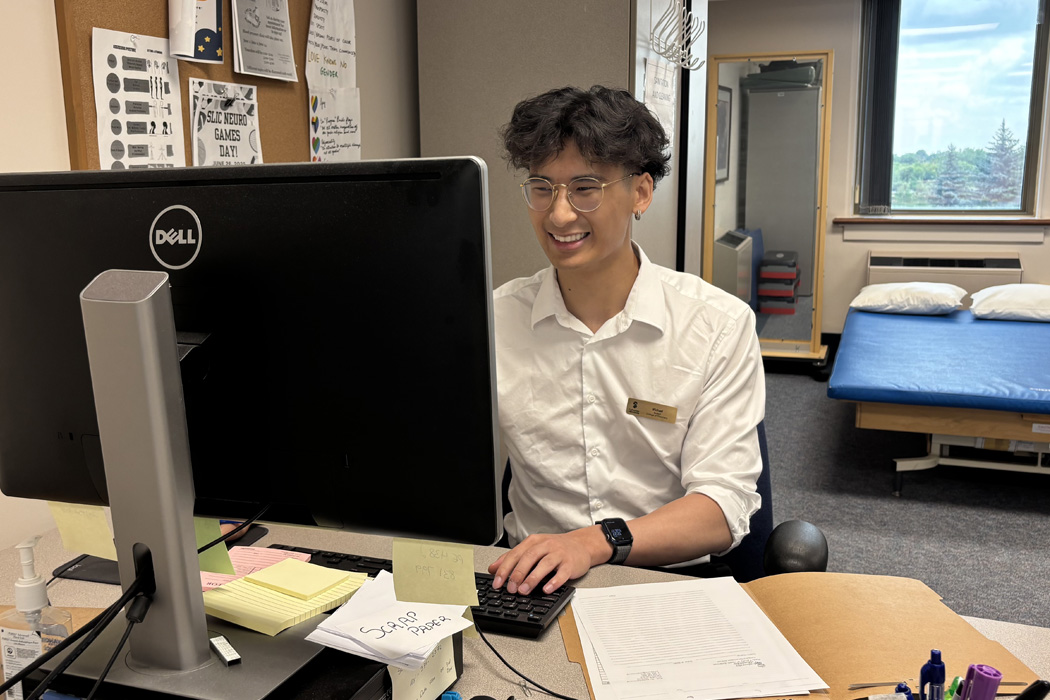
Michael Li at the Student-Led Interprofessional Neuro Clinic at Riverview Health Centre.
Interprofessional student-led clinic expands roles for pharmacy, respiratory therapy
The Rady Faculty of Health Sciences’ Student-Led Interprofessional Neuro Clinic, housed at Riverview Health Centre, welcomed its first intern from the College of Pharmacy this spring.
Fourth-year pharmacy student Michael Li is currently on an eight-week experiential rotation at the clinic. In previous years the interprofessional site only had two-day visits from pharmacy students to work alongside others from rehabilitation sciences and nursing.
“He is on site, interacting with the clients, and he’s able to provide more consistency than with just one-off appointments,” said College of Pharmacy instructor Michelle Boyce.
Li works directly with clients, performing medication reviews with a focus on neurological conditions such as Parkinson’s disease, multiple sclerosis and stroke recovery.
“We learn a lot from each other and seeing how different our programs are and the overlaps we have with another,” Li said.
As part of his placement, Li is also leading a sleep hygiene workshop, along with two occupational therapy (OT) students – Omar Hashmi and Rhiana Clelland – on the importance of getting the right amount of sleep, and strategies to accomplish the goals.
“We’ll be giving tips on setting a sleep schedule, creating a bedtime routine, optimizing the sleep environment, and education on when to seek professional help. As well we will be comparing the effectiveness of sleep hygiene to pharmacological therapies,” he said.
Li is currently interested in primary care or community care after he completes the doctor of pharmacy (PharmD) program.
“Primary care is very similar to what we are doing here [at Riverview], working with other professions, and patients coming in for appointments,” he said.
The clinic was founded in 2003 at UM’s Bannatyne Campus and moved to Riverview Health Centre in 2022. For 12 weeks a year, physical therapy (PT) students run the clinic under supervision as part of their fieldwork experience. In recent years, pharmacy, nursing, OT and respiratory therapy (RT) students also joined for various lengths of time.
Sarah Conci, PT instructor and coordinator of the clinic, said the program’s evolution to include more health disciplines has been positive for the students, as they can experience interprofessional learning while working with real clients
“The students value the real and genuine collaboration, problem solving with other health-care team members, and being able to see, in a real-life health-care environment, how each of their roles can overlap or complement each other.
RT students get primary care exposure
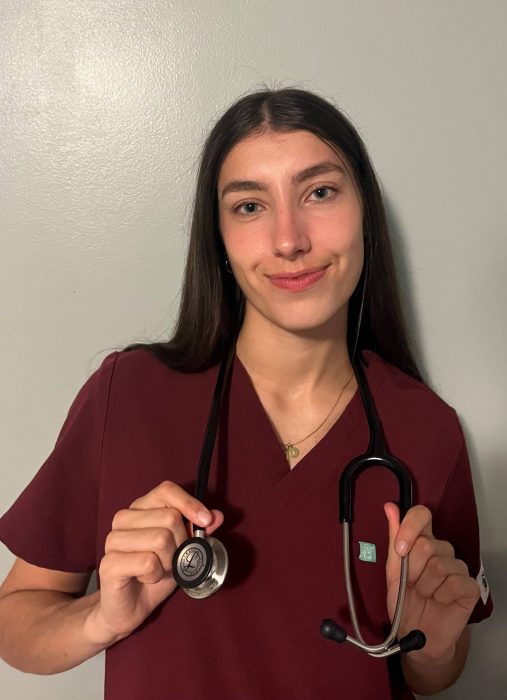
Emily Firth
Sandra Biesheuvel, RT instructor at the College of Rehabilitation Sciences, said this was the second-year students from the program took part in the clinic. She saw it as an opportunity to expose RT students to primary care and how the profession can be expanded into that kind of setting.
“They currently don’t have any clinical education in primary care in the program because, traditionally, our profession is situated in acute care in a hospital, primarily in the intensive care units,” Biesheuvel said.
RT students worked at the clinic for a full day, doing 30-minute patient assessments.
“We got to see four patients throughout the day. We looked at their charts and got a history, assessed their lungs, and did spirometry to test their lung volumes,” said second-year RT student Emily Firth.
The interprofessional setting allowed the RT students to work closely with students from the PT program and learn about their roles.
“The patients would come in and see us first and the physio student would observe what we do as an RT in the clinic setting. After our assessment was over, we would follow the PT through their assessment and observe the activities they were doing with the patient. There’s definitely some overlap, like with patients who have decreased muscle function,” Firth said.