






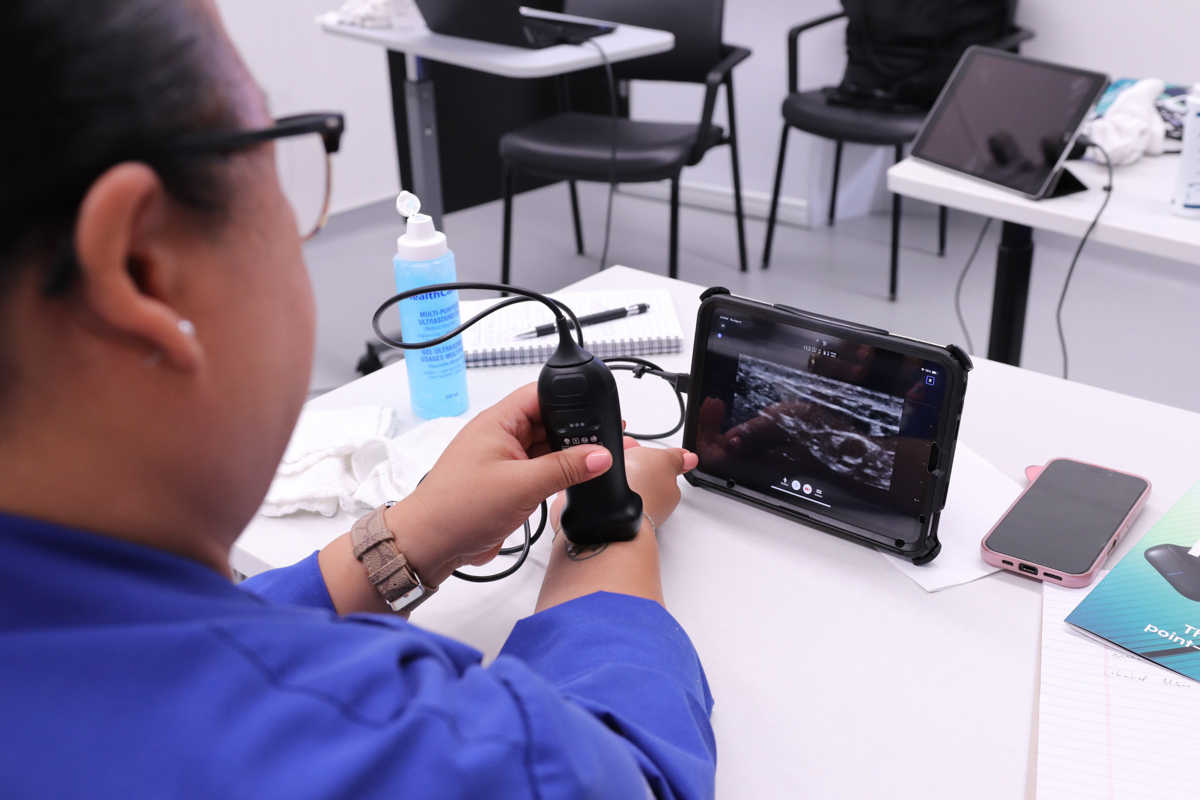
Staff from the Clinical Learning and Simulation Program demonstrates the use of a handheld point-of-care ultrasound probe.
Handheld ultrasound: The next stethoscope?
UM expands medical student training
The Rady Faculty of Health Sciences is expanding the use of point-of-care ultrasound (POCUS), a handheld imaging tool that allows clinicians to see inside the body in real time. Experts in the Max Rady College of Medicine said POCUS could become as essential as the stethoscope.
“We believe POCUS could be the next stethoscope – a device physicians have relied on for decades,” said Dr. James Butler, associate dean of Undergraduate Medical Education (UGME).
The faculty recently acquired 80 new handheld ultrasound probes for student use – an expansion from two handheld devices. Medical students also continue to share three cart-based ultrasound systems.
Butler said the goal is to expose students to handheld ultrasound technology from the start of their education.
The initiative is a collaboration between UGME and the Clinical Learning and Simulation Program (CLSP). Funding from the Manitoba government supported the equipment purchase, part of a broader expansion that increased enrolment in the MD program from 110 to 140 students.
Hands-on learning with new tech
Dr. Tomislav Jelic, co-director of the POCUS curriculum and director of ultrasound in the department of emergency medicine, said the technology is unique.
“This handheld ultrasound uses one probe for different types of scans,” he said. “Instead of using separate probes for areas such as the abdomen, heart, lungs and muscles, this single device tackles it all. Clinicians can check many areas without switching equipment.”
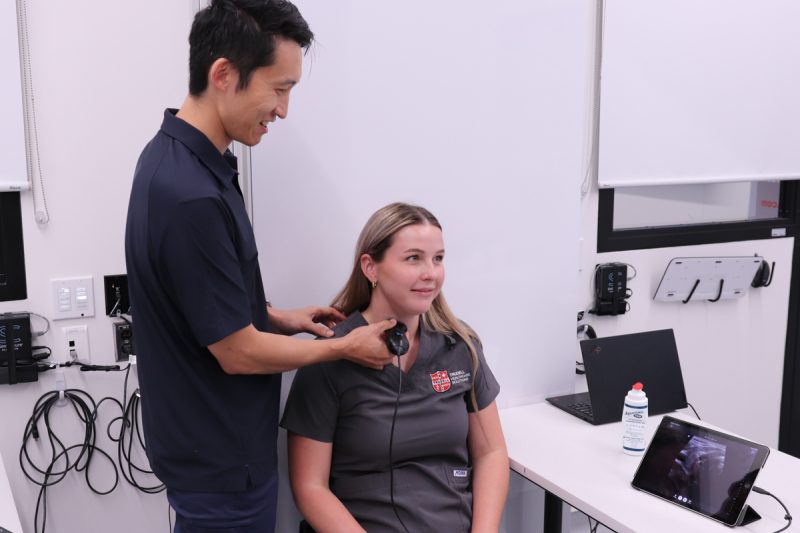
Dr. Terry Li demonstrates the use of a POCUS probe during a train-the-trainer session.
Dr. Terry Li, POCUS co-director and assistant professor of human anatomy and cell science, said the new probes offer several advantages over traditional models.
“It offers better durability and image quality, is easier to clean and safer to handle,” he said.
Students practice with the devices in simulation labs at UM’s Bannatyne campus. They work with standardized patients – actors trained to portray patients – and volunteers during their pre-clerkship years, the first two years of medical school before the final two years of clerkship featuring a series of clinical rotations.
“We plan to integrate POCUS into clinical training with real patients during clerkship,” said Jelic, referring to the hands-on phase of medical education in hospitals.
“Training students with modern technology to enhance their understanding of anatomy and diagnostic techniques is essential. Ultrasound paints a different picture and helps students better understand what they’re learning from textbooks.”
Supporting rural health
Jelic said the handheld probes are more than just a compact alternative to cart-based systems – they also have the potential to improve care in remote and underserved communities.
“These areas often lack access to imaging equipment such as X-rays,” he said. “When working in isolated communities, giving students a probe that can provide critical imaging in situations where X-rays aren’t available is powerful. It means they can deliver better care to Manitobans.”
Leading the way in Canada
The Max Rady College of Medicine is the first medical school in Canada to make this kind of investment, Li said.
“We’re focused on preparing future physicians to use this technology safely and responsibly,” he said. “It’s exciting that the University of Manitoba, together with the province, is leading this advancement – putting us ahead of the curve nationally.”