






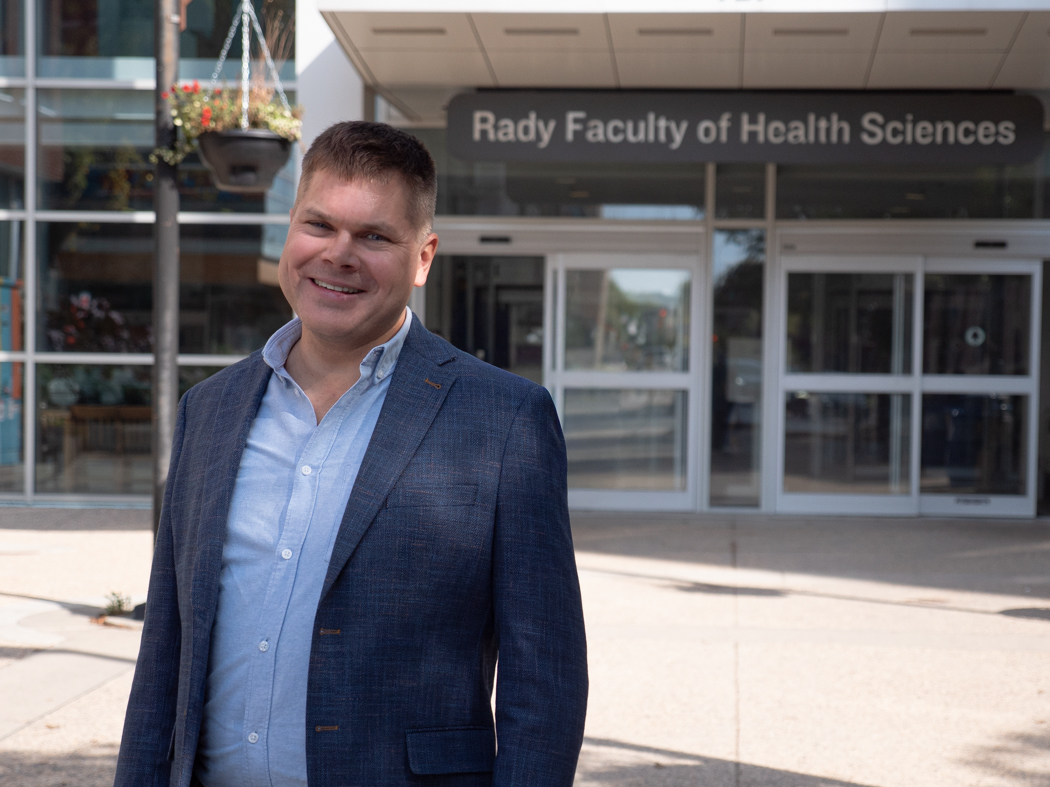
Barret Monchka stands in front of the Brodie Centre at the University of Manitoba’s Bannatyne campus.
AI-powered health data research by Rady PhD student aims to improve patient outcomes and privacy
Barret Monchka, a PhD student at the College of Community and Global Health (CCGH) in the Rady Faculty of Health Sciences, is advancing data linkage using artificial intelligence and improving patient data protection. His work aims to ensure more accurate research findings to inform health-care planning and policy.
Monchka, who holds a computer science degree from the University of Manitoba, is also a data analyst at the George and Fay Yee Centre for Healthcare Innovation (CHI) — a UM/Shared Health research unit.
He completed a master’s degree with the department of community health sciences (now CCGH) at the Max Rady College of Medicine and recently received a prestigious 2025 Vanier Canada Graduate Scholarship to fund his PhD.
We spoke with Monchka about his path to health sciences and his research.
What inspired you to pursue a career in health research and drew you to community and global health?
I worked as a software developer in industry for a few years before pursuing a joint role at UM with CHI and the Vaccine and Drug Evaluation Centre. That exposure to population health research sparked my passion for the field, and I’ve now been with CHI for 10 years.
I find it extremely satisfying to contribute to our understanding of human health and produce findings that inform health-care policy and planning. I also enjoy improving the methods we use to ensure research findings are reliable.
Can you tell us about your research and how it could impact health care in Canada?
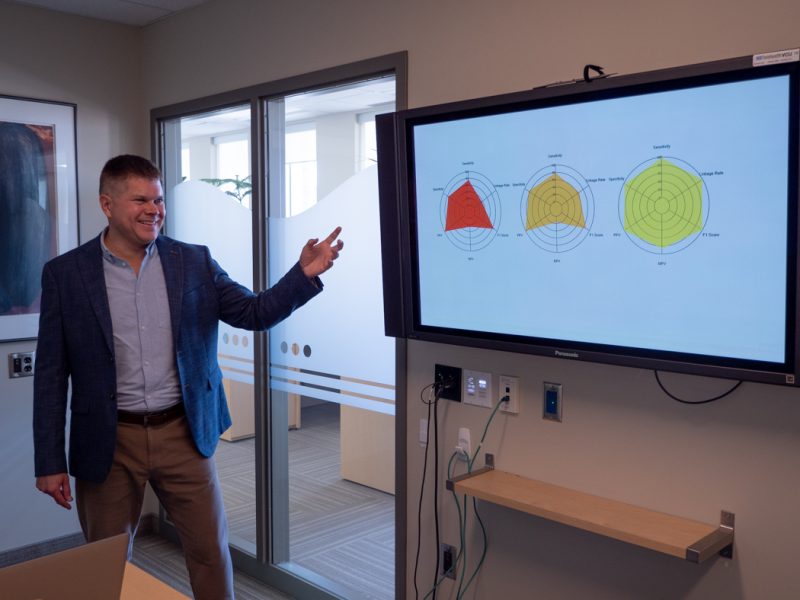
Barret Monchka presents his research in a meeting room at the University of Manitoba’s Bannatyne campus.
My research focuses on improving how we link data from multiple sources such as education and health records, using datasets securely accessed from the Manitoba Population Research Data Repository at Rady Faculty’s Manitoba Centre for Health Policy and Statistics Canada’s Research Data Centre. Better linkage helps us understand how social factors like education, income and living conditions influence health.
Linking data across systems is challenging. For example, schools and health-care systems use different identifiers, so we rely on non-unique information like names and birthdates, which can lead to mismatches. If these mistakes disproportionately affect certain groups — by gender or age, for instance — they can distort study results and worsen health inequities.
The development of AI models can improve these datasets to more accurately and equitably predict health outcomes. I’m also evaluating privacy-protecting techniques that encrypt personal information before linking, and assessing whether using AI to accelerate linkage increases errors or introduces bias.
How does your role at CHI complement your research at CCGH?
At CHI, our focus is on the patient’s perspective. Patients, caregivers and their families are involved in every step of the research process.
Patients are increasingly concerned about data privacy — how their personal information is used and who has access to it. Participants may be reluctant to join health studies if they feel their data isn’t secure.
In response to these concerns, I’ve spent the past few years at CHI investigating current data linkage practices and identifying key areas for improvement — work that laid the foundation for my PhD research.
Who has mentored you in your research?
CCGH faculty are experts in their fields, and I’ve been fortunate to learn from many of them. Dr. Lisa Lix, professor at CCGH and Canada Research Chair in methods for electronic health data quality, has been instrumental in guiding me. She’s helped me hone my research skills, especially in developing improved statistical and machine learning methods.
Dr. William Leslie, professor at the Max Rady College of Medicine and director of the Manitoba Bone Mineral Density Program, is a leading osteoporosis researcher. He mentored me in using AI for medical image analysis. We’ve worked on novel research projects to assess how AI can automatically identify vertebral fractures — fractures in the spine — in bone mineral density scans.
How has CCGH supported your learning?
CCGH has a strong reputation for producing outstanding graduates skilled in community health research — both qualitative and quantitative. The program gave me a solid foundation in applied biostatistics and quantitative epidemiology through high-quality courses and mentorship.
The college is very supportive of graduate students applying for competitive funding. The recommendations and advice I received from CCGH faculty were instrumental in helping me secure awards, including the Vanier Scholarship.