






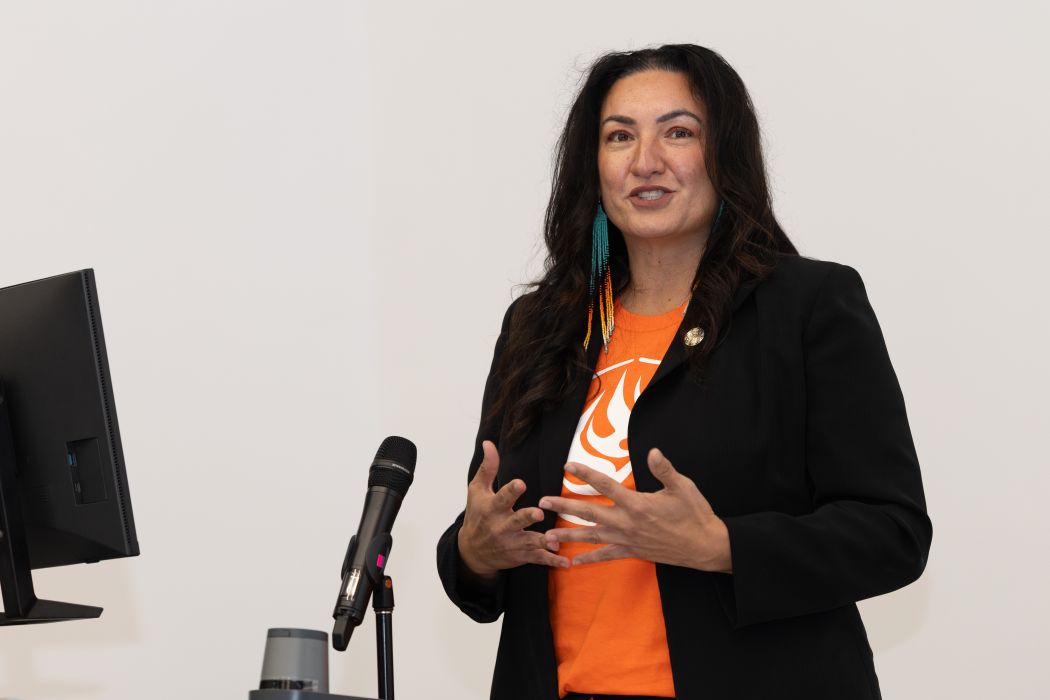
'Representation alone is not enough,' Dr. Angie Bruce, vice-president (Indigenous) of UM, said about the hiring of Indigenous faculty.
Rady symposium explores recruitment, retention of Indigenous faculty
Increasing the number of Indigenous faculty members at UM requires a strategy to ensure that they are not just hired, but valued and supported, speakers said at a symposium on Sept. 25.
“Representation alone is not enough,” said Dr. Angie Bruce, vice-president (Indigenous) of UM. “We must move beyond tokenism and towards a genuine commitment to inclusion, belonging and respect.”
Bruce was a keynote speaker at the day-long symposium on the Bannatyne campus on the theme “Reimagining the recruitment and retention of Indigenous scholars in the Rady Faculty of Health Sciences.”
The event was co-chaired by the Rady Faculty’s Dr. Peter Nickerson, dean, and Dr. Marcia Anderson, vice-dean, Indigenous health, social justice and anti-racism.
Reflecting the fact that about 20 per cent of Manitoba’s population is First Nations, Métis or Inuit, the Rady Faculty’s goal is for 20 per cent of faculty members to be Indigenous, Nickerson said.
Indigenous scholars will soon be hired for a new endowed professorship and chair, both in Indigenous health, he said.
In her address, Bruce said First Nations, Métis and Inuit faculty members often feel isolated and become exhausted from fighting to create space for Indigenous knowledge.
Some at UM, she said, have been criticized by their departments for incorporating Indigenous content into the curriculum. Yet at the same time, they have been pressured to teach Indigenous courses that are outside their academic discipline.
“Leaders must ensure that Indigenous faculty are not only welcomed, but are respected for their academic expertise,” Bruce said.
The current metrics used for academic promotion and tenure tend to disadvantage Indigenous scholars, speakers said. Giving faculty members credit for community service was suggested as one way to address this imbalance.
Indigenous academics who attain leadership roles become mentors who “light the way” and help newer Indigenous scholars to navigate the complex university bureaucracy, speakers said.
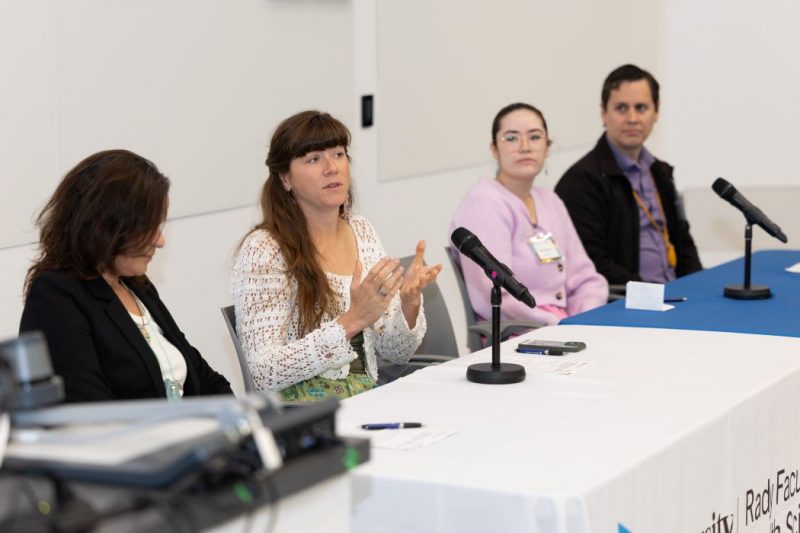
(Left to right): Panelists included physician Dr. Sara Goulet, occupational therapist Braydn Matheson, nurse Shayna Moore and pharmacist Derrick Sanderson.
Symposium panelist Shayna Moore, a Cree nurse who graduated from UM last year, recalled being inspired by Maori nursing leaders during an experiential learning trip to New Zealand.
“Their instructors were Indigenous, and their researchers. It allowed me to see myself in a position like that,” said Moore, who is now a coach for Indigenous students at the College of Nursing.
Many Indigenous scholars experience a “push and pull” between their academic responsibilities and their community obligations, speakers said.
Panelist Braydn Matheson, a UM-educated occupational therapist with ties to Peguis First Nation, said that during her studies, she had to take responsibility for a child from her community. She was fortunate, she said, that Indigenous faculty members were supportive.
Several speakers talked about masking their authentic identities in order to feel accepted in academia.
“I feel, every time I walk in this building, like I need to be somebody I’m not,” said Dr. Sara Goulet, a UM-educated Métis family doctor who is associate dean (admissions) of the Max Rady College of Medicine.
Goulet credited her success as a leader to support from other Indigenous faculty. “It is so important for us to have each other,” she said.
Derrick Sanderson, a UM pharmacy alum who is a member of Opaskwayak Cree Nation, said all UM students in the health sciences need to learn about the holistic Indigenous view of health.
The event’s second keynote address was given by two leaders from the University of Winnipeg (U of W): Dr. Pavlina Radia, provost and vice-president (academic), and Dr. Chantal Fiola, associate vice-president (Indigenous engagement).
They spoke about U of W’s recent “cluster hire” of nine Indigenous scholars.
That process, they said, included ensuring that hiring committees were trained in unbiased practices and cultural sensitivity; circulating job postings widely within Indigenous channels; verifying Indigenous identity as a condition of employment; and providing “wraparound support” to Indigenous hires.
Radia and Fiola said that in the future, they hope to see Elders and Indigenous community members represented on hiring panels. That’s currently not permitted under the U of W and UM faculty collective agreements.
Panelists Dr. Wanda Phillips-Beck, Indigenous Research Chair in Nursing and Seven Generations Scholar at the First Nations Health and Social Secretariat of Manitoba, and Dr. Linda Diffey, director of Ongomiizwin – Indigenous Institute of Health and Healing – Research, said the highest priority for many Indigenous scholars is to do research or clinical work that centres on their community’s needs.
“A lot of scholars want to have direct relationships and ties to their communities,” Phillips-Beck said.
The panelists called for transformative policy change at UM so professionals across all health disciplines can maintain clinical roles in communities while simultaneously holding faculty positions. Currently, only medical professionals have such flexibility.
For Indigenous alumni in professions such as nursing, working as a mentor, coach or preceptor (professional who supervises learners) in an Indigenous community could serve as a gateway to a Rady academic appointment, suggested panelist Melanie MacKinnon, executive director of Ongomiizwin.
“I wonder if … we have an opportunity to reframe what we mean by ‘faculty,’” she said. “We can start bringing them into our university community when they’re practising in community.”
The insights and ideas that were shared at the symposium will be used in formulating a strategy for the recruitment and retention of Indigenous scholars in the Rady Faculty, organizers said.