







Announcing the 2024 Green Investment Fund projects
Six innovative projects will help UM reach its sustainability goals
We’re marking a milestone for sustainable innovation at the University of Manitoba: the Green Investment Fund has entered its second successful year! From 19 strong proposals submitted by students, faculty, and staff, six projects have been selected for funding—more than double the number of initiatives awarded during the inaugural 2023 competition.
Building on the momentum of last year’s projects—like the LED retrofit at the Animal Holding Facility and a helium recovery system for nuclear magnetic resonance (NMR) spectrometers—this year’s cohort brings fresh energy and ambition to our Climate Action Plan’s four core pillars: waste, energy & buildings, transportation, and land use.
Each winning proposal stood out for its environmental impact, cost-saving potential, and clear plan to repay funds within the required 10-year window.
“This year’s submissions were truly inspiring,” says Raman Dhaliwal, Associate Vice-President (Administration). “We’re delighted to invest in six projects that will help us realize our net zero greenhouse gas emissions goals, while engaging the UM community in hands-on sustainability action in pursuit of our Climate Action Plan.”
Green Investment Fund projects
Fixing fume hoods
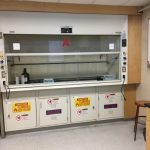
Fume hood.
Energy consumption from heating buildings is one of UM’s largest source of emissions, with labs being some of the highest energy consuming spaces on campus.
Fume hoods – enclosed workstations that exhaust harmful fumes to the outside environment – are an integral part of lab safety. Unfortunately, fume hood sashes are regularly left open after experiments are complete. Each fume hood sash left open can have more impact on greenhouse gas (GHG) emissions than leaving the front door of your home open in winter.
Two Green Investment Fund projects are tackling energy loss from fume hoods.
Shut your sash!
Most fume hoods are variable air volume hoods – which exhaust air in proportion to the sash height. Essentially, the higher the sash height, the greater the amount of air exhausted and the greater amount of energy used.
An educational campaign spearheaded by the Science Students’ Association, with support from Daniel Heschuk, program development specialist in the Faculty of Science, will highlight the high energy requirements of fume hoods, beginning with a university-wide “Shut your Sash” contest to build awareness and engagement. The Environmental Health and Safety Office is updating their Fume Hood Program to include training materials and new fume hood stickers to not only identify optimal sash heights for safety and lower-energy use, but to help advertise the Shut the Sash campaign.
With significant uptake, this project has the potential to realize annual energy savings of $342,600 and a reduction in greenhouse gas emissions by up to 1,000 tonnes annually.
Fume hood presence detection program
A walkthrough of select labs in December 2024 found all were left open after term had ended. If these had been left open during the winter break, they would have had a significant impact on energy consumption and GHG emissions.
The UM Fume Hood Presence Detection Program will install 79 fume hood presence sensors in Parker building 200 level undergrad labs, integrated with the fume hood control/exhaust systems.
When no user is detected near the sensor, the fume hood will reduce airflow through the fume hood, resulting in a reduction of energy needed to heat and move more air into the lab. This project is estimated to reduce energy costs by $59,250, decreasing UM’s GHG emissions by 160 tonnes annually.
Cardboard recycling for the win
Cardboard recycling makes up 40 tonnes of the overall UM waste stream. The current cardboard baler in the basement of Helen Glass is at the end of its lifespan, and replacing it, along with adding an additional cardboard baler at Pembina Hall, will divert even more cardboard waste from the landfill.
Baling cardboard reduces contamination in the recycling stream and earns the university a rebate. This project will reduce waste going to the landfill and save $9,640 annually.
Electromagnetic air filters
What if we could increase indoor air quality and reduce waste and energy consumption at the same time? A team from Operations and Maintenance is leading a project to replace traditional cardboard pleated air filters with electromagnetic filters which capture particles 40 times smaller than traditional filters and outperform HEPA filters at the viral range.
The pilot project in the Wallace Building will also reduce waste, since only the fiberglass filter media is replaced, meaning the entire filter doesn’t enter the waste stream. As the filters are more efficient, it is anticipated they will save 63,100 kWh (kilowatt-hours) of electricity annually, reduce demand on infrastructure and save $5,000 a year.
Lights, safety… parking
Upgrading the Bannatyne campus parkade with improved LED light fixtures and occupancy sensors will reduce the energy consumption of the parkade by more than 130,000 kWh/year, while providing a safer parking experience for both those driving and walking in the parkade. As a bonus, maintenance costs will be reduced by a further 50 per cent, for annual cost savings of more than $10,000.
Smart heating and cooling
This pilot project will see the installation of data acquisition devices on a variety of existing heating and cooling sensors on equipment in three buildings: EITC-E3, Biological Sciences and UMSU University Centre. Using an algorithm, pattern recognition techniques and machine learning, the system will highlight areas where energy consumption can be decreased, equipment efficiency will be improved and mechanical issues will be detected quickly, extending the life of the equipment. This, in turn, will enhance comfort in heating and cooling.
Energy savings of at least two to seven per cent are projected. These energy reductions will reduce greenhouse gas emissions, energy use, water use, waste and demand on infrastructure, with projected annual cost savings between $21,000 to $76,000.
Got a project idea?
This year’s application period for the UM Green Investment Fund will be opening soon! Keep an eye on UM Today for all the details.
If you have any questions about the Green Investment Fund or its projects, reach out to greenfund@umanitoba.ca.