






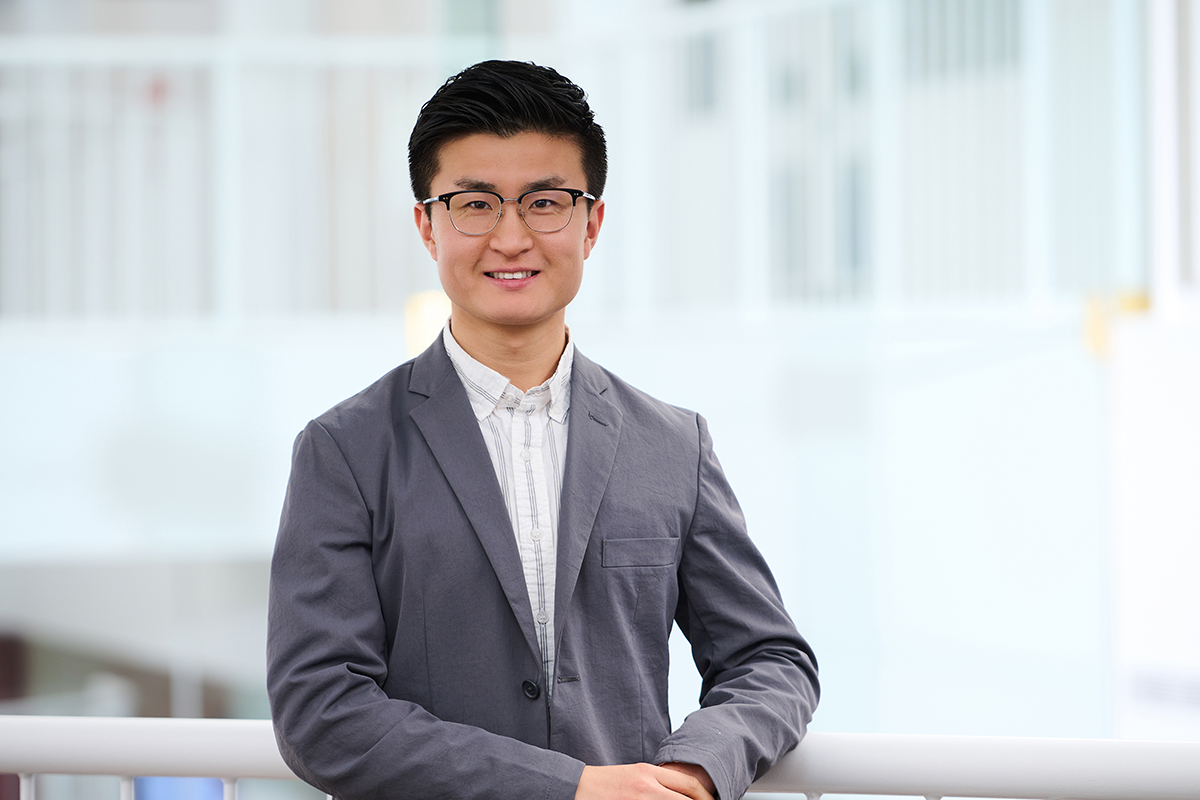
Wenxi Pu
World Mental Health Day – A Conversation with Asper Dean of Teaching & Learning, Wenxi Pu
Asper School of Business Associate Dean of Teaching & Learning and The Asssociates Fellow in Innovation, Wenxi Pu, can’t stop thinking about what we’re thinking about when we use technology.
On each annual World Mental Health Day, technology’s role in our lives changes. While the promise of technology has been to bring us closer, what we see in countless articles, books, and just everyday life, is that technology has driven us further apart, leaving us stressed and lonely.
Through the Asper School, Pu is on multiple research projects at the cross section of technology, mental health, and business, but with a positive spin. He’s on the forefront of figuring out how we can use these tools in an ethical, positive and responsible ways that promote mental health, or as he might say it, “looking inward.”
What effect has rapidly advancing technology had on our mental health?
Right now, everything is becoming metrified. And AI learns from that.
Think about friendship. It used to be only “we’re good friends, we share some common hobbies. We like each other, I feel good when I’m around this guy.” Now it’s how many likes, how many followers you have, how many mutual connections. That now seems to decide the value of your social worth.
There’s this term called the McDonalization of friendships. Everyone wants the fast track, when a real friendship requires more time, more energy.
In the future, when you apply that to mental health, it collapses the complex question of “how do you feel?” into something like “your depression is at a two, it needs to be at one.” Think how employers could use that data against us for the purpose of efficiency. “Your depression is at a three? That’s too high. You need to take a few days off.”
What I’m studying now, is, how can we stop moving in that direction.
Are there ways in which we can use technology like AI and social media in a positive way for our mental health?
I don’t want to undermine the detrimental effects of social media and AI on us. Our human mind is trained to get distracted, right? It’s a vicious cycle. Because of your short attention span, you can’t get any work done. You get stressed. You go to social media to come down. You get a shorter attention span. You get more stressed. On and on.
AI is a turbocharged version. Social media is like “you like this post? I’ll show you this.” It just wants your attention. AI is worse because it always wants more. When you ask for help creating something, it’ll do it then ask, “do you want a visualization of that?”
But on the other side, we can design a human-centred AI in a way that promotes mindfulness, right? It can say, “you don’t have to chat with me, go outside for a walk or chat with a friend. Give your family a call.”
It’s the same with social media. Both are such powerful tools that you could use them effectively to promote, say, deepening your offline relationships.
What kind of critical thinking should we do as these technologies become more prevalent in our day-to-day lives?
You have to realize that technology is pushing us to look outward. You got X amount of likes, rather than how you really feel.
Even this conversation, as it’s being recorded, AI is going to give you bullet points of the transcription, but is that all we really are? Bullet points? No, there’s a richness to this conversation that isn’t really being captured by that.
Before we had cameras, when we would look at something really new, we would just look at it, right? Imagine seeing an elephant for the first time, looking at the trunk, the big ears, everything. That’s great for our mental health. Now what do we do? We take a picture that you’ll probably never look at again, then we move on.
So that’s why I encourage everyone to look inward.
What is something positive people can try on World Mental Health day?
Personally, I would highly encourage people to meditate. I think we can incorporate that as part of our daily routine, to really understand ourselves.
Typically, I wake up one hour earlier in the morning, and just sit there, focus on my breath. Watch my thoughts go by.
—
The Asper School of Business aims to expand global knowledge and engage in intellectual exploration to advance teaching, learning, and research. Our researchers’ scholarly work is regularly published in internationally renowned publications.
Be part of this flourishing research culture and learn more about research programs in management (MSc and PhD) at the Stu Clark Graduate School here