






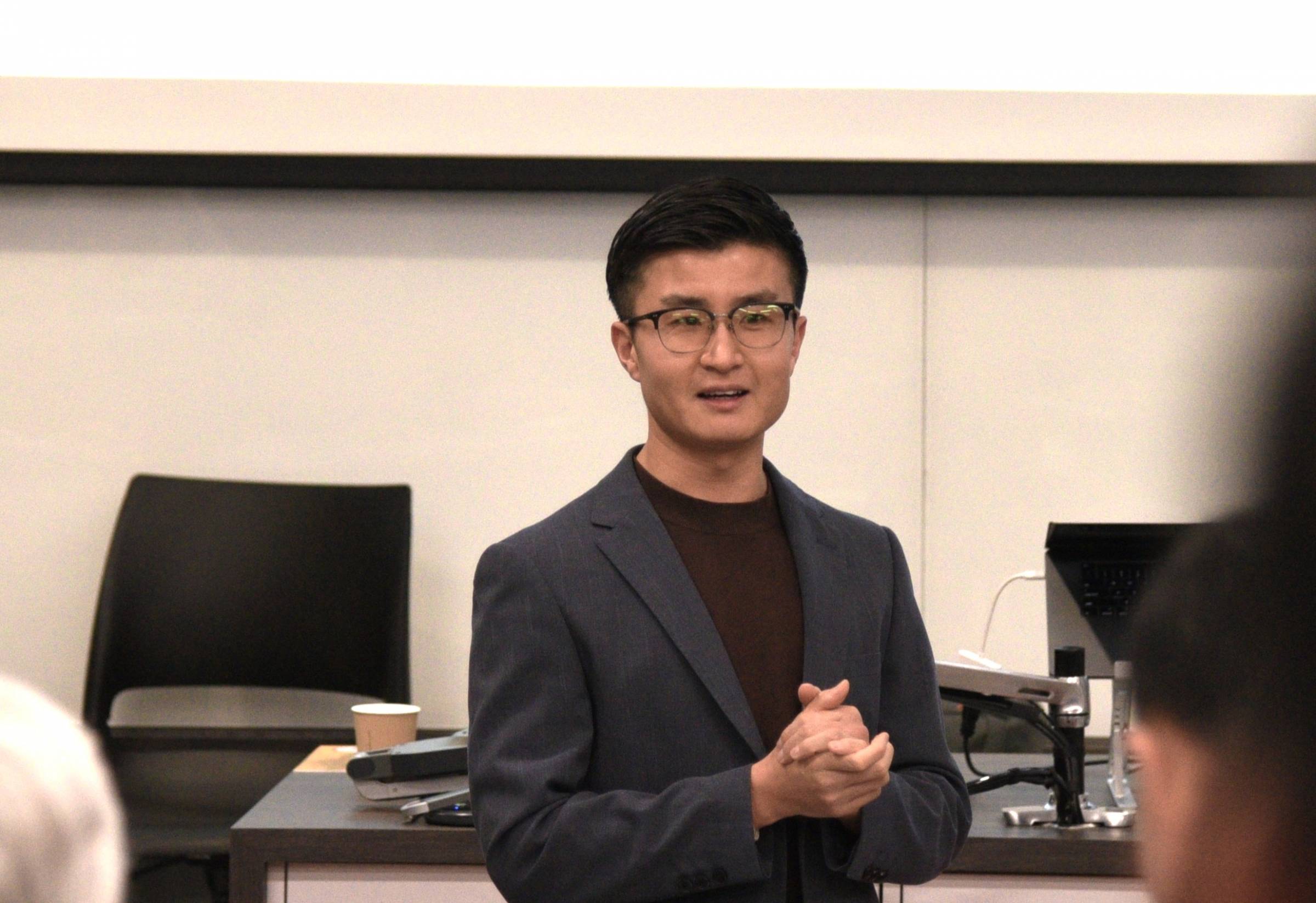
Wenxi Pu speaks at Reg Litz teaching day
Thinking Human at Reg Litz Teaching Day 2025
In what would prove to be a perfect introduction to Reg Litz Teaching Day, Judy Jayasuriya, Asper School’s case competition coach, spoke about her experience when Reg Litz was her professor.
She remembered that on the first day of a long 8 a.m. class, Litz knew everyone’s name by the afternoon. He would recall small details students had mentioned in passing, such as a trip they were going on, and warmly ask about them later on, to their surprise.
The impact of those small interactions was not lost on her, as she looks back now as an educator.
“It’s those small ways that you bring those barriers down between an educator and a learner,” Jayasuriya said “When you become comfortable with people and you’re willing to talk about your vulnerabilities in a way you wouldn’t when you have your guard up.”
Annually, Asper School of Business faculty comes together to celebrate Reg Litz teaching day, named in remembrance of Litz.
Programmed by Asper Associate Dean of Teaching & Learning, Wenxi Pu, this year’s topic, Business Education in the Age of AI Agents: Designing Human-centered, Process-Oriented, and Experiential Learning, probed educators to start thinking in new and different ways about how AI shapes the classroom.
“As business educators, we need to start exploring options and alternatives for the age of AI agent, to make education more human-centred, process-oriented, and experiential. Students are at the heart of everything we do, and we are committed to fostering their academic excellence through changing times,” said Pu.
Dean of the Asper School of Business, Dr. Bruno Silvestre, said, “this is one of the most important days on the academic calendar, as it brings together all Asper teaching staff committed to teaching excellence to engage, learn and share their experiences, challenges and trends related to the rapidly-evolving business teaching area.”
Litz’s human-centered, caring philosophies weaved through the day, as the presenters consistently came back to the idea of thinking human first amidst the noise of technology.
Where are we headed?
Keynote speaker Wei Chen, Associate Professor of Operations and Information Management at the University of Connecticut, strikingly depicted the new capabilities of AI and asked challenging questions.

Wei Chen. (Peter Morenus/UConn Photo)
First, he tracked the history of knowledge: from a preserver age where humans collected libraries of various knowledge; to the producer age during the industrial revolution, where humans took a more active role in testing hypotheses through experiments; to now, the evaluator age, where “AI generates, we evaluate.”
Demonstrating the evaluator age, Chen played a song created by the AI song generator Suno. One of his students, a mother prompted the AI for an emotional song about the love she feels for her kids (with lyrics such as “hold on little ones, we’ll be alright”).
Despite Suno’s flawless creation of piano and voice, the song fell flat. There was some kind of emotional dimension that Chen knew we were missing.
“I put this example here to say that these technologies are becoming increasingly good,” he said. “But it is a human emotion and human evaluation that determines the quality, or how well-received the generated product will be.”
The lesson: authenticity in human thought and emotion is more important than technical impressiveness.
Another example demonstrated how AI can help us critically think, instead of taking away our ability to do so. Chen showcased a “co-thinker” that leverages ideas not by offering its own, but by interrogating the idea you’ve given and asking you questions you may not have thought of.
The topic of AI offers us many chances to get existential and spiral into scary versions of the future. Critical questions Chen asked, like “how do we know we’re teaching students the right lessons for the future job market?” or “who evaluates the evaluators?” invite our minds to wander into dark places.
Instead, thinking of their compassion for students and their challenges, the room was invigorated by the next obstacle to overcome.
—
At the Asper School of Business, students thrive thanks to a strong commitment to teaching excellence. Asper’s intimate class sizes and dynamic course offerings provide opportunities to exchange ideas and dig deep into the issues and challenges of today’s business world. Learn more about programs of study, from undergraduate and research, to professional and executive programs here.