






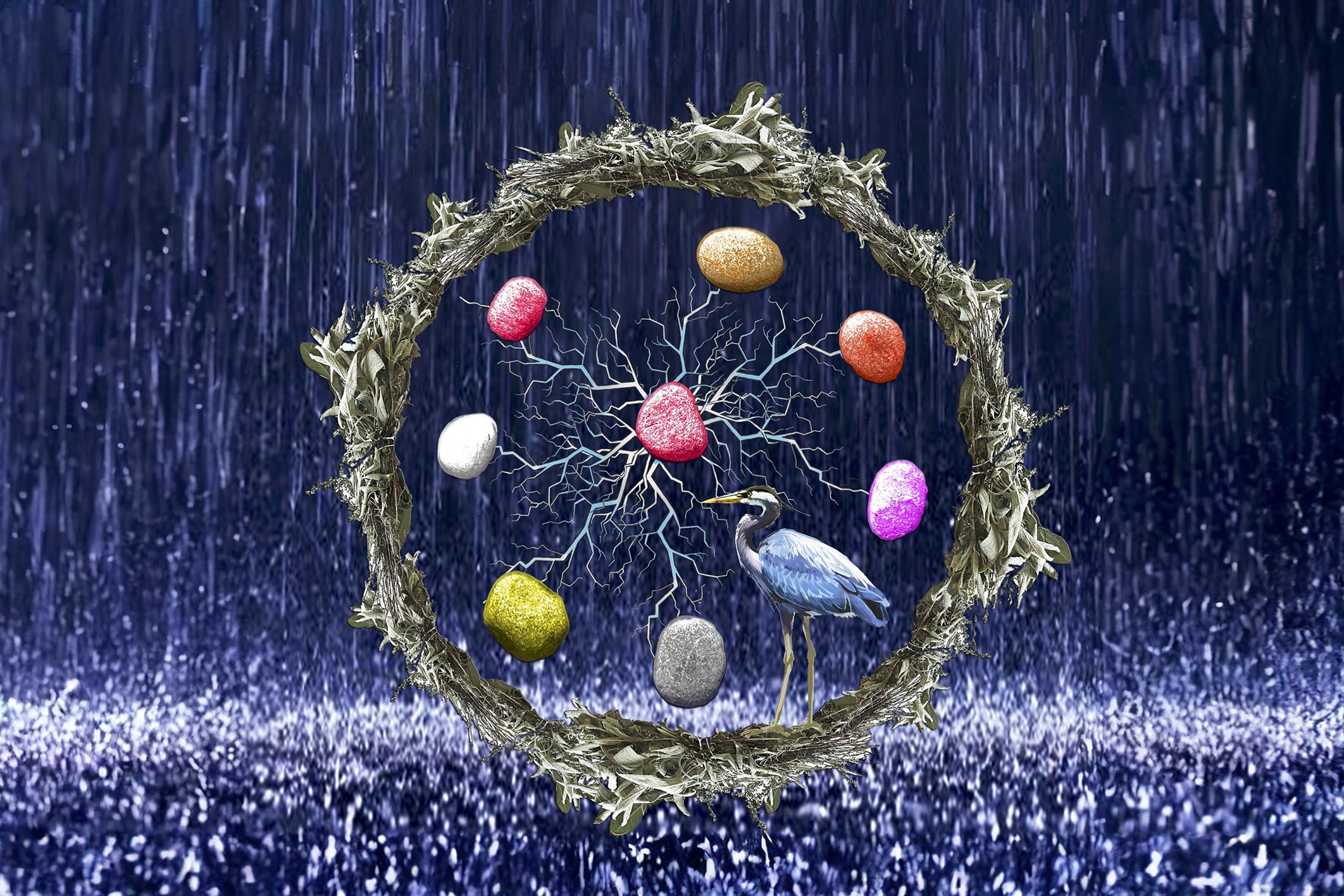
The artwork, created by Leah Fontaine, a PhD student in the Faculty of Education, visually represents the words and image Grandfather received through ceremony.
Taking the Blue Heron Pathway to Education
Access students invited to pursue a career in Education
On a beautiful summer day, members from both the Access Program and the Faculty of Education gathered on the land of Unkan Wanbdi Wakita, the Dakota Grandfather-in-Residence of the Access Program, for a ceremony to name the new pathway for students interested in a career in teaching. From the ceremony, emerged the newly adopted official name of the partnership program, which the Access Program and the Faculty of Education unveiled on Monday, September 22: Hoka Canku – the Blue Heron Pathway to Education.
Reflecting on the meaning of teaching
According to Dakota teachings, the Hoka, or Blue Heron, symbolizes patience, grace, balance, and determination – qualities that not only embody the role of teachers but also serve as central themes in EDUA 1790 Introduction to Teaching, a course offered exclusively to students in the Access Program. First offered in Fall 2024, the course invites students to explore a career in teaching, reflect on the purpose and meaning of education, and consider its impact on communities. Marti Ford, an Associate Professor and Associate Dean (Indigenous Education) in the Faculty of Education, who taught the first offering in Fall 2024, relates the significance of the course to her own experience: “I was planning on going into medicine. But I wanted time to focus on being a good mom. I wanted to help the Indigenous community. Education was the way to go. Education is such an important career. You can do so much with it. You can make changes in your own community. You can provide children with opportunities. If they have people to guide them, they can see what they can be, and they can do anything.” That sense of purpose resonates with many students. Saige Marchand, a second-year Access student with Métis roots, chose to participate in the course for similar reasons: “I knew I wanted to join a field of study that involved helping others. Education provides help and care to people of a wide range of backgrounds and experiences.” Taking the course allowed Saige to “meet people within the Education field that gave me knowledge and insight into the world of Education.”
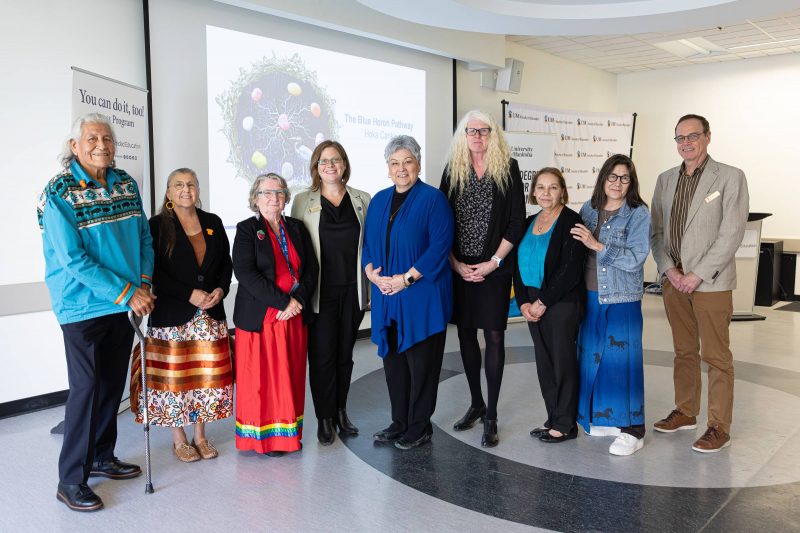
The Access Program in Extended Education and Faculty of Education unveil the name of the new pathway.
Building relationships
Beyond the introductory course, the Blue Heron Pathway offers Access students ongoing opportunities to deepen their connection with the Faculty of Education. Joint information sessions led by advisors from both Access and Education, networking luncheons with Education faculty and staff, as well as workshops with teachers in the field – some of them former Access students – help foster a sense of familiarity and belonging that inspire students and strengthen their commitment to pursuing a degree in Education. Throughout their academic journey, students continue to benefit from the holistic supports provided by the Access Program, which include personal counselling, spiritual guidance, and academic skill building – all of which contribute to their success and well-being as they work toward completing their first degree. With its strong emphasis on community building, the Blue Heron Pathway also models a core value of teaching. Jordan Flett, a third-year Access student from Norway House who hopes to return to his community as a Physical Education teacher, recalls how meaningful student-teacher relationships shaped his own school experience: “When I was in high school, I used to notice students with their teachers and how the students were full of joy. There are teachers who have that friendly, conversational, and honest attitude that kids can go and talk to. I want to be one of those teachers because they make school more enjoyable and comfortable.”
Supporting the needs of Indigenous communities
The initiative could not be more timely. “It is always an honour to guide students toward the teaching profession,” says Diedre Desmarais, Director of the Access Program, “but right now, our communities are in desperate need of these trained individuals. We are so happy to be a part of this initiative that has been years in the making.” Jan Stewart, Dean of the Faculty of Education, also stresses the need for action: “We have a serious shortage of teachers in Manitoba as well as across many parts of the country. This is particularly critical for our Indigenous communities and rural areas of Manitoba. Indigenous students need to see themselves better reflected in the schools that they attend and in the curriculum that they study. If we can encourage more Indigenous youth to be teachers, we will also be building the foundation for our next generation of educational leaders, policy makers and school administrators.” This message is not lost on students pursuing the Blue Heron Pathway – many of whom plan to return to their home communities after earning their Bachelor of Education degree. By centring the pathway in traditional Indigenous teachings, students are able to integrate both disciplinary and cultural knowledge while experiencing education through an Indigenous lens. Gherie Swampy, a student from Sagkeeng Anicinabe Nation who worked in her community as an Educational Assistant prior to joining the University of Manitoba and hopes to return as a teacher, recalls one of the most powerful moments on her journey: “My most memorable experience was sitting down and listening to Elder Mary Courchene talk about her experience as a First Nations educator and what inspired her. I loved listening to her life story and what she has overcome throughout her lifetime to achieve the things she has. This helped me bring to light the kind of educator I would love to become one day.”