






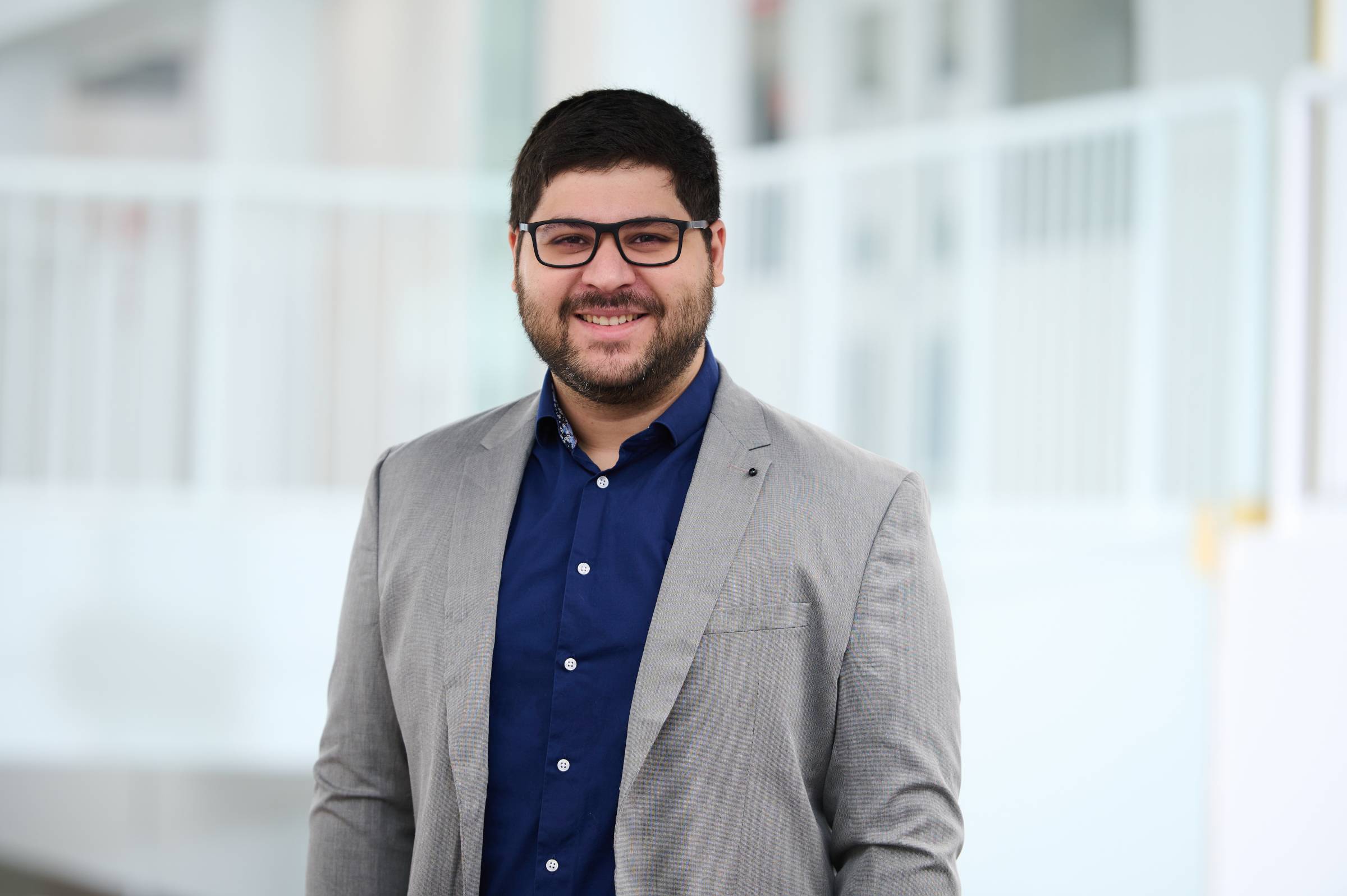
Minelle Silva, Professor of Supply Chain Sustainability and the Director of Sustainability at the Asper School of Business
Seeing the Supply Chain as a Chain of Relationships
Asper Professor and Director of Sustainability Minelle Silva publishes a years-in-the-making research article in FT50-ranked publication
Oftentimes the world of supply chain management is thought of as a world of numbers and things. Crates passing through stops. But what if it’s hiding a surprisingly emotional layer behind a wall of ones and zeroes?
Minelle Silva, Professor of Supply Chain Sustainability and the Director of Sustainability at the Asper School of Business, has an answer to that question.
His article, Switching the Telescope Lens: A Sociomaterial Perspective of Sustainable Agricultural (Proto)Practices Transfer in an Agrifood Supply Chain, who he co-authored with Karina Santos and Susana Pereira of FGV EAESP in Brazil, and Linda Hendry of Lancaster University, was recently published in the FT50-ranked Journal of Operations Management.
Getting the article published in such a highly regarded journal was a homecoming for Silva. Despite understanding how challenging it is to get a qualitative article in, his team worked hard to get it there.
“I think we were a bit bold in trying to bring a different approach to this specific journal, but of course, it was accepted in the end. […] This paper is a bit special because it’s qualitative research with a different theory, in a different field,” says Silva.
The Sociomaterial Perspective
While most articles in this field focus on quantitative research and modeling, Silva’s is focused more on sociology-related theory. The distinct perspective employed by Silva’s team differentiated their article the majority of supply-chain-related pieces.
He and his team use a “sociomaterial” perspective as the lens for this article.
This perspective sees the supply chain not just as a group of things moving from one place to another, but also recognizes it as a group of people who move things from one link of the chain to the next, who inevitably create a web of social and emotional implications along the way.
“It’s bringing real life to those relations. […] we cannot just think about what is happening, but why is this happening? Who is the person carrying this?” says Silva.
Silva and his team analyze how Sustainable Agricultural Practices (SUSAPs) in the Brazilian Agrifood industry spread through the supply chain via people, social relationships and emotional attachments.
He zooms in on the example of how a caring and cruelty-free relationship between a farmer and chicken creates sustainability. “We had cases of farmers saying ‘Ok, I know them by heart, I know everything happening, I raised them.’ So there is some emotional elements, attachments and other things that are not usually there.”
These are big ideas, and it took a big amount of time to gather everything they needed and effectively communicate the ideas. Starting in 2019, they spent three years collecting data, a year-and-a-half writing and making revisions, finally being published in May 2025.
The Boomerang Effect
Their findings use the metaphor of the “boomerang effect” to explain how SUSAPs best work their way through the supply chain. They found that first-tier suppliers (the large organizations who manage farmers) have the most ability to make the supply chain more sustainable.
Theoretically, when first-tier suppliers make an intentional commitment to sustainability (throwing the boomerang) it becomes an infectious idea that works its way down the chain and comes back to them in the form of healthier business.
“Usually the literature says that the buyer [such as a grocery store] is the most important part of the supply chain because they have power and influence,” says Silva. “But we found here that if they don’t have a very good supplier in the first level, the products won’t flow in the way they want. The products won’t become as sustainable or healthy as expected.”
Don’t Look for the Easy Way
Getting published in Journal of Operations Management is an achievement Silva is “really proud” of. Publication here clearly shows that the paper brought something innovative to the sustainable supply chain story.
He plans to keep innovating: “I like the idea of bringing the subjective into an area that is highly objective,” says Silva.
When asked if he has advice for students doing their own research, he says, “Don’t look for the easy way. If it’s too easy, something’s wrong.”
And it’s true—Silva and his colleagues fought an uphill battle. They won.
_______
The Asper School of Business aims to expand global knowledge and engage in intellectual exploration to advance teaching, learning, and research. Our researchers’ scholarly work is regularly published in internationally renowned publications.
Be part of this flourishing research culture and learn more about research programs in management (MSc and PhD) at the Stu Clark Graduate School here.