






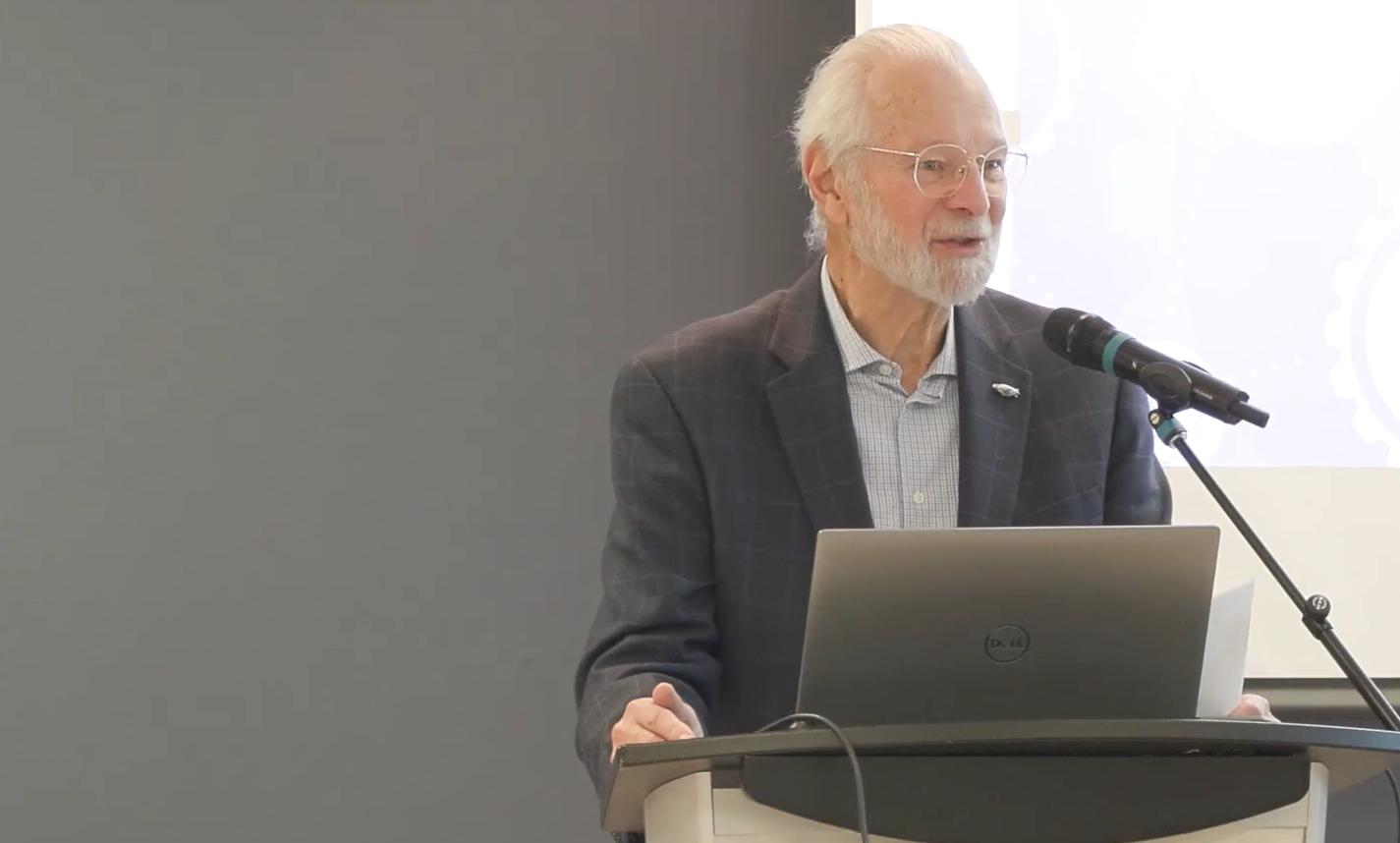
University of Manitoba Transport Institute Director Barry Prentice
Protectionism, Diversification and more at the 30th Annual Fields on Wheels Conference
October 8th, 2025, marked the 30th Fields on Wheels conference, an annual meeting hosted by the University of Manitoba Transport Institute (UMTI) at the Asper School of Business, that brings together practitioners and academics exploring modern supply chain management challenges in agriculture and food production.
This year, the topic was an undeniably topical one, “Taxing Trade: Implications for Agriculture and Transportation,” focusing on the United States’ threat of tariffs against Canada and other countries.
Introducing the topic at a podium, Professor in Supply Chanin Management and Director of the UMTI Barry Prentice remarked that trade with America has gotten “a little unusual, perhaps because of the unusual person in the White House.”
However, as easy as it would’ve been to say “tariffs are bad” over and over again, guest speakers consistently urged the conference’s highest-ever attendance of over 250 to think past the easy narrative.
Diversification in the age of Tariffs
While indeed the speakers echoed the detrimental effect of tariffs on our supply chain, political relationships, and economy, the message was ultimately a more positive one: to counter protectionism, we have to diversify.
To diversify is to expand operations, and find new streams where farmers, suppliers and distributors can create new value and profit—in this case to offset U.S. tariffs.
Cam Dahl, General Manager of Manitoba Pork, and Brittany Wood, who oversees Trade and Transportation at Canada Canola Growers Association, both touched on potential solutions. These included increasing sales to different countries, offering new products and lobbying with the Canadian government.
Small changes can be enough to make a considerable difference. However, Dahl acknowledged that major industry-wide changes would be nearly impossible with over 400 Canadian agriculture organizations trying to advocate for different agendas.
When someone in the audience asked him how these organizations would collectively work together to diversify in the face of new tax and tariffs, he said, with a laugh, “Of course, that’s completely unanswerable.”
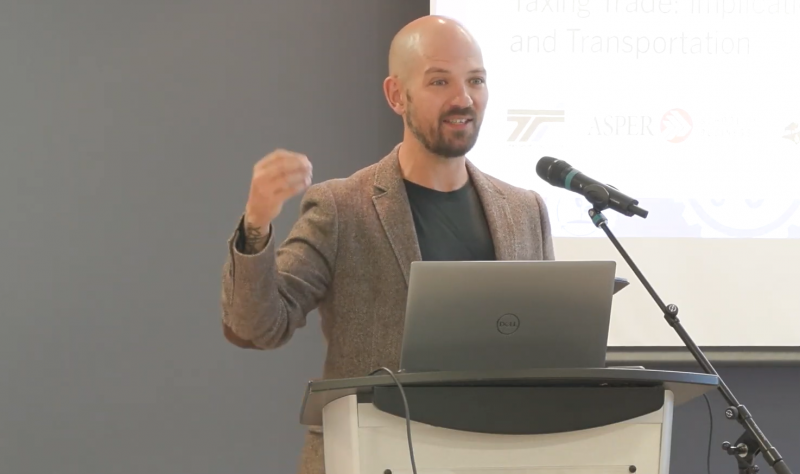
Michael Mikulak
Buying Local
Consumers also have the power to change the game, and diversify—by buying local.
However, Michael Mikulak, Executive Director of Food & Beverage Manitoba, explained that buying local, though great overall, is a concept that has been oversimplified to the point where it does undue damage to the agriculture industry.
“We have to resist the urge to believe in silver bullets that are going to fix everything,” he said. “We can’t eat our way out of this problem.”
He explained that when you buy locally—on one hand, you’re being inclusionary, but on the other hand, you’re being exclusionary. It’s better to a variety of local foods and imports (even from the United States, who will “not be replaced” in our economy) as well as investing in local agriculture infrastructure, which ultimately grows the economy for everyone.
Food is one of humanity’s greatest connectors, he said, so we can’t let it start to divide us.
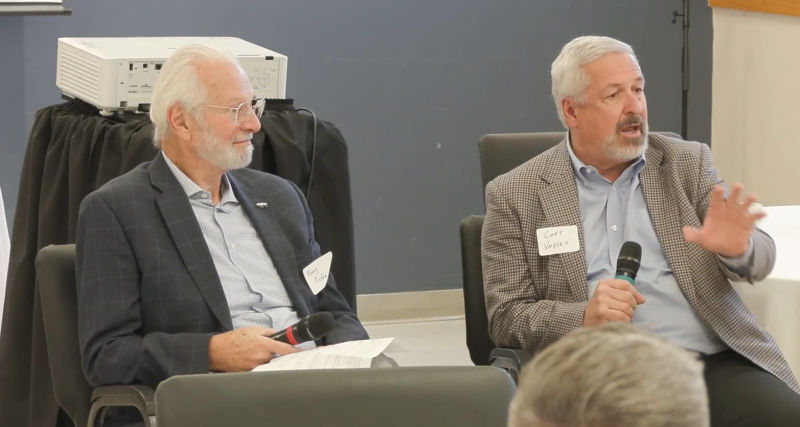
(L-R) Barry Prentice and Curt Vossen
Buyer Beware
At a noon-hour casual discussion, Former CEO of Richardson International, Curt Vossen, and UMTI’s Prentice joked that they should “write a history book together.”
Speaking about tariffs, they rooted themselves in their deep collective knowledge of their field to refute the notion that tariffs were going to be a knockout blow to the industry.
“Trade is going to get intermingled with geopolitics. Buyer beware,” said Vossen.
Vossen shared stories of similar trade times during his tenure as CEO of Richardson International, where he navigated intense trade barriers with China and other world powers.
Prentice added the industry saying: “Wheat is 13% protein, 87% politics.”
Prentice also encouraged us to look elsewhere for perspective, saying that in Europe, roundup-ready canola can’t be used for human consumption. “That’s a 1000% tariff, if you wish.”
“As we start looking at tariffs, we say, well, what about the non-tariff barriers?” he said.
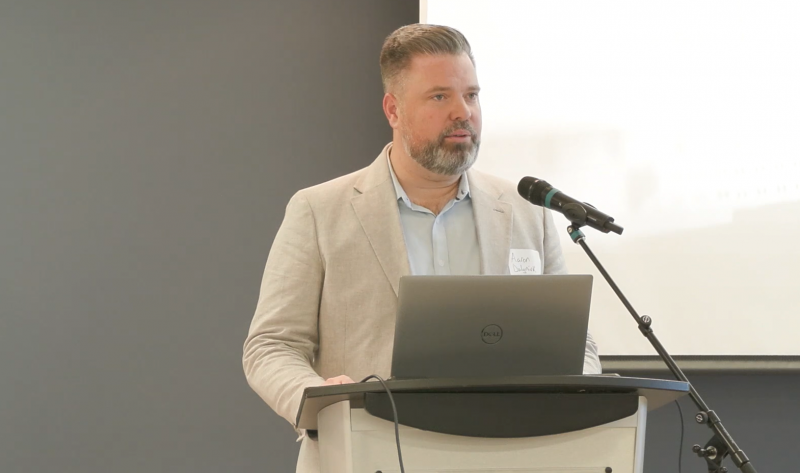
Aaron Dolyniuk
Repairing the Transportation industry
Presenting on the trucking industry, Manitoba Trucking Association Executive Director, Aaron Dolyniuk painted the trucking industry in the image of the wild west.
He described a dangerous world that, still reeling from COVID, has developed a cancerous strain of labour exploitation and human trafficking, where bad actors in management roles take advantage of the industry’s lack of proper paper trails.
Because of poor or non-existent record keeping and a lack of guardrails, bad actors are maliciously forcing these unqualified drivers into unsafe work and underpaying qualified ones. Dolyniuk proposed many changes to the industry, including a higher level of government regulation and qualification standards, but the first step, he said, is spreading awareness.
30 years of Fields on Wheels
At the very first Fields on Wheels, 30 years ago, Barry Prentice, who started the conference and remains director of the Transport Institute, prematurely called it “the first annual Fields on Wheels”—only for it to go on for decades.
“I guess I wasn’t wrong in my aspirations,” he joked.
“The idea of Fields on Wheels was to create a better bridge between the university, the commercial sector, and the government,” he said. “You find out what’s really going on, not just what you might read in the newspaper on a Sunday.”
Other than some academics-only meetings, Fields on Wheels is the only conference of its kind in Canada, where the more everyday issues of the industry are addressed. This is an important note because the agriculture industry is “the largest source of manufacturing in the country, by a long shot,” Prentice said.
Yet—according to him, it doesn’t get the attention it deserves. “If you walked into Tim Horton’s and asked what was the biggest manufacturing industry in Canada, no one would be putting up agriculture and food.”
Prentice has been around for a long time, and loves joking about that fact. He talks about old stories, like the harsh uncertainty of COVID of a few years ago, or the “grain wars” of decades ago, in the same way veterans speak of world wars.
In three decades of Fields on Wheels (and more to come), he’s starting to notice that issues arise, then they go away, like the seasons or the tides.
“Nowadays, it’s the grain supply chain is almost boring,” he said in an interview. But he’s joking. He’s a true lover of the industry, and he certainly does not believe that.
—
In recent years, past Fields on Wheels conferences have been recorded and available to watch publicly as webinars. Click here to find these resources, as well as journal publications, and information on future events from the Transport Institute.