






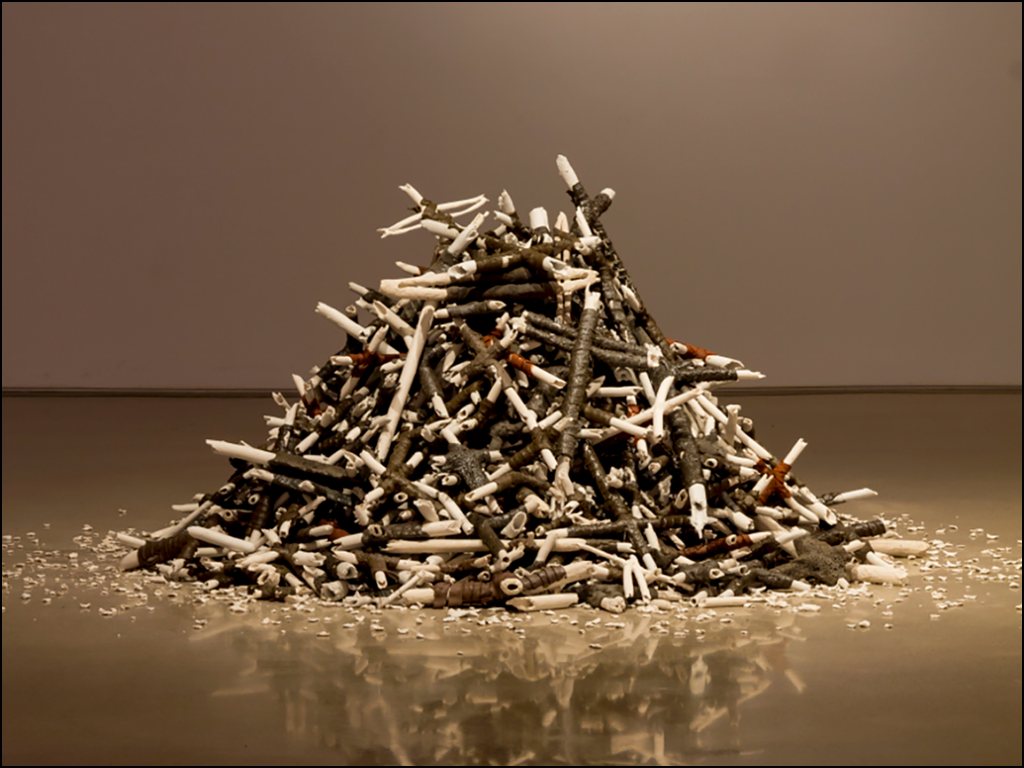
Monica Mercedes Martinez, everyone is fallen except for us fallen, School of Art Gallery, 2012. Photo credit: Larry Glawson.
Honouring the life and work of artist and MFA alumna Monica Mercedes Martinez (1974–2025)
Monica Mercedes Martinez (January 26, 1974, to October 22, 2025)
It was with great sadness that the School of Art at the University of Manitoba learned of the passing of Monica Mercedes Martinez on October 22, 2025. Monica was one of the first students to receive her Master of Fine Arts degree at the University of Manitoba. She and three others made up the first cohort of graduate students in fine arts when the new MFA program began in 2010. Monica Martinez graduated in 2012.
 Monica’s thesis exhibition, installed in the School of Art Gallery in ARTlab in 2012, was powerful and poignant. Referencing her Chilean background Monica created hundreds of porcelain bones wrapped in red earthenware clay and stacked them up into a mountain-like shape on the gallery floor. Her thesis exhibition titled everyone is fallen except for us fallen… represented the skeletons of those tossed out of helicopters above the Atacama Desert during the reign of Augusto Pinochet, military dictator of Chile from 1973 to 1990. Monica moved from Chile to Alberta when she was three years old. She talked about inherited generational trauma, and her thesis exhibition allowed her to dive deeply into reflecting on her cultural history and the impact it had on her family. “As a Chilean who grew up on the Canadian Prairies, she uses her practice to discuss the historical foundations that influence how we define who we are and where we belong” (returnatacama.com/whoweare).
After graduating Monica helped found a group of female Latino artists who called themselves Mujer Artista, a new initiative in 2014 designed to develop opportunities for local Latin women artists in Winnipeg. Monica Martinez participated in several group exhibitions and performances at Ace Art Inc. in Winnipeg’s Exchange District under the auspices of Mujer Artista.
In 2016 Monica travelled to Chile with a group of women artists known as CONSTELACIONES with the intention of burying her MFA thesis exhibition in the Atacama Desert, performing “a ritual of return, remembrance and witness” (returnatacama.com/performance/chile). Six large boxes filled with sculptural forms created by Monica to honour and remember the lives affected by the 1973 coup in Chile were returned to the desert in a performance piece titled Return Atacama. “Returning these symbols of grief, violence, and time to Chile completes a journey that began with Monica’s family’s exile . . . ” (returnatacama.com/performance/chile). One of the participants in the performance states of her experience: “Return Atacama dramatizes trauma memory as it is evoked by Martinez’s sculptural figures, abstract forms embodying the tension between disappearance and trace, resuscitating the bones of the desaparecidos. Their material hybridity—red terracotta and white porcelain—and textured surfaces are inscribed by her personal and collective memories that speak to her ‘mestizo identity’” (returnatacama.hemi.press/chapter/return-to-atacama-an-incomplete-alphabet-of-bearing-witness).
While studying in Winnipeg Monica formed many professional and personal relationships. Her warmth, kindness, and generosity was felt by the art community as she shared her inventive and unique art practice presenting work that was deeply provocative, challenging, and often interactive. Monica’s public interventions, such as Softening the Line (2014), where she encased a wrought iron fence in Winnipeg’s north Main Street area in red clay, brought attention to social and cultural lines that demarcate unspoken boundaries not to be crossed. An image of Monica pinching plugs of wet red clay onto the fence in the red-stained snow around her appeared on the cover of the Winter issue of Cahiers métiers d’art = Craft Journal, wherein Monica also contributed a review of an exhibition titled Saves Nine at the Manitoba Craft Council in 2013.
In 2021 Monica Martinez was included in a chapter written by Heidi McKenzie in Craft is Political (edited by D Wood, Bloomsbury Press). In her essay McKenzie wrote about the work of three Canadian mixed-race ceramic artists of colour, “Liminality: The Work of Monica Mercedes Martinez, PJ Anderson, and Habiba El-Sayed.” In the essay Monica is quoted saying, “The conversations I’ve had with the curious, the confused and the outright hostile people who observe my work are essential because, to me, art is a living thing that should make you question. When I develop new work, these conversations revolve in my mind” (email correspondence with the author, October 2019). In an exhibition at the Canadian Clay and Glass Gallery in Waterloo, Ontario she performed containher (2019). Standing inside a cage, pressing wet, red clay into the chicken-wire enclosure, Monica gradually disappeared from the viewer’s gaze as she continued to work from the bottom up. It was important to Monica to draw attention to the messiness of the making process by performing it publicly, standing in stark contrast to the orderly presence of the finished artworks pristinely displayed in the space around her. Monica’s legacy will live on in the thought-provoking artworks she leaves behind.
Of Monica’s premature passing, Dr. Oliver Botar, Associate Director of the Graduate Program at the School of Art states, “I remember well her quiet yet powerful presence and the stunning depth of her thesis exhibition. As part of the first cohort in the MFA Program, it is particularly poignant that she should have left us so soon. As Associate Director responsible for Graduate Studies, I wish to honour her memory.”
Monica’s graduate program advisor Prof. Grace Nickel fondly remembers Monica’s resolve and dedication, and her unconventional approach to working with clay. “I’ll never forget how Monica broke all the ‘clay rules’ in her approach to the medium and how, once constructed, she transported hundreds of forms produced for her thesis exhibition with great determination and perseverance across uneven terrain and treacherous ice in the winter to move them from her studio in the Art Barn to the kilns in the Ceramics and Sculpture Building.” A breezeway now connects the two buildings, but at the time the graduate program was blessed to have a student with the generosity and kindness to not complain and make it work. This attitude encapsulates Monica’s giving spirit and deep commitment to those whose lives she touched.
Monica Martinez often shared her artwork in clandestine ways, breaking down conventional notions of exhibiting in galleries. Prof. Nickel remembers, “one day when I arrived at the studio, I noticed a red line encircling the entire Ceramics Building, red earthenware clay pressed into the mortar in a single line all along the outer periphery of the nondescript single-storey structure, as if to say I was here and I’m leaving my mark. I’m reminded of Monica every time it rains because there is a beautiful cascade of red clay softly washing down the walls of the building as it runs down to return to the earth.” In another project she surreptitiously placed small stacks of figurative bricks throughout the university campus waiting for the lucky finder to take one home as a memento. These found works will now hold even more meaning and memory.
Monica’s quiet yet powerful presence will be deeply missed by many. Condolences to her family and friends.
Monica’s obituary can be found at trinityfuneralhome.ca/obituary/monica-mercedes-martinez