






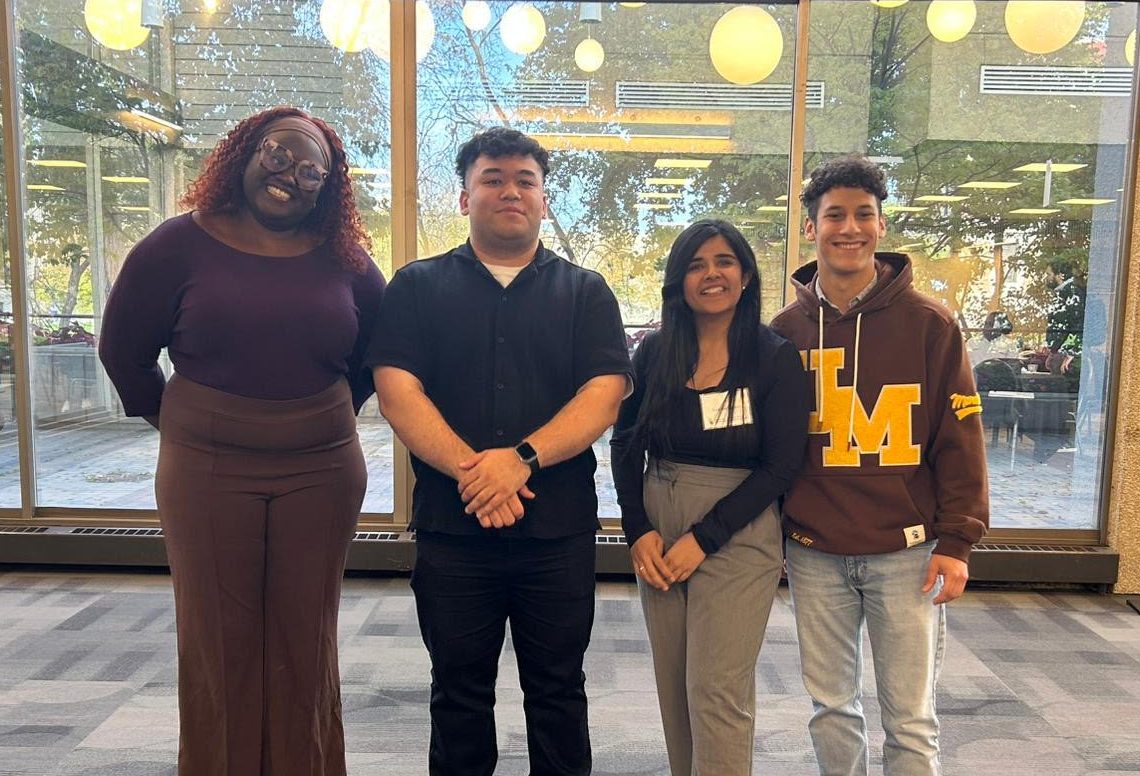
Team ALLFOURONE
Giving Back with the President’s Student Leadership Program
Across five projects, young leaders in PSLP have made a meaningful community impact
 It often takes leadership to identify a problem in the community. From there, it certainly takes leadership to create the solution.
Recently, students in the President’s Student Leadership Program (PSLP) have done both.
PSLP, running out of the James W. Burns Leadership Institute housed within the Asper School of Business—is a fully-funded, pan-provincial leadership program that selects up to 24 PSLP Fellows per year across all disciplines from Manitoba’s post-secondary institutions.
2025 saw the seventh cohort of students enter the program. After engaging in week-long leadership seminars and workshops, where they meet and have in-depth discussions with senior leaders across sectors and learn from subject-matter experts, the group breaks into teams of four. In consultation and then partnership with a community organization, each team designs a project that focuses on filling an identified need and making community impact.
“In each of the five projects this summer, students immersed themselves in a spirit of giving back, using their unique skills to find a community partner, design a project and contribute to community members,” said Suzanne Gagnon, Asper Associate Dean of Research and Graduate Research Programs and Director of the James W. Burns Leadership Institute.
“In addition, each group traversed complex issues that were often new to them, gaining valuable insights and honing a well-rounded set of tested leadership skill,” said Dr. Gagnon.
We detail each team’s story of community impact below.
ALLFOURONE: Stories Across Generations
Team ALLFOURONE created an “intergenerational bonding initiative,” forming meaningful connections between senior residents of a care home (reaching as high as age 103) and elementary school students (reaching as high as age 11).
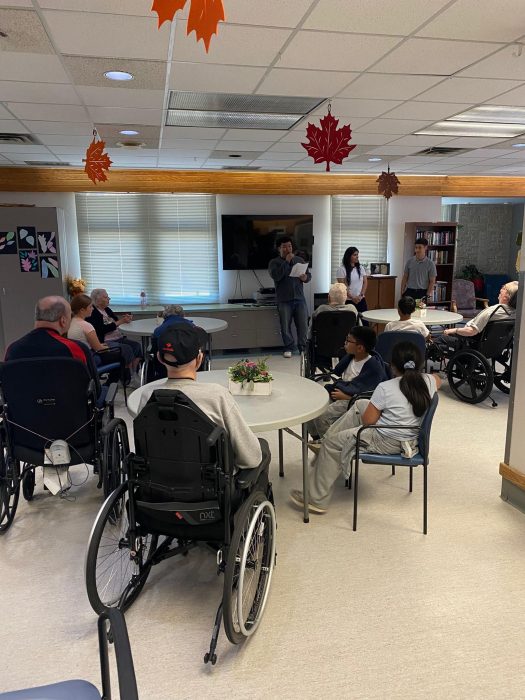
They called it “Stories Across Generations.” Together, the team designed and facilitated an afternoon where students from Margaret Park School and Luther Personal Care Home could connect through activities like trivia, storytelling and conversation.
The team identified the need for this project when they observed that youth and seniors can both feel overlooked or misunderstood. As these sessions unfolded, Keji Preston (UM Bachelor of Arts in Psychology), a member of the team, said “you could truly feel the room fill with joy.”
“A simple question like ‘what was your favourite game as a child?’ could spark a conversation that had a student and a resident laughing like they were old friends” she said.
The team realized this was special—a true bridge where both generations felt seen and heard.
“This project was a powerful reminder of the value every person holds,” said Preston.
During her time with PSLP, she felt like she realized a fundamental truth about leadership. “It’s not about a title; it’s about the responsibility to identify a need and the courage to take the first step in addressing it.
“This program gave me the tools, the network, and the confidence to do that, and for that, I am immensely grateful.”
GOal Getterz: Weaving Dreams
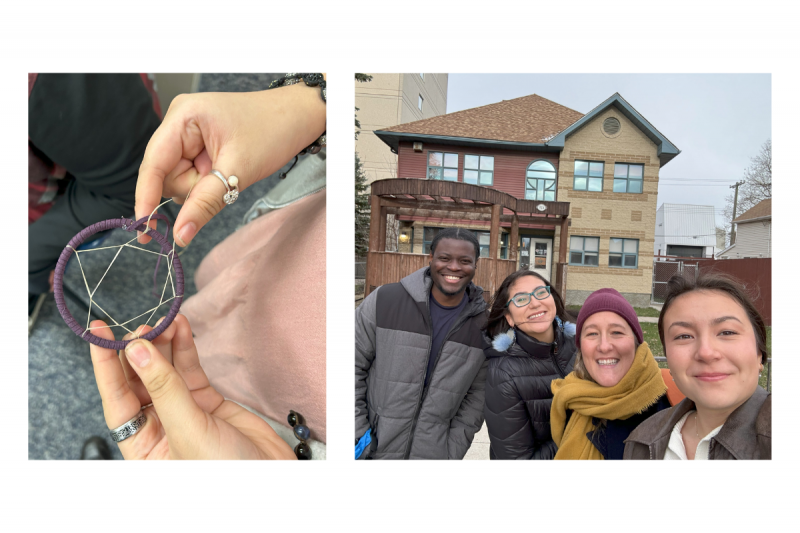
GOal Getterz partnered with Rising Sun, an off-campus school program of Gordon Bell High School to provide a crafting workshop, that doubled as a seminar on seeing mental health through an Indigenous lens.
As the high school students crafted dreamcatchers, they also had an open dialogue, connecting with the youth about their journeys so far, their dreams, and how they can make a positive impact on their community.
In Indigenous culture, a dreamcatcher is a profound symbol of protection, consisting of a circle and a web. The web is woven to capture bad thoughts and nightmares, holding them until they dissipate with daylight.
One member of the team, Ashley Sinclair (UM Bachelor of Arts in Psychology), is a Knowledge Keeper, and led the discussions. Team member Nicole Herpai (UM Doctor of Philosophy in Community Health Sciences) said that with the easygoing environment of crafting, the students felt at ease, opening up and sharing personal stories.
After the workshop, the team created a manual for how to re-create their event. It includes an explanation of the importance of the workshop and how to do it in a good way while observing appropriate cultural practices. More than anything, it’s a spark—a spark to pay it forward to others, which is what great leaders do.
Team M.I.C.K. – “Soft skills” for University
No matter what subject you study at university, everyone who comes through becomes a true expert in one thing: how to survive university.
Team M.I.C.K. forged an alliance with the Immigrant and Refugee Community Organization of Manitoba (IRCOM), to create an event where they could support Canadian newcomers with advice and “soft-skills” to get prepared for university.
Working with immigrants was something everyone in the group could relate to, as they each had either previous experience volunteering, or were a newcomer themselves.
Together with their deep collective knowledge of University, they hosted a preliminary event in August; the full event is planned for February 2026, when most will begin the application process.
During initial discussions with newcomers, group representative Kolby Wiebe (UM BSc in Chemistry) described a moment where they answered students’ questions about financial aid.
“When we saw the students realize that they may actually be able to afford going to university it was really cool,” Wiebe said. Once they understood it was a possibility, the group was flooded with eager questions.
Wiebe found PSLP to be a great opportunity to connect to the community in a way he wouldn’t have otherwise been able to.
“Getting outside the lab and interacting with motivated people across Winnipeg in all different positions really made me think about why I am doing the work I do and what impact it has,” he said.
Team M.A.C.C. – Supporting Newcomers on their Entrepreneurship Journey
If building a business is like building a house, how would you do it without a blueprint, or any way to source materials and equipment?
Entrepreneurship is hard. It’s even harder if you don’t know the local systems, resources, and tools in your toolbox.
Every member of team M.A.C.C. has connections to immigrant communities and identified this seemingly impossible task for newcomers who are aspiring entrepreneurs. Team representative Carolyn Wang (BComm [Hons.]) says they “thought it was important to give back since the resources available for newcomers helped us and our families.”
To help break the barrier, they connected experienced entrepreneurs and newcomers looking to start a business for virtual meetings where they could receive personalized advice.
They also created a guide—2025 Business Start-Up Guide for Manitoban Immigrants—which outlines the many resources available to entrepreneurs. It has gained impressive visibility on LinkedIn, expanding their audience and reaching an even larger community who can use and share the document all year round.
The Breakthrough Project – An Inspiration Fair for Indigenous Youth
Anthony Theriault’s (BComm [Hons.]) team was having a hard time coming up with a name, at first. They created a mission statement: “To build impact to contribute to daily life so people can live their best lives and flourish.” They decided on “The Breakthrough Project.”
Hence, their project became about breaking through: to Indigenous youth.
Partnering with Rossbrook House, an inner-city drop-in centre for youth, they created an event where youth and young Indigenous adults (guides) from a range of paths could share stories.
“Think of it as an inspiration fair” said Theriault.
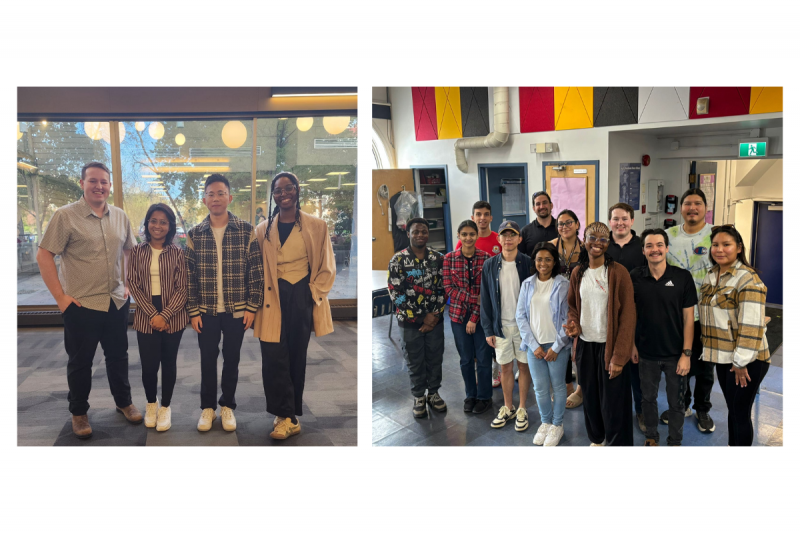
While sharing a meal, guides and youth swapped stories. Afterwards, each member of The Breakthrough Project hosted a games table where they could personally connect with the youth.
“This was one of the best parts, getting to talk with the youth hands-on about their goals and passions” Theriault said. “We really wanted the youth to lead their own way, and that’s what happened!”
The interactivity of the event turned out to be its greatest strength. A teacher’s assistant told them “This was completely different from other external presentations. The youth got to explore their interests rather than being forced to listen.”
Everyone left the day feeling inspired, knowing they had created authentic connections with the youth. According to Theriault, rumour has it that this might just be the start of an annual tradition.
—
The President’s Student Leadership Program, led by the James W. Burns Leadership Institute at the Asper School of Business is a fulfilling opportunity for students to develop a robust, real-world leadership toolkit. It is a transformative experience that builds valuable networks and skills for the next generation of changemakers. Applications to Cohort 8 of the PSLP opens on January 19, 2026. Click here to learn more about PSLP.