






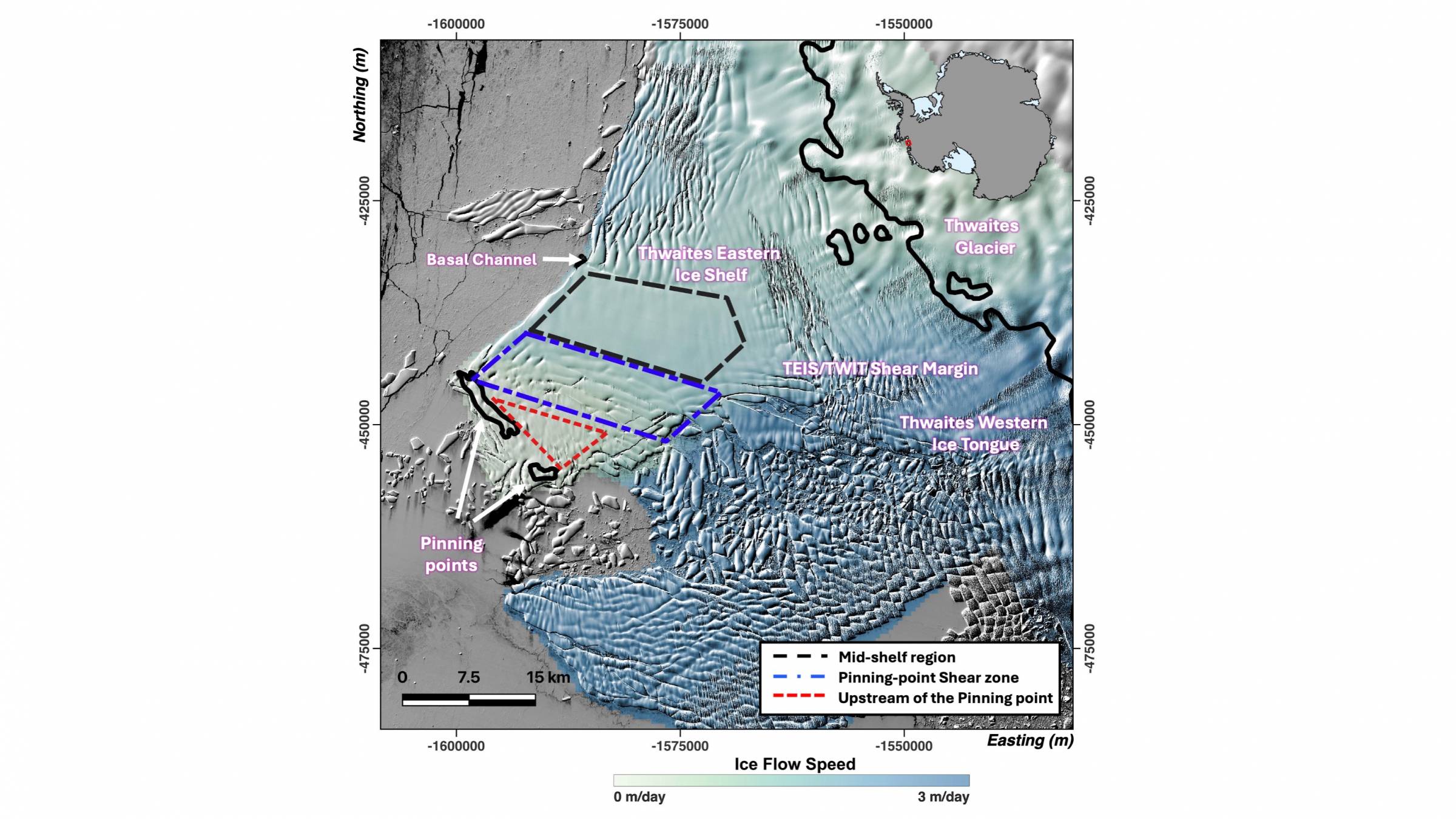
An image showing ice flow speed at the Thwaites Glacier in West Antarctica.
Cracking the code of Thwaites ice shelf’s disintegration
A new study led by researchers from the University of Manitoba’s Centre for Earth Observation Science provides the most detailed account yet of how the Thwaites Eastern Ice Shelf in West Antarctica has progressively disintegrated over the past two decades.
Thwaites Glacier in West Antarctica — often called the “Doomsday Glacier” — is one of the fastest-changing ice–ocean systems on Earth, and its future remains a major uncertainty in global sea-level rise projections. One of its floating extensions, the Thwaites Eastern Ice Shelf (TEIS), is partially confined and anchored by a pinning point at its northern terminus. Over the last two decades, TEIS has experienced progressive fracturing around a prominent shear zone upstream of this pinning point.
A new study has been published in the Journal of Geophysical Research: Earth Surface (AGU, 2025), which provides a comprehensive detailing of how the progressive disintegration has been taking place over the last two decades. The study has been published from the Centre for Earth Observation Sciences and led by Debangshu Banerjee, a recent graduate student from the Centre for Earth Observation Science (CEOS), together with Dr. Karen Alley (Assistant Professor, CEOS) and Dr. David Lilien (Assistant Professor, Indiana University Bloomington and former Research Associate at CEOS). The research is part of the TARSAN (Thwaites-Amundsen Regional Survey and Network) project, one of the components of the International Thwaites Glacier Collaboration (ITGC) – a major U.S.–U.K. research initiative studying the processes driving change in the Thwaites Glacier of West Antarctica. Renowned glaciologists Dr. Ted Scambos, Dr. Martin Truffer, Dr. Adrian Luckman, and Dr. Erin Pettitt have also been a part of this research.
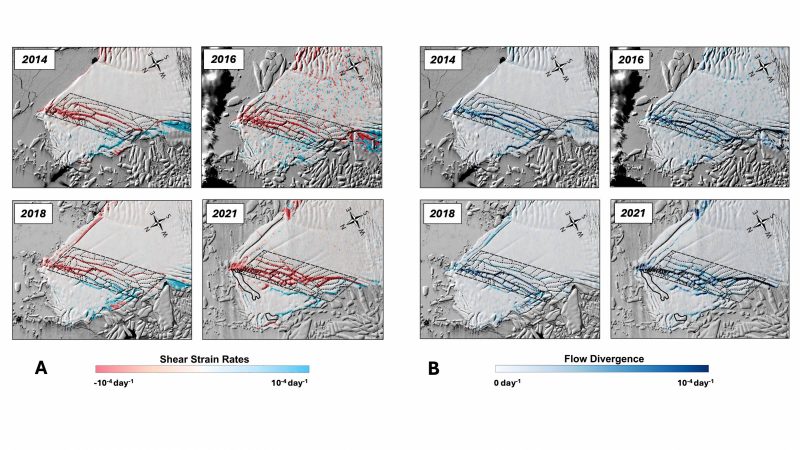
A series of diagrams showing the shear strain rates and flow divergence of the An image showing ice flow speed at the Thwaites Glacier from 2014 to 2021.
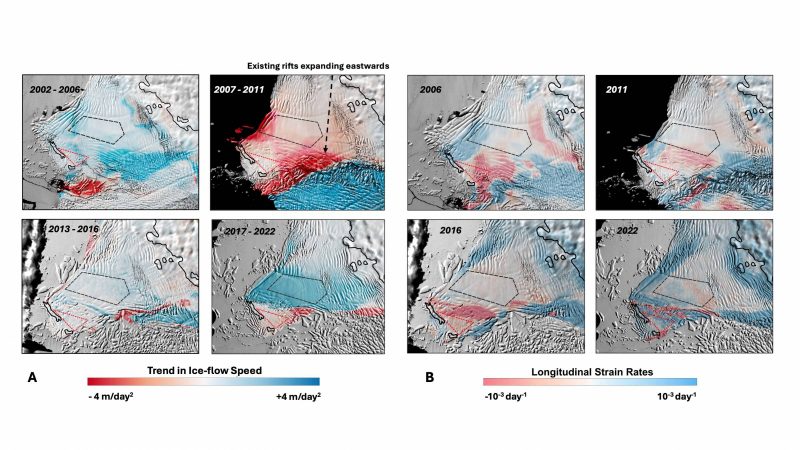
A series of diagrams showing a trend in ice-flow speed and the strain rates from 2006 to 2022.
Drawing on two decades (2002–2022) of satellite imagery, ice-flow velocity measurements, and in-situ GPS records, the team traced the evolution of fractures within the TEIS shear zone and their connection to changes in ice dynamics. The analysis revealed that the gradual development of these fractures led to the shelf’s progressive detachment from its pinning point, causing accelerated flow upstream and a loss of mechanical stability. The study identifies four distinct stages in this weakening process and offers two key insights. First, the fractures developed in two phases: an initial propagation of long, flow-parallel fractures, followed by shorter fractures oriented perpendicular to the direction of ice flow. Second, the researchers found evidence for a positive feedback mechanism between fracture-induced damage and ice acceleration—an amplifying cycle that hastened the shelf’s disintegration in recent years.
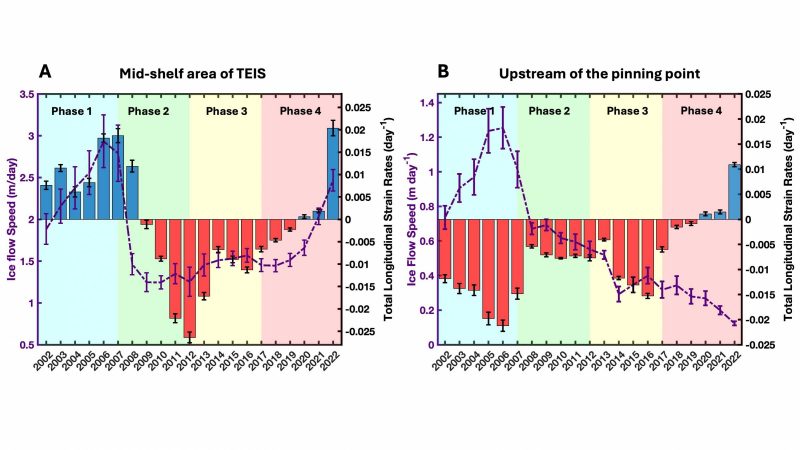
Two graphs that show the mid-shelf area of TEIS and the upstream pinning point from 2002 to 2022.
The research highlights how the pinning point, once a major stabilizing force for the TEIS, has gradually transitioned into a destabilizing agent through four distinct stages. This pattern of ice-shelf disintegration may serve as a warning for other Antarctic ice shelves that are currently showing similar signs of weakening. The continued loss of these floating ice shelves could have significant implications for the Antarctic Ice Sheet’s future contribution to global sea-level rise.
You can read more from the publication using the following DOI: https://agupubs.onlinelibrary.wiley.com/doi/10.1029/2025JF008352