






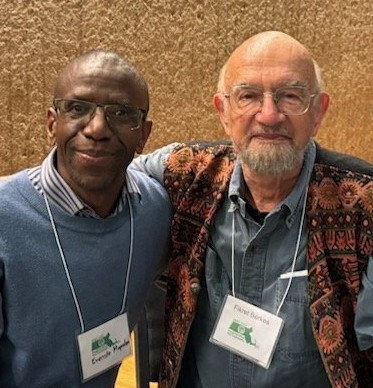
An image from the Awards Dinner, with IASC President-Elect, Everisto Mapedza (Ghana) on the left, next to Fikret Berkes.
Celebrating a Legacy: NRI Professor Honored with Lifetime Achievement Award
Dr. Fikret Berkes from the Natural Resources Institute has been awarded the Certificate of Honor for Lifetime Achievement of Commons Scholarship from the International Association for the Study of the Commons.
Earlier this June, Dr. Fikret Berkes was announced as the recipient of the Certificate of Honor for Lifetime Achievement of Commons Scholarship. This special award was presented at the 20th Biennial Conference of the International Association for the Study of the Commons, at the University of Massachusetts Amherst. The award was presented by Dr. Xavier Basurto (Stanford University), along with personal reflections provided by Dr. Ron Oakerson (Professor Emeritus, Houghton College), Dr. Raul Lejano (Professor, New York University), Dr. Leticia Merino (Professor, UNAM, Mexico), Dr. Iain Davidson-Hunt (Professor, U of M), and concluded with a Hawaiian chant offered by Dr. Mehana Blaich Vaughan (Professor, University of Hawai’i at Manoa) to honour Dr. Berkes’ work with Hawaiian colleagues.
As stated by Dr. Basurto in presenting the award, “Professor Fikret Berkes has been a consistent voice and strong influence in various areas of knowledge as his hundreds of articles and many books demonstrate.” He noted Berkes’ work in the area of commons (the governance of jointly used resources such as fisheries and forestry), and his approach involving social and ecological resilience and learning from traditional ecological knowledge (Indigenous knowledge). Basurto named some of Dr. Berkes’ notable publications throughout his years of research. “In 1989, he published Common Property Resources: Ecology and Community-based Sustainable Development.” The book was part of a cohort of contributions that together made a strong case for self-governance and community-based management, including McCay and Acheson’s The Question of the Commons (1987) and Elinor Ostrom’s Governing the Commons (1990), for which she received the Nobel Prize in Economic Sciences in 2009.
Berkes’ collaboration with Dr. Carl Folke, Beijer Institute for Ecological Economics (Royal Swedish Academy of Sciences) and Stockholm University, started in the early 1990s, paving the way for the trailblazing book, Linking Social and Ecological Systems (Cambridge University Press, 1998). This book and its 2003 sequel, Navigating Social-Ecological Systems (which included three chapters co-authored with U of M scholars), connected commons research with social-ecological resilience and traditional ecological knowledge. This work also led to Ostrom’s social-ecological systems framework, the consolidation of the Resilience Alliance, and the Stockholm Resilience Centre, among other important research initiatives and ideas, Basurto noted. In the area of traditional ecological knowledge, Berkes’ book Sacred Ecology (Routledge, 1999; presently in its 2018 fourth edition) is used widely as a textbook internationally. It has been translated into Chinese and Persian, with a Spanish translation in progress.
In concluding the award presentation, Basurto said “…if you work on traditional ecological knowledge, resilience, social-ecological systems, community-based conservation, or commons issues, Fikret has been behind the development of these fields. The International Association for the Study of the Commons awards this Certificate of Honor to Fikret Berkes for his lifelong contributions to Commons Theory, teaching and practice. For being a holder of stories of commoners, commoning, and commons.” Berkes’ theoretical focus is on the conditions through which the “tragedy of the commons” may be avoided. His practice is guided by the idea that people should be able to participate in resource and environmental decisions that affect their lives and livelihoods.
Originally trained as a marine ecologist, Berkes’ work across academic disciplines started in the 1970s, at a time when interdisciplinary research was not common and not rewarded. Combining various natural science and social science disciplines and learning from Indigenous ways of knowing and the wisdom of traditional peoples, led to a (then unusual) transdisciplinary approach. However, such approaches are increasingly considered to be necessary for dealing with the complex environmental problems of today’s rapidly changing world. Disciplinary approaches are simply insufficient to cope with or adapt to problems such as climate change.
Dr. Berkes came to the U of M in 1991 as the Director of the Natural Resources Institute. He is a two-term Tier 1 Canada Research Chair (2002-16) and a Fellow of the Royal Society of Canada. In 2016, he became Distinguished Professor Emeritus at the U of M. About one-third of his 280 refereed publications over 50 years has been co-authored with U of M graduate students and faculty. As of August 2025, his 116,000 Google Scholar citations makes him the most highly cited U of M scholar. His recent books include Governing for Transformation towards Sustainable Small-scale Fisheries (FAO, Rome, 2025, open-access https://doi.org/10.4060/cd4289en), Advanced Introduction to Resilience (Edward Elgar, 2023), and Toward a New Social Contract (TBTI, 2021). His website https://umanitoba.ca/environment-earth-resources/dr-fikret-berkes-profile-page includes a list of Publications.