






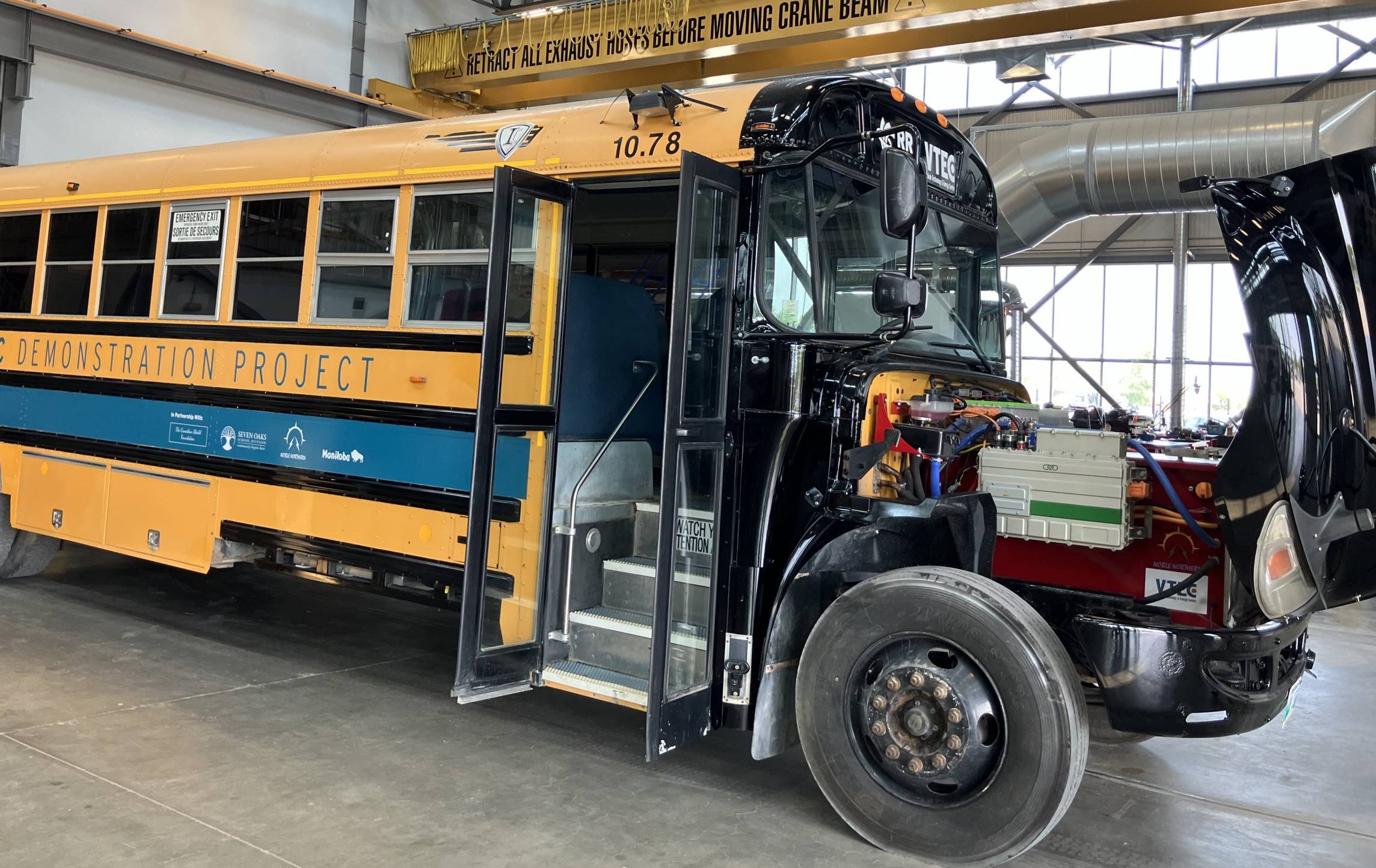
The converted bus analyzed by Asper MBA students
Is it worth it to make school buses electric?
Asper School MBA students conduct a cost-benefit analysis weighing the impact of converting diesel school buses to electric
Things we know about school buses. They drive the same predictable route every day, for a relatively short time; each day, they come to a central location while kids are not in school (the middle of the day, and evenings); and they use diesel, which emits significant greenhouse gases when used.
While some see a series of routine facts, transportation scholars like Asper School MBA students Mario Petit, Maitha Alshamsi, and Geoffrey Hurd, see an opportunity.
They see that school buses should be the easiest type of vehicle to transition to a primarily electric power source. And it would make a huge environmental difference to do so.
Because their routes are short, and they’re at the central location for long periods of time, they can be charged often without needing a special, large power source. And because they use diesel in large quantities (not to mention, while transporting children) electrifying school buses would do huge good.
However, factory-built electric school buses remain too expensive for individual school divisions. The key question becomes, how do you find an affordable way to electrify.
Convert or buy new?
Under guidance from their Asper School of Business’ sessional instructor in Supply Chain Management Dr. Robert Parsons, Petit, Alshamsi, and Hurd weighed the pros and cons of converting already-existing school buses from diesel to electric in an experiential learning opportunity.
The major assist at their disposal: the first school bus in Manitoba to be re-powered from diesel to electric.
The school bus itself was converted by Red River College Polytechnic students as part of their Electric School Bus Conversion initiative undertaken through the Vehile Tehnology and Energy Centre (VTEC). Dr. Parsons and the three Asper students were brought on to create a cost-benefit analysis.
In it, they show that for school divisions, obtaining new electric school buses is not economically feasible, as they cost in the neighbourhood of 3x the price of a comparable diesel bus. However, re-powering them is affordable and still benefits the environment.
Among their practical-minded solutions, they propose that as school buses face various wear and tear, they could convert to electric instead of replacing a diesel engine, thus saving on fuel while investing in sustainability.
They also examine how governments play a role in greenhouse gas reduction by offering incentive programs. If governments were create a $20,000 per bus incentive—modest in the transportation industry—it could relieve school boards of much of the financial risk and make their vision a reality.
Dr. Barry Prentice, Director of UMTI and Professor in Supply Chain Management at the Asper School of Business, was impressed by the students, whose report clearly showed a realistic path for the transportation industry.
“Achieving sustainable transportation has never been simple nor straightforward, requiring careful analysis and planning,” he said. “Solid work by the MBA students continues to exemplify the strengths of the Asper School of Business in identifying and validating realistic pathways toward a zero-emission future.”
A unique learning experience
Asper MBA student Geoffrey Hurd said that the opportunity to have the actual bus be a practical element in this study really helped him see past the theory of the classroom. It also allowed his team’s work to be realistic, and to have real-world applications.
Nathan Greidanus, Associate Dean, Professional Graduate Programs and Executive Education, at the Asper School of Business noted that the Electric School Bus Conversion project empowered Asper MBA students to create important work.
“Experiential learning is at the heart of the Asper MBA. When students collaborate with community partners on complex sustainability and innovation challenges, they deepen their skills and demonstrate the values that define the Asper School. Experiences like this shape the leaders Manitoba needs for the future,” he said.
—
The University of Manitoba Transport Institute plays a highly important role in defining the direction of Canada’s and the world’s future scholarly research in transportation and logistics. Learn more here.
With one of the most flexible and adaptable programs in Canada, the Asper MBA program is designed to meet the market-driven needs of today’s industry professionals. Take the first step in transforming your career today