






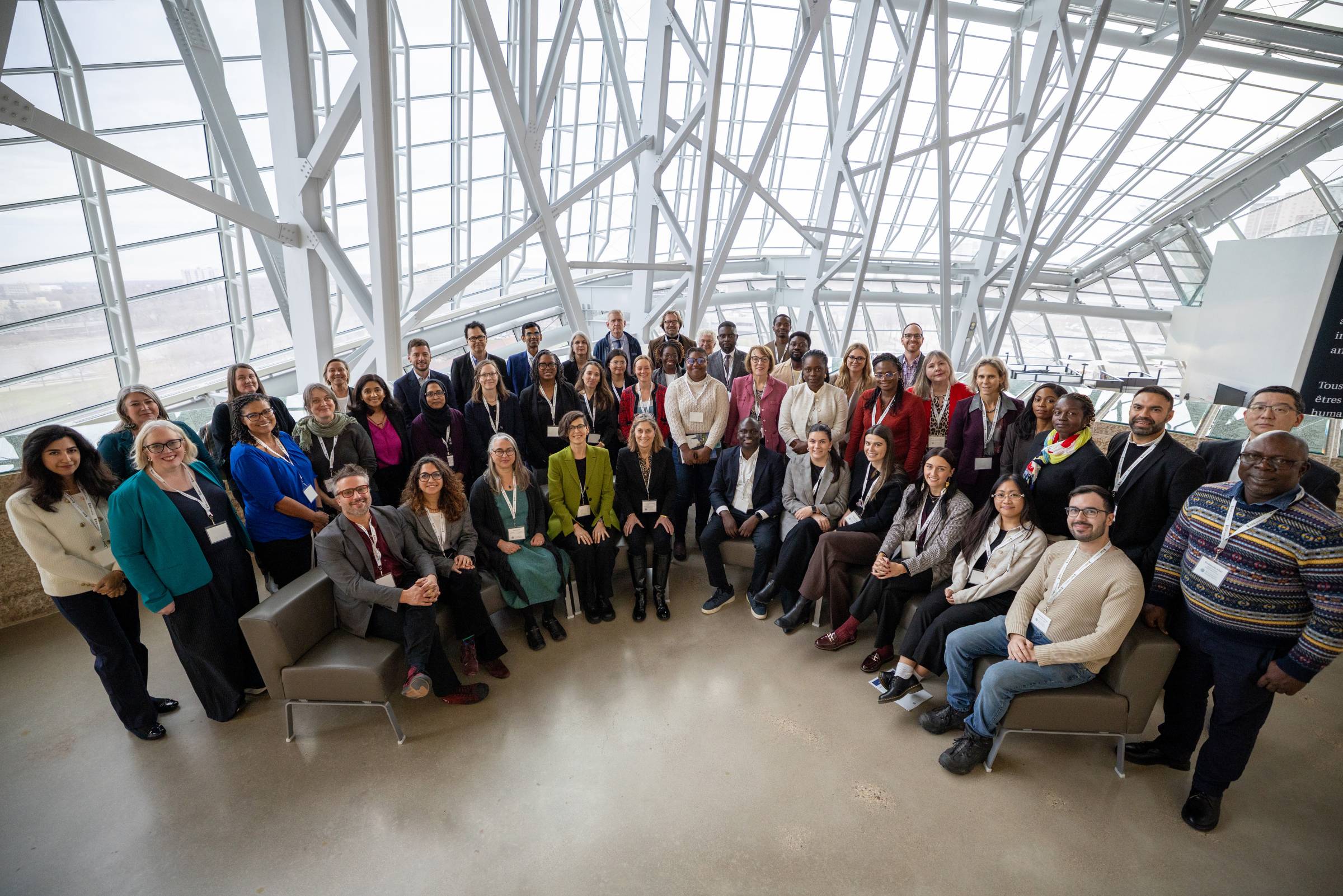
Scholars studying Business Law and Human Rights gathered in Winnipeg from around the world to learn from each other at both a workshop and conference hosted by the Canadian Forum for Business and Human Rights housed at the Faculty of Law’s Desautels Centre. Photo by Adam Dolman.
Canadian Forum for Business and Human Rights event strengthened global research network
Days before the Grey Cup, Winnipeg was the gathering place for another group of people with a shared passion. On November 13-14, 2025, the University of Manitoba Faculty of Law hosted the inaugural Canadian Forum for Business and Human Rights Conference. Scholars from across the globe met first at Robson Hall for a workshop, and then at the Canadian Museum for Human Rights for a conference to share research, knowledge, and ideas about Business and Human Rights – a critical area of law that deeply affects all aspects of the economy, society, and the environment worldwide.
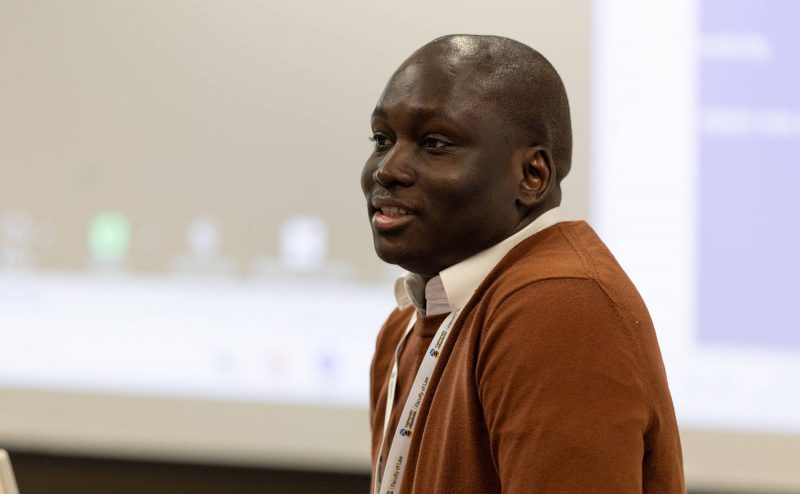
Conference organizer, Dr. Akinwumi Ogunranti, Faculty of Law, University of Manitoba. Photo by Adam Dolman.
The first day was dedicated to 10 excellent early-career researchers who presented on various Business and Human Rights (BHR) intersectional themes, including investment, climate, environment, labour, politics, and transnational litigation. These scholars received feedback and career advice from established scholars whose work continues to shape the BHR field. “We appreciate their generosity and dedication to mentoring young scholars,” said workshop and conference lead organizer, Dr. Akinwumi Ogunranti, an assistant professor at the Faculty of Law.
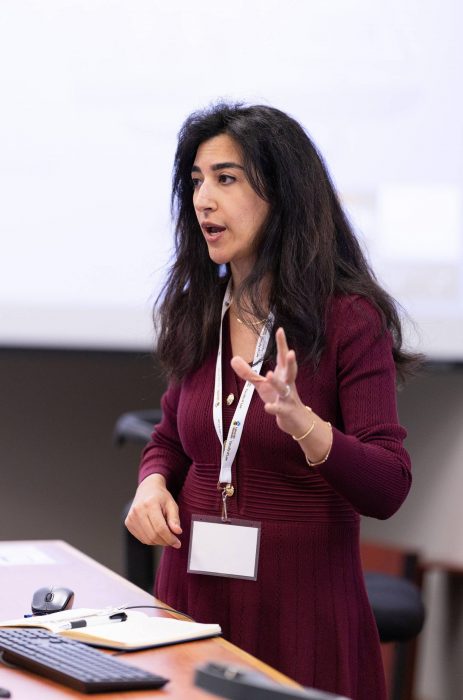
Yasmina Salama is a PhD candidate at the Peter Allard School of Law, University of British Columbia, Canada, who presented her paper at the workshop. Photo by Adam Dolman.
The workshop ended with a film screening by Dr Malcolm Rogge, titled “The Tribunal,” which attendees found deeply affecting. Peter A. Allard School of Law (University of British Columbia) PhD candidate Yasmin Salama shared that the film was “a powerful highlight, particularly a scene showing an interviewee leaving through hundreds of pages of arbitral reasoning, her face marked by disbelief as she searched for acknowledgement of the ‘week of terror’ her community endured, which serves as a sobering reminder of the disconnect between ISDS [Investor-State Dispute Settlement] and the lives it impacts.”
At the workshop, Salama had presented her paper “Contesting the Political Risk Paradigm: Socially Driven Measures and the Limits of ISDS Exception,” and received feedback from commentators, Professors Linda Reif (Faculty of Law, University of Alberta) and Sara Seck (Schulich School of Law, Dalhousie University).
“The total of twenty-eight hours of travel between Nuremberg and Winnipeg was absolutely worth it,” said Otgontuya Davaanyam, a postdoctoral researcher on Business and Human Rights, and Corporate Responsibility and Human Rights for Indigenous Peoples at Friedrich Alexander University Erlangen Nuremberg, Germany, who presented a paper at the workshop. “It was inspiring to meet many leading BHR scholars whose work I have read and cited for more than a decade. I received exceptionally generous feedback that will significantly strengthen the next stage of my work.”
Similarly, Loveth Ovedje, a PhD candidate at the Schulich School of Law, said she deeply appreciated the quality of feedback and discussion from the senior scholars attending the workshop. “The level of intellectual exchange, the incisive questions, and the generous comments from Dr. Hassan Ahmad will significantly strengthen my work going forward… It is a rare privilege to have one’s work read so carefully and taken so seriously in such a stimulating environment,” she said.
As for the conference held the next day at the CMHR, Ovedje said she “left with new insights, fresh perspectives, and a renewed sense of motivation for my own research.”
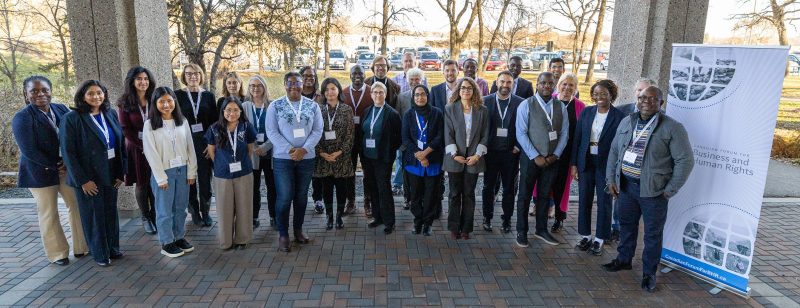
PhD candidates and post-doctoral scholars from across the globe gathered at the University of Manitoba for the opportunity to present their research to established, expert scholars in the field of Business and Human Rights. This workshop was hosted by the Canadian Forum for Business and Human Rights at Robson Hall. Photo by Adam Dolman.
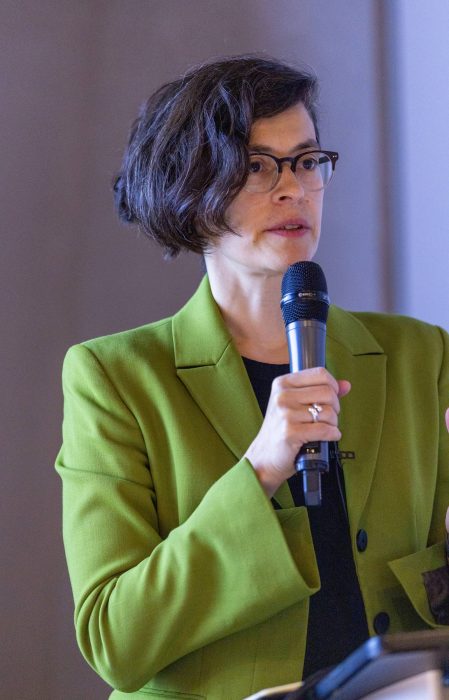
Conference keynote speaker, Fernanda Hopenhaym, Business and Human Rights specialist and member of the UN Working Group on Business and Human Rights.
The conference brought together over 50 participants from Canada and beyond, including the United Kingdom and the United States. Starting with a traditional Indigenous water ceremony and Dean Richard Jochelson’s welcoming address, Fernanda Hopenhaym, a member of the United Nations Working Group on Business and Human Rights, delivered a thought-provoking keynote address on the state of BHR in times of transition. This was followed by a plenary session and parallel panel sessions that addressed various issues, including Indigenous rights, judicial and non-judicial remedies, climate change, investment, and child labour.
The two-day event provided a safe space for frank conversations and networking opportunities among scholars, practitioners, policymakers, NGOs, and rights-holders.
The event achieved the following objectives:
• Created greater awareness of business and human rights (BHR) issues among emerging scholars in Canada;
• Provided mentorship for doctoral students and early career researchers to produce innovative, rigorous scholarship that contributes to the BHR literature and policy debates in Canada;
• Provided an opportunity for students to engage and network with a range of experts from across Canada and all over the world, including the United States, and the United Kingdom;
• Provided an opportunity for participants to publish short paper contributions in a special issue of the peer-reviewed open-access Manitoba Law Journal;
• Laid the foundation for consolidating current knowledge on the subject and for developing an interdisciplinary global research team to support the development of future collaborative research on these pressing issues;
• Provided an opportunity for some members of local Indigenous communities to share their experiences of corporate abuse and brainstorm on pathways forward.
The organizers express deepest thanks to the workshop and conference’s generous sponsors: the University of Manitoba, the Faculty of Law, Desautels. The Business Law Accelerator, Research Manitoba, The Manitoba Law Foundation, Law Commission of Canada, and the Legal Research Institute.
The event would not have been possible without the organizing team led by the Faculty of Law, University of Manitoba’s Assistant Professor Akinwumi Ogunranti, Penelope Simons, Sara Seck, Anil Yilmaz, and Laura Reimer.