






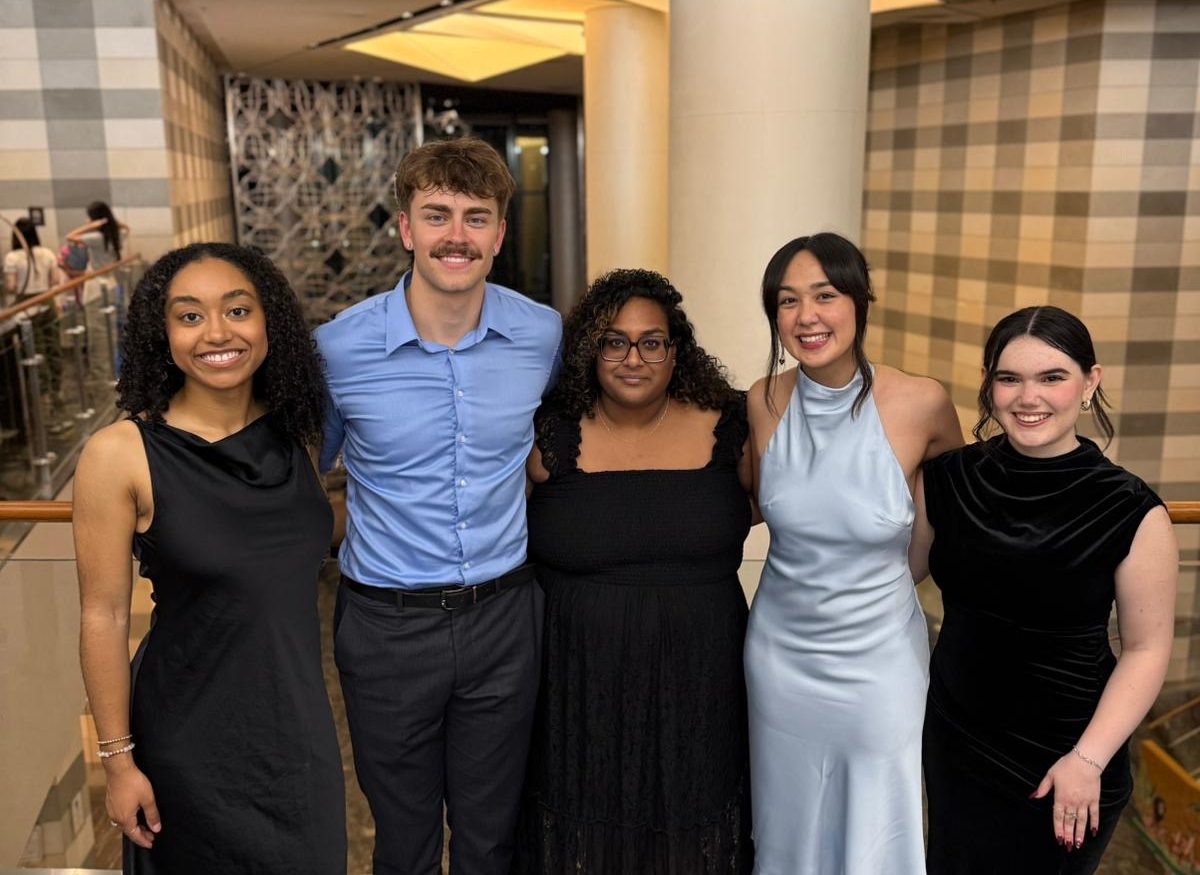
(L-R) Kayla Odidison, Ben Penner, Judy Jaysuriya, Olivia Velasco, Nikol Sokolsky
Inside Asper’s Second-Place Finish at Thailand’s Thammasat Undergraduate Business Competition
It’s not every day that the words “Manitoba” or “the Asper School of Business” make it all the way to Bangkok, Thailand.
However, they might start to be in higher rotation after a team of four Asper BComm students earned a second-place finish at the Thammasat Undergraduate Business Competition (TUBC).
Competing against some of the world’s top business schools, the team—consisting of Kayla Odidison, Ben Penner, Nikol Sokolsky, and Olivia Velasco—demonstrated that Asper’s commitment to experiential learning opportunities is truly spreading the Asper name across the globe.
The second-place finish marks the Asper School’s highest placement at this level of the international case competition stage.
The first two rounds: an uphill (and nearly sleepless) battle
The time: October 6-12, 2025. The location: the five-star Amari hotel in Bangkok (side note: Odidison is still thinking about the top-notch complimentary breakfast).
The facts: getting to the final competition at TUBC is not a given. Twenty teams compete to get the most points in two rounds of presentations; the top five make it to the finals.
In the first round, where competitors are given five hours to prepare their presentation, the team analyzed how Lazada, a Thai e-commerce platform similar to Amazon, could upscale their brand into selling more premium items. This round was worth 30% of their points.
With 24 points out of a potential 30, Asper earned second place in their division, which was a solid result, but one that turned getting to the finals into an uphill battle; they would have to score much better in the second round if they wanted to advance.
With twenty-four hours to prepare their second presentation, the team harbored themselves in their hotel room to study how a major construction contractor in Thailand, Stetcon, could make high-margin, sustainable growth.
With papers plastered onto every wall of their hotel room (“It was a total tornado in our room,” says Odidison), the team pulled an *almost* all-nighter: they only slept for an hour-and-a-half during the 24-hour crunchtime.
The way the hotel was set up, they could see the light from their competitors’ windows. Penner says their mantra was “If they’re up, we’re up.”
Running on adrenaline, they were able to score a perfect score of 70 to win their division and advance to the finals.
Case Competition Tip #1: Go one level deeper
Kayla Odidison: When you’re studying an industry that you’re not very familiar with, it can be hard to take your real-life experience and apply it to your analysis. How low should you go in detail? How intimate should I go? Judy would always say, “always think one level deeper”
The finals: putting Asper on the map
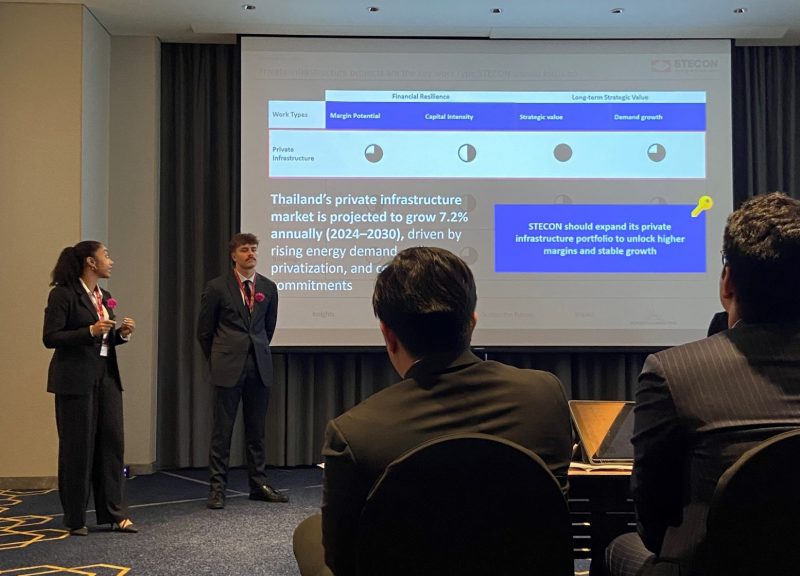
In the finals, team Asper again delivered their second-round presentation for a board of judges and the Stetcon C-suite. Even the son of Thailand’s Prime Minister was in attendance as a Stetcon executive.
As the nerve-racking finals began, their presentation seemed to be going well, until three minutes in, when, as Velasco was speaking, they were forced to face yet another rigorous challenge: technical difficulties.
“The slide deck on the screen behind us shut off, went totally black,” says Velasco. “But the judges still have our slides, and the timer is still going. So we’re like, ‘Just keep going. No slides.’ And I think it was amazing we were able to do so.”
Eventually, they were stopped and had to restart their presentation, but the fact that the outage didn’t phase them won them numerous compliments.
After they presented, Sokolsky recounted the story of how when the judges began giving their feedback, the team’s stomachs dropped as one judge said, “your content was hard to follow” followed by a too-long pause, and then excitedly said “…because your storytelling was just so great.”
Case Competition Tip #2: Tell a good story
Nikol Sokolsky: At the beginning, we tried to throw everything in the kitchen sink in our recommendations and try to fix all the world’s problems. Our coaches helped us funnel it down, and find our main problem. When you focus on one section it makes your ideas much more nuanced and fully digestible.
Knowing that in their hearts, they had nailed their presentation and question period, a podium finish would’ve been just a cherry on top.
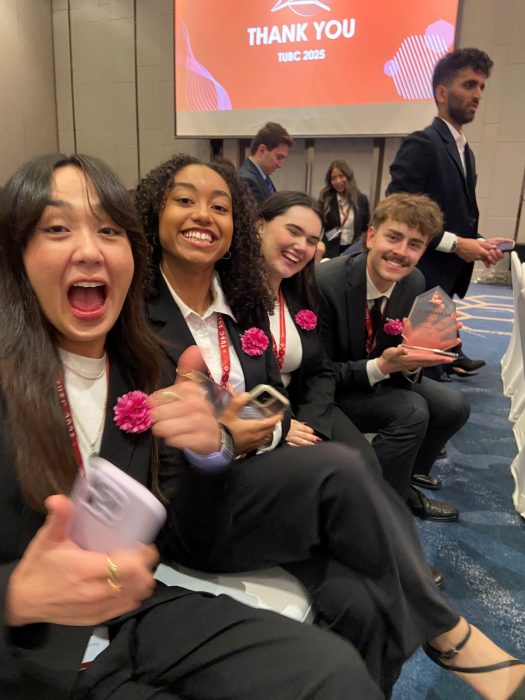
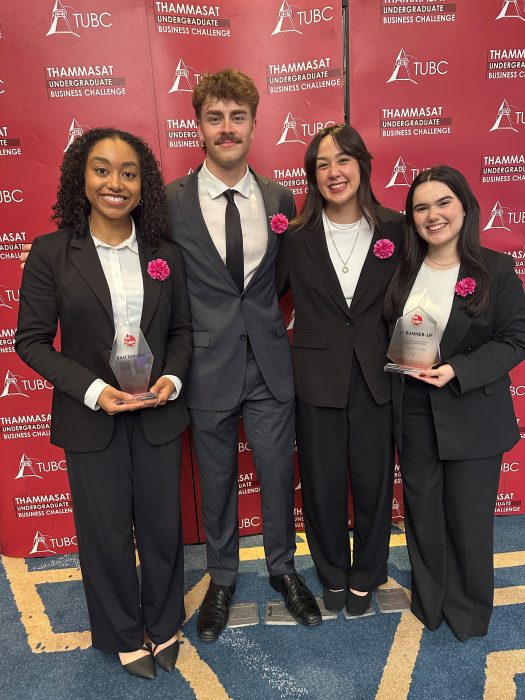
To their delight, as the awards were announced, Kayla Odidison won best speaker of the competition, and the team placed second.
“Obviously there was jumping, and a bit of screaming,” says Penner with a laugh.
While they’re proud of what they achieved, their pride stems from the people and the place they represented.
They described representing Manitoba in Thailand as an underdog story—as very few of the other teams they talked to even knew where Manitoba was.
Velasco says that seeing the Asper School of Business as the second-place team in a group of “heavy hitters” like Rotterdam School of Management (the Netherlands) and Nanyang Technological University (Singapore) filled her with a tremendous sense of pride.
Even more than representing home on the global stage, they were just happy to make their coach, Judy Jayasuriya, proud. She is also the lead of case competition program at the Asper School.
“It was so good to see Judy so excited because she’s put such a tremendous amount of work into not only us, but every case competition team,” says Penner.
Case Competition Tip #3: Practice makes perfect
Olivia Velasco: Get those reps in. When it comes to speaking, building the confidence to speak naturally is a huge thing that only comes with practice. And when you’ve spent 24 hours with the material, it’s really ingrained in you and you know what you’re talking about.
Teammates to Friends
Case competitions are key experiences that put learning into action, as you learn to think critically while under pressure (and sometimes, sleep deprived) and gain confidence.
Jayasuriya says that it’s because of the Asper School of Business’ commitment to experiential learning that students get to (a) experience competitions like Thammasat and (b) get the support they need from the case competition office and volunteers, to allow students to grow, and eventually excel along the way.
Odidison, who won best speaker of the competition, says “the very first case I did, I’m like ‘why am I even on this team?’ and now I feel like I’ve grown into a leader. […] It allows you to grow as a person, but also as a young professional.”
Case competitions are also community-builders, as you form a potent bond with a team of collaborators, just as you would in the workplace.
Case Competition Tip #4: Never silo yourself off from the team
Ben Penner: In case competitions, you see a lot of teams who maybe have really strong people on them, but they’re sitting in opposite corners of the room when they’re working. For us, what worked so well is that we never had silos. We’re always working together.
Certainly part of the reason Odidison, Penner, Sokolsky and Velasco were successful is the undeniable chemistry between them.
Their skills were highly complimentary. Jayasuriya interviews students and assembles the teams so they can thrive (the team refers to her as “the mastermind”).
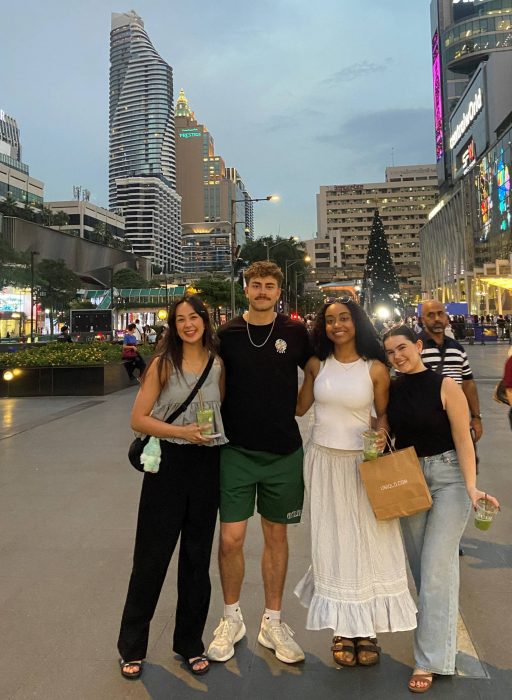
As the team describes it, Penner is technical and can learn the ins-and-outs of the concrete industry like nobody’s business; Odidison is the storyteller who threads all the data into a consistent narrative; Sokolsky brings creative ideas and ensures the energy is always sky-high; and Velasco has deep analytical thinking skills that turn numbers into stories.
“The team’s work ethic, dedication and commitment to both the competition and their team allowed them to represent Asper to the best of their abilities” says Jayasuriya.
Throughout their month-long prep for the competition and the trip itself, the bond between them became equal parts genuine collaboration and genuine friendship.
On their bags, each team member still sports their matching Labubu dolls from Thailand, and they talk about their pre-presentation dancing routine to Rihanna’s “Breakin’ Dishes,” like it was 10 minutes ago.
Through all the challenges they faced on the way to a historic finish, the greatest reason for their success might just be that they’re always laughing.
—
The team was supported by an incredible group of mentors of Asper professors, Asper alumni, and subject matter experts from various fields who volunteered their time: Bhaumik Gandhi, Lukas Neville, Byron Wright, Arly Akerstream, Cole Hutchison, Nick Sutton, Daniel Kokan, Thea Hughes, Garrison Glatz, Nolan Ward, Tyler Roslinsky, Richard Watson, Cody Nowell, Eli Koulack, Geoffrey Hurd, Priyanji Mediwake, Shihhan Iwasaki, Chelsea Kokan, Ramy Penne, Tien Nguyen and Melani Fernando
—
Case competitions give students an opportunity to showcase complex problem-solving skills in diverse teams. One of the many experiential learning opportunities available to students at the Asper School of Business, case competition connects students to top business school and industry experts around the world and right here in Manitoba. Learn more about case competition opportunities at the Asper School of Business.