






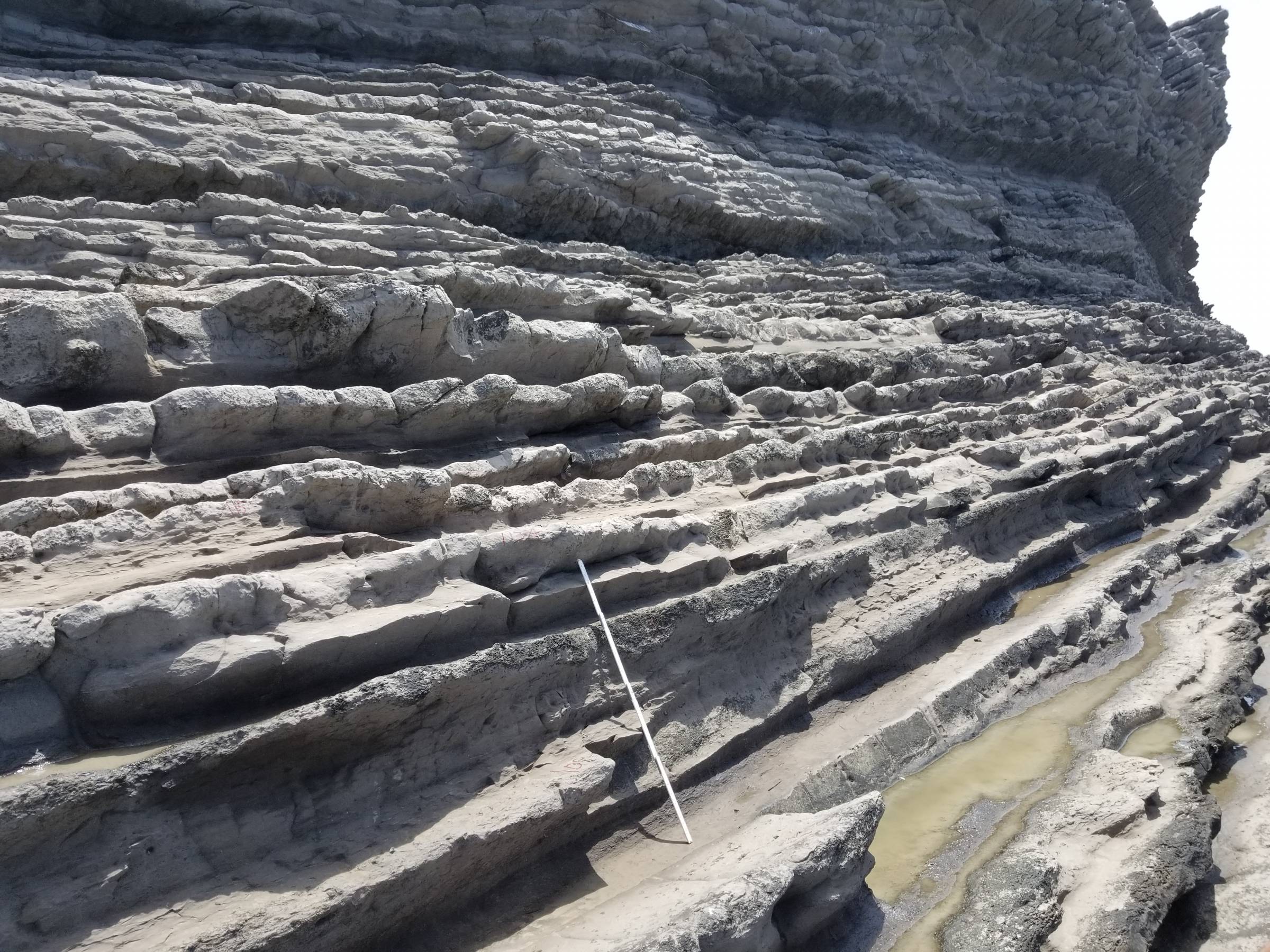
Ancient rock formations
Decoding Earth’s future
Climate clues hidden in Jurassic era rock samples
The key to predicting Earth’s future? Look at what happened millions of years ago.
UM researchers are drilling deep into Earth’s surface to produce core samples that date back as far as the Jurassic era. These rock samples contain a well-preserved timeline that researchers can use to pinpoint the exact timing of major environmental shifts and how they affected surface sedimentary organic matter at the time. Understanding the effects of historic environmental events can help predict future impacts of climate change on Canada’s unique ecosystems.
New state-of-the-art equipment
UM has a powerful new tool to analyze ancient rock core samples, thanks to funding from the John R. Evans Leaders Fund (JELF) awarded to Dr. Ricardo Silva, assistant professor, Clayton H. Riddell Faculty of Environment, Earth and Resources.
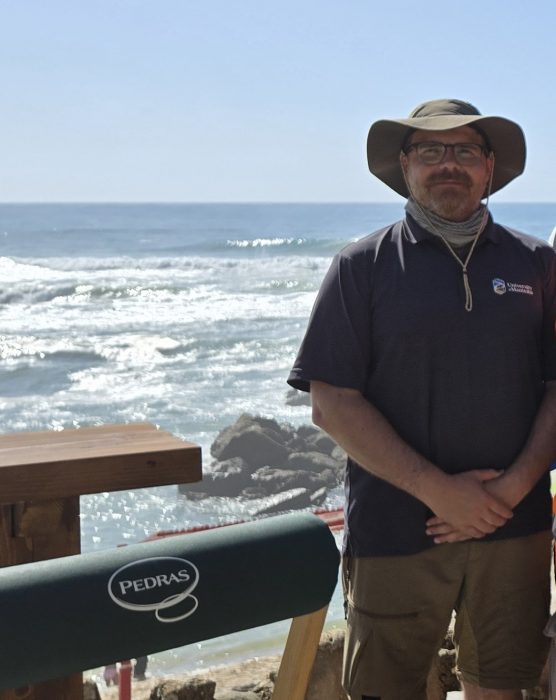
Dr. Ricardo Silva
The new equipment heats small amounts of sediment and rock to identify the type of organic materials inside—the only one of its kind at a Canadian post-secondary institution. It allows researchers to quickly and cost-effectively measure the amount and type of organic matter in a wide variety of materials.
Silva will use the new equipment to study ancient marine rocks from several geological periods, which will help him, and researchers worldwide, understand how past climate events have changed our planet. He leads a global network of researchers including the Middle Jurassic Earth System and Timescale or M-JET, which is supported by the International Continental Scientific Drilling Program.
Their goal is to uncover crucial insights into Earth’s distant past, dating back to when the continents began to take their current shape. By collecting rock samples from deep underground, they are building a timeline that shows significant climate events that happened about 150 million years ago. This exciting research helps us learn more about our planet’s past and how it has evolved over time.
“These core samples serve as a vital record, preserving evidence of ancient environmental conditions,” says Silva. “We carefully remove small fragments of rock material and distribute them to researchers worldwide. This allows for a broad range of experiments aimed at reconstructing Earth’s prehistoric climate, ecosystems and environmental change.”
Providing evidence-based data for future policymaking
Silva’s research showcases UM’s commitment to tackling climate change and supporting studies on sustainability. This work is important for ongoing governmental efforts at both the provincial and federal levels, focusing on how issues like melting permafrost and other environmental changes impact Canada’s ecosystems and carbon cycling processes.
By studying how organic carbon moves between rocks and surface sediments, Silva aims to contribute to practical strategies for adapting to and reducing the effects of climate change. This kind of research is particularly relevant for the Arctic region and will shed light on how climate change affects wildlife, natural resources and both Indigenous and non-Indigenous communities.
Using Silva’s new testing equipment, researchers can gather important information about soil quality that will impact agricultural producers as they develop more sustainable land management strategies. By looking at the organic matter in the soil, they can learn more about what affects the growth of crops. The insights will be helpful in creating management practices that enhance the types of crops grown and their production, especially considering the changing climate in the Canadian prairies.
Silva’s work will provide valuable insights that promote responsible resource extraction while also aiming to lessen the impact on the environment.
“Our research aims to improve how resources like oil, gas and critical minerals are extracted in Manitoba,” says Silva. “For 2024-25, the province’s mining and oil and gas industries are expected to generate about $3.4 billion in production value. These sectors play a key role in northern communities by creating jobs, supporting local businesses and contributing to economic develop.”
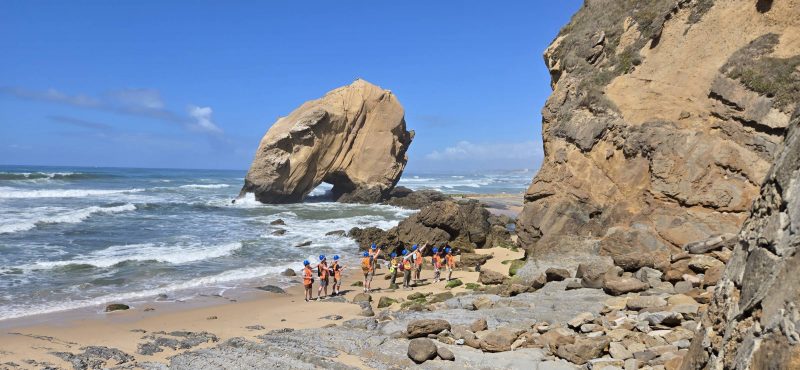
Atlantic Sedimentary Basin research site, Portugal
With their groundbreaking research into past climate events, UM researchers are positioning themselves at the forefront of global efforts to understand and prepare for future environmental challenges and opportunities. Their work will play a vital role in shaping policies that balance resource management with sustainability, ensuring that decisions are guided by data and focused on protecting the environment.
2024-25 John R. Evans Leaders Fund (JELF) funding at UM:
Hooman Derakhshani (Applied Animal Microbiology) Microbiome solutions for mitigating environmental impacts of the livestock industry, $159,999
Renée Douville, Henry Dunn (Pharmacology and Therapeutics) Subcellular Protein Assembly (SPA) platforms for investigating mechanisms of neurological disease, $344,169
Julia Gamble (Anthropology), Kirstin Brink, Michael Schindler (Earth Sciences) Multimodal imaging and digital applications to deep time biorhythms and developmental biology, $513,071
Peng Hu, (Electrical and Computer Engineering) Infrastructure to advance the study of space-air-ground integrated network systems and applications, $160,000
Savino Longo, (Physics and Astronomy) Sub, atomic particle detector innovation laboratory, $159,872
Barbara Porto (Medical Microbiology and Infectious Diseases) The respiratory infections modelling lab: Enhancing capacity for aerosol exposure and lung mechanics studies, $155,600
Ricardo Sliva, (Earth and Resources) Sedimentary organic matter research facility, $156, 670
Cedric Tremblay, (Immunology), Samantha Pauls (Pharmacy) ImmunoMetabolism Suite (IMS) for translational research, $345,000
Chengjin Wang, (Civil Engineering) Triple quadrupole liquid chromatography–mass spectrometry for micropollutant control investigation, $159,753
Research at the University of Manitoba is partially supported by funding from the Government of Canada Research Support Fund.