







2025 UM Vanier Scholars clockwise from top left: Barret Monchka, Deanne Nixie Miao, Md. Abdul Aziz, Chamali Kodikara
Meet UM’s 2025 Vanier Scholars
Four UM graduate students have received the prestigious 2025 Vanier Canada Graduate Scholarships.
The PhD students at UM are among the 166 scholars in the 2025 cohort. They conduct world-leading research in the Rady Faculty of Health Sciences and the Faculty of Agriculture and Food Sciences, receiving $150,000 each, over three years, to continue their research.
“We are incredibly proud of our four Vanier scholars, who represent the best of research leadership in Canada,” says Dr. Mario Pinto, Vice-President (Research and International). “UM is pleased to provide the research infrastructure and mentorship to help these promising graduate students to achieve their goals and work to solve the world’s most pressing problems.”
UM’s 2025 Vanier Scholars
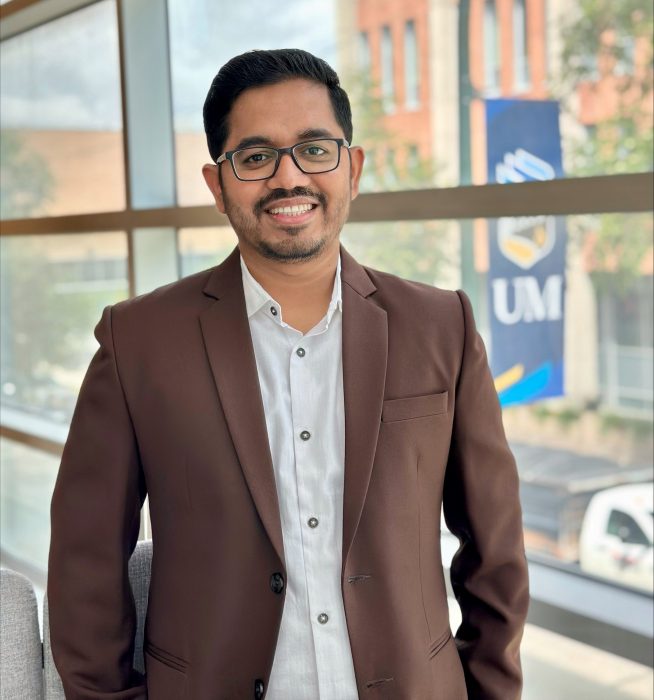
Md. Abdul Aziz, photo credit Mahin Hasan
Md. Abdul Aziz is a PhD student in the College of Pharmacy, Rady Faculty of Health Sciences.
Trends in antidepressant use for mental health disorders in Manitoba
Aziz’s research aims to understand real-world patterns of antidepressant use over a long time period. Millions of people take antidepressants to help them with mood and anxiety disorders, but many discontinue their medications early. Aziz is using Manitoba population health data to determine what factors force someone to discontinue their medications. He is also examining how often specific antidepressants are used, especially when a person’s genes might influence how they respond to these medications.
“This is a dream come true and fills me with immense gratitude,” says Aziz. “It is an honour to be recognized for my research and provides me with invaluable freedom to devote my time to bridging the gap between health-care professionals and patients to optimize drug therapies.”
His work is supported by the Canadian Institutes of Health Research.

Barret Monchka
Barret Monchka is a PhD student in the College of Community and Global Health, Rady Faculty of Health Sciences.
Improving data linkage techniques to enhance research reliability, efficiency and privacy protection
Monchka’s research will enhance the accuracy of patient-oriented research by improving how researchers link data from diverse sources, such as health, education and income. Weaving together these siloed data sets allows researchers to improve their understanding of the non-medical factors that impact health outcomes. His work will strengthen the foundations of public health research and will lay the groundwork for developing future AI models to be more equitable.
“Receiving this highly competitive award is an incredible honour,” says Monchka. “It allows me to continue advancing research at the intersection of population health, computer science and statistics and showcases the importance of using quality data to improve health outcomes.”
His work is supported by the Canadian Institutes of Health Research.

Chamali Kodikara
Chamali Kodikara is a PhD student in the Faulty of Agriculture and Food Science in the Department of Food and Human Nutritional Sciences.
Enhancing wheat safety through new strategies for better detection and management of Ergot contamination
Kodikara’s research focuses on protecting the quality and sustainability of Canada’s world-renowned wheat by detecting and reducing naturally occurring toxins called ergot alkaloids. These compounds are produced by fungi and can pose human health risks if they enter the food supply. Her work uses high-resolution mass spectrometry and cold-plasma processing as innovative tools to improve grain safety.
“The Vanier Scholarship affirms the value of my work and the role I can play in advancing food safety, sustainability, and public well-being. This support allows me to expand knowledge, build partnerships, and be a force for positive change that benefits people in Canada and around the world.”
Her work is supported by the Natural Sciences and Engineering Research Council.

Deanne Nixie Miao
Deanne Nixie Miao is a PhD student in the department of biochemistry and medical genetics in the Max Rady College of Medicine, Rady Faculty of Health Sciences.
Understanding the genetics of hearing loss caused by cisplatin
Miao’s research focuses on cisplatin, a widely used cancer drug that can cause hearing loss in up to 80 per cent of patients. It especially affects children, who are at a three-fold higher risk of developing cisplatin-induced hearing loss compared to adults. Despite its prevalence, there is a knowledge gap regarding how genes, pathways and specific ear cells are affected by cisplatin. Miao will use cutting-edge single-cell technologies to identify specific genes, pathways and ear cells to help predict and prevent hearing loss.
“Receiving the Vanier Scholarship reinforces that my work and my voice belong in research,” says Miao. “As a Filipino-Canadian PhD student, I don’t often see people in my field who look like me. This honour gives me the confidence to grow as an independent researcher and inspires me to contribute to solutions that can improve the lives of people affected by drug toxicities.”
Her work is supported by the Natural Sciences and Engineering Research Council of Canada.
Vanier Scholars are chosen for their academic excellence, research potential and leadership. Students are nominated by their university, evaluated by multi-disciplinary peer-review committees and selected by a board composed of world-renowned Canadian and international experts.
“While this is the last year of the Vanier competition, UM’s Vanier scholars continue to be recognized for their groundbreaking research and academic excellence. This funding allows them to continue their journey to transform our world through their research, leadership and desire to make a difference,” says Dr. Kelley Main, Dean, Faculty of Graduate and Postdoctoral Studies. “Congratulations to all of them on this outstanding achievement.”
A total of 59 UM graduate students have been named Vanier Scholars over the past 17 years.
Research at the University of Manitoba is partially supported by funding from the Government of Canada Research Support Fund.