






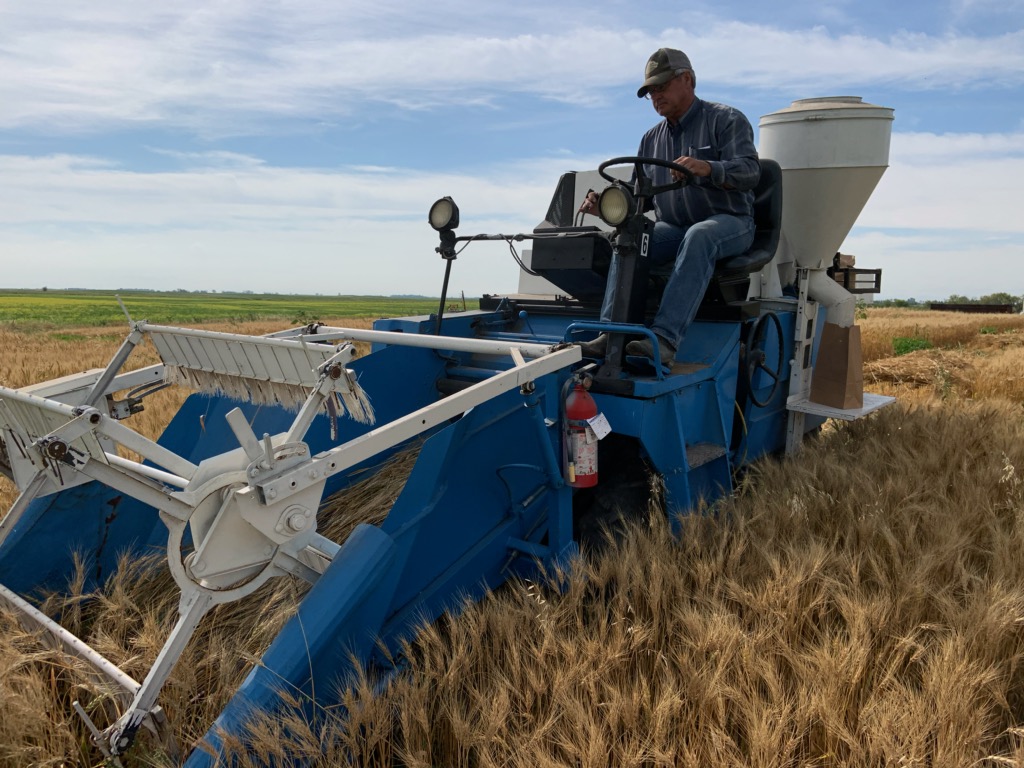
David Rourke operating a piece of farming equipment on his property.
“Net Positive” Carbon Grain Farming – An Interview with PhD Graduate, David Rourke
In this article, PhD graduate David Rourke from the Natural Resources Institute is interviewed about his approach to lower emissions and how to mitigate the environmental impacts caused by the farming industry.
As the global conversation around climate change intensifies, the agricultural sector is emerging as both a contributor to the problem and a potential part of the solution. In this interview, we explore the concept of “Net Positive” carbon grain farming with PhD graduate, David Rourke, through his thesis. Rourke is a seasoned grain farmer and researcher who focuses on the Northern Great Plains.
Drawing from his experience in Zero Till farming, a deep commitment to climate responsibility, and a passion for leaving a better world for his grandchildren, Rourke offers a grounded yet innovative perspective on how farmers can lead in the fight against global warming.
What exactly is “net positive carbon grain farming” and why is it important?
David Rourke: “Net Positive”, or “NP” carbon grain farming is the ability to drastically lower emissions and increase carbon sequestration to the point where sequestration is larger than emissions. While many countries and companies have a target of Net Zero in place for 2050, grain farmers [are sought] due to the ability to sequester atmospheric [carbon] into the soil. This helps increase the productivity of the fields at the same time as it sequesters the extra carbon. This makes farming quite unique.
Why does your research focus on the Northern Great Plains?
David Rourke: While most of my work is in Western Canada, the term Great Plains also included the western plains of the USA. Three of my participants were from North and South Dakota. The Great Plains are a semi arid to sub-humid growing region, making them distinctly different from the humid soil zones of Eastern North America where 40 inches of rain is normal, whereas the Great Plains would have 10 to 20 inches of annual participation. Some “Best Management Practices”, or “BMPs” that work well in a place like Guelph fail when tried in the Great Plains area — unless there is irrigation.
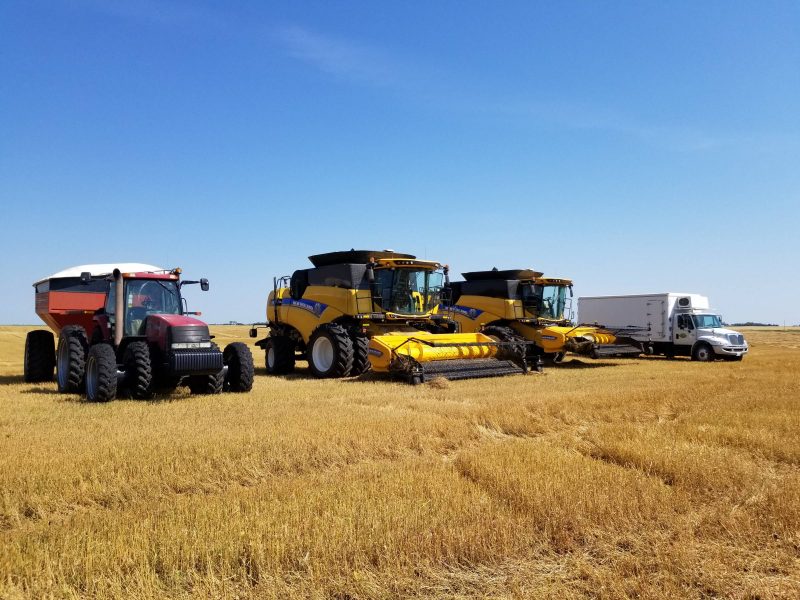
A series of different sized equipment used by David Rourke on the farm.
What is your background like, and how has it influenced your approach to this work?
David Rourke: First, I am an active grain farmer in the Great Plains and have experienced the effects of limited rainfall and occasionally excessive precipitation. My MSc looked at crop residue management in Zero Till. I have been using Zero Till to limit erosion, increase water use efficiency and fertiliser efficiency since 1980. Although from time to time I have ventured off the path looking for something better, repeatedly a Zero Till based production system gives the best results. However, my general rule is that when something becomes the preferred system of production and is used continually, nature finds a way to leverage those vulnerabilities. Zero till’s vulnerability is herbicide resistance; we must be vigilant in this regard.
What methods of analysis have you found most instrumental in your studies, and why?
David Rourke: My study used narrative research based on in-depth qualitative interviews. Using a number of sources and connections I was able to identify 16 participants who I considered to be interested in and, in some cases, successfully active in developing Net Positive practices on their own farms. Dr. Debra Davidson, in a 2019 study conducted in Alberta, found up to 90% of the farmers surveyed did not believe the climate was changing or did not believe the 100 million barrels of oil equivalents that the world uses every day could possibly have any effect on the climate. Thus, to find these 16 participants that believe in anthropogenic global warming, or “AGW”, and want to be part of the solutions makes them innovative and unique.
Can you expand on your journey as a student, and what led you to studying at the Natural Resources Institute?
David Rourke: When I first looked for a project, a university, and an advisor to do the PhD, I looked at several quantitative projects at North Dakota State University, University of Saskatchewan, University of Guelph as well as UM. After a discussion with Dr. Martin Entz about a project where I would interview farmers on their innovative practices, he suggested I talk to Dr. Iain Davidson-Hunt at the Natural Resources Institute at the UM. This was the right choice for the project and for me. Covid was a blessing for me and my project. I took all my courses online and did all my interviews on Zoom. It was efficient and low carbon. I perhaps did not have as much collegial interactions as would 25-year-old on-site students, but being an active farmer and living 250 km from the UM, [along with] Covid and on-line technology made the project feasible.
While my scientific experience in the 45 years leading up to my PhD study was in quantitative science (small plot replicated research), I was looking for a new system; a system developed by farmers who were already trying to address AGW. And at the same time looking to record their successes, enablers, as well as failures, or at least the gaps and barriers that limited their ability to move the needle. I developed the BERT/E adoption rating score allowing me to characterize the strength of BMPs that were being promoted in Western Canada to tackle AGW. The interdisciplinary approach used at NRI was an excellent fit to this type of qualitative discovery.
David Rourke posing for a photo on “Rourke Farms” property.
You’ve mentioned your grandchildren as a key factor in your motivation behind your work. Could you expand on how they inform your research?
David Rourke: There is a saying, if you were born in Canada, you have won the lottery of life. I have had a blessed life, I have been privileged, not that I come from a rich family or was given a large sum of money to start life. I was privileged to be encouraged and enabled to go to university, to find a life partner when I was only 17, being given a chance to rent 300 acres to farm as a start and over time able to buy 6000 acres, completing a M.Sc. degree and then using all of that to leverage many opportunities, including the development of the largest independent field research service company in Western Canada. The point is for the last 100 years the world has grown in an unbelievable way based on the ignorance of negative externalities caused by our fossil fuel-based societies. It is “payback time” if we have any hope of our descendants to have anywhere close to the blessed life our generation has had. Pope Francis in his “Encyclical on Climate Change and Inequality”, states that man has created this climate change problem and it is not right to pass it on to the next generation, we must take responsibility now. I have 9 grandkids who depend on us to make the right decision and actions now.
Have you noticed any challenges or pushback from other farmers? What opinions have you encountered?
David Rourke: I developed the language and an approach for my research so that my conversations with farmers and others working in western agriculture were a step in the evolution of best management farm practices (BMPs). Fortunately, the ways to become Net Positive are also ways to increase profitability and resilience on many Western Canadian farms. I use [terms] such as No Regret BMPs, Neutral BMPs , Sacrifice or even Dead End BMPs to sharpen the point of the readiness of specific BMPs to be taken up by western grain farmers in their farming operations. Being a commercial grain farmer helps me to consider language that will speak to farmers in their assessment of BMPs to move towards net positive for their farms. Unless the BMPs can make farm practice either more profitable, faster, or easier to do they are not likely to be adopted by farmers. This is not theory – it is reality on my farm as it is on all farms. I have found some people that get quite excited believing that AGW is not a real thing. We need to find the common ground focusing on BMPs that are good for the farmer, society, and the environment – I believe my research is a step towards that goal.
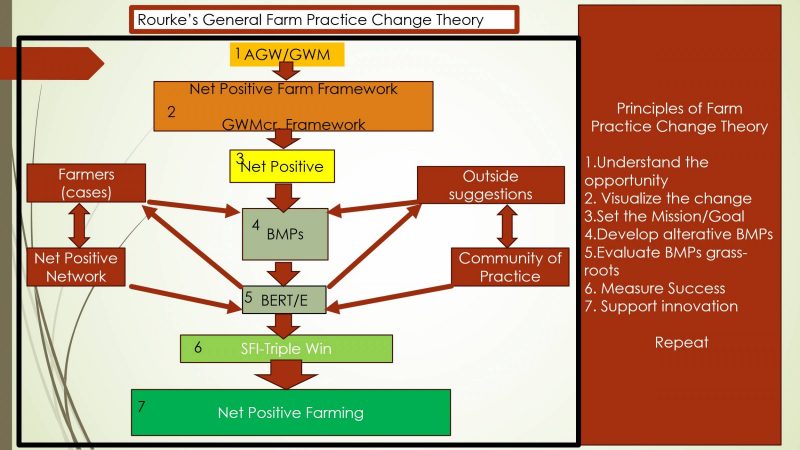
A diagram created by David Rourke that illustrates his “General Farm Practice Change Theory”.
What’s next for you and your work?
David Rourke: I am looking for opportunities to use my finding to help move the needle. I have made presentations to Agriculture and Agri-food Canada’s agriculture policy advisors, to conservation NGOs, and to farm groups who believe in Net Positive. I have an extensive quantitative field research program on Soil Health, Biological Nitrogen replacement products and a Zero Till project on dry beans, which can be tricky to get just right. My field tour was July 29th, 2025 at Minto, Manitoba. The plot work is supported by Living Labs, (Manitoba Association of Watershed and AAFC), Scotiabank, MB Forage and Grassland Association, MB Pulse and Soybean Growers, MB Crop Alliance, and MB Canola Growers.
I am also pursuing the development of a Net Positive Farm Network and NP Community of Practice. The NP Network would be a think tank and information sharing network but could also be valuable as a unique interface to connect with what I call the Science Based Target Initiative (SBTi) companies who have set Net Zero by 2050 pledges and are looking for Net Zero or NP supply chains. This would help identify gaps and solutions, and in the end, help demonstrate new No Regret BMPs.