






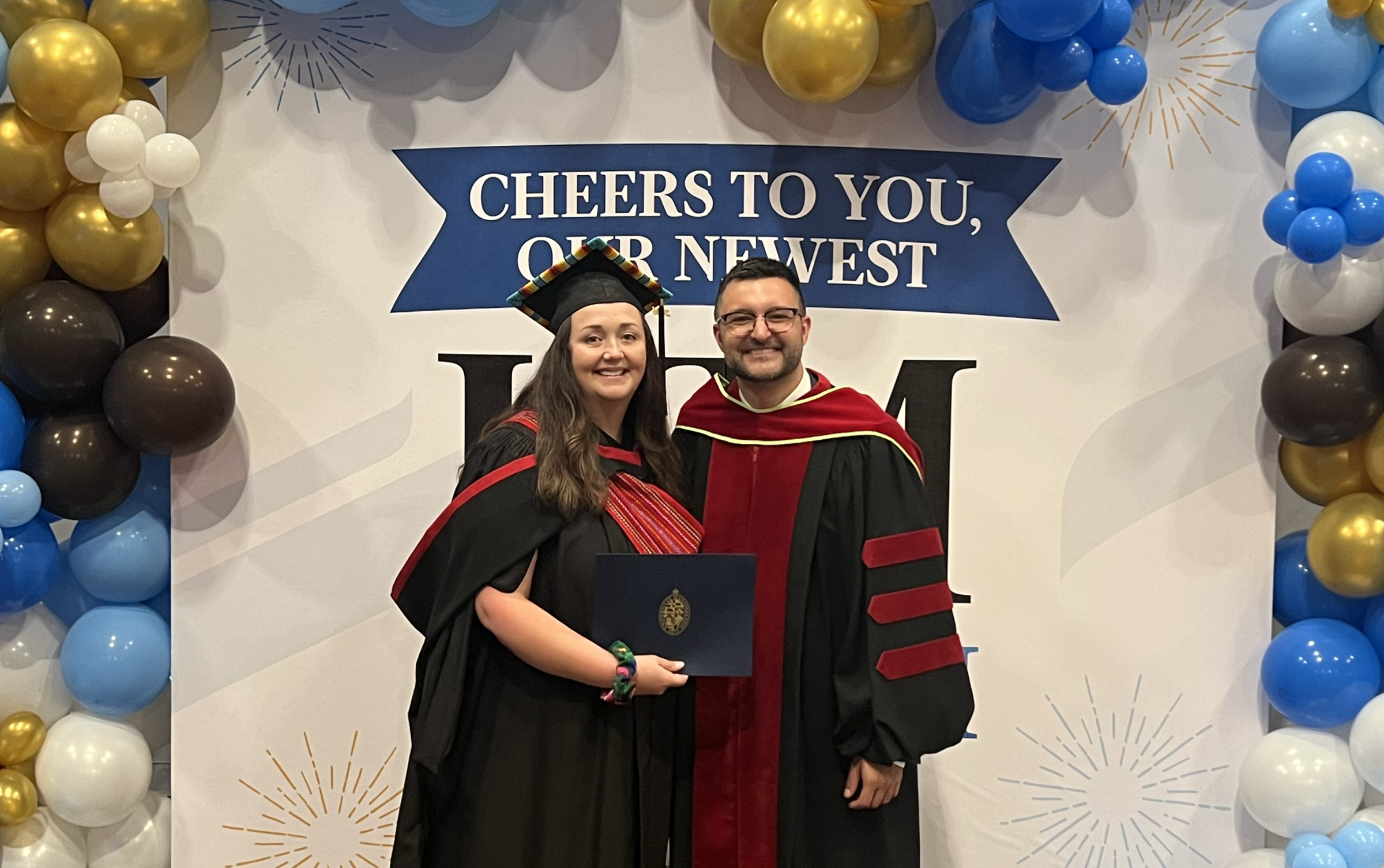
Tara Christianson, UM Distinguished Master’s Thesis Prize recipient with Dr. Rusty Souleymanov, Associate Dean, Faculty of Social Work
Meet Tara Christianson, recipient of the 2025 UM Distinguished Master’s Thesis Prize
Tara Christianson recently graduated from the Master of Social Work program and received a University of Manitoba Distinguished Master’s Thesis Prize for her thesis titled: The Impact of COVID-19 on Services for Indigenous People Who Use Substances and Are Living with HIV in Winnipeg, Manitoba. The prize is given out annually to recognize the achievements of Master’s graduates who submitted groundbreaking theses in the previous academic year. The Faculty of Social Work congratulates Tara and looks forward to learning more about her experience in the program, her current research interests and her plans for the future.
Can you tell me a little bit about yourself?
My name is Tara Christianson; I was born and raised in Treaty 1 territory and have lived in Winnipeg for the past 18 years. I am Red River Métis, citizen of the Manitoba Métis Federation and a member of the Bison Local. I also have Scottish, Irish, and English settler ancestry. I’m a mom, a partner, sister, daughter and auntie. I’m also a registered social worker that works in the mainstream health care system.
What is your research about and why did you choose this particular topic for your thesis?
My MSW thesis explored the impact of COVID-19 on services for Indigenous people living with HIV who use substances. As someone working on the front line of health care throughout the COVID-19 pandemic, I witnessed the rapid changes to service and the detrimental impact it had on many individuals already marginalized by a colonial system designed to oppress, such as Indigenous people and people who use substances. Research, particularly highly medicalized HIV research, tends to be rooted in westernized concepts that do not acknowledge the vast Indigenous knowledge systems that exist. The community-based research design of my thesis provided me the opportunity to engage directly with community to learn their experiences and perspectives in relation to accessing and providing services during that time. I believe that community knowledge is the key to addressing many of the harms experienced within systems by rejecting deficit-based models of care and centering the wisdom, practices, and relationships within Indigenous communities. Utilizing Indigenous Storywork helped me to remain grounded within that understanding throughout the entirety of my thesis.
What program are you graduating from and can you tell me a little about your experience in the program?
I graduated from the Faculty of Social Work Master’s program. I started the program in the height of the COVID-19 pandemic when all classes were still online, coming to in person classes during the last semester of my program. I was fortunate enough to have connection with the Village Lab and developed relationship with other students, faculty, and community throughout that time.
Dr. Rusty Souleymanov was my faculty advisor as well as mentor through the Village Lab where he is the director. I am grateful to have been matched with Dr. Souleymanov and am looking forward to continuing my work with him during my PhD. I was fortunate to be able to ground myself in community and Indigenous research methodologies with his guidance and support.
Do you have any advice for students interested in the MSW program?
Consider the thesis route and choose a research topic that you are truly passionate about. I entered the social work profession with the intent of disrupting the systems that perpetuate harm – many of which this profession has had a foundational and ongoing role in. For me, I feel that this academic route is helping me do that. I am grateful to have the pleasure to engage in community-based research and am deeply honoured for the stories that have been shared with me through this work. I have a deep commitment to community and ensuring that those stories are brought forward in ways that work towards lasting change.
Any other information you would like to share? Vision for the future? Other research interests?
This work for me is ongoing. I’ll be starting my PhD in social work in September 2025 and look forward to expanding on some of the findings from my MSW thesis, notably surrounding folx who use substances and are currently unhoused. I’ll be working from a community-based research design and incorporating the Métis Kitchen Table approach. I think that it is absolutely necessary as well to continually be working to decolonize academia and utilizing Indigenous research methods that move beyond western models and concepts.
Lastly, I would like to express my sincere gratitude to the Faculty of Social Work for the nomination. I am humbled and honoured to be one of this year’s recipients. I am very happy to see the recognition for these insightful and meaningful stories gifted by community.