







How Will Connectivity Change Life in the North?
A caribou hunter rides his snowmobile onto a frozen inlet, guided by knowledge passed down through generations.
But climate change is reshaping the ice—it freezes later, breaks earlier and is far less predictable. One wrong move can be deadly. And when accidents happen, survival depends on getting help fast. Yet in most northern communities, there is no cell service and satellite connections are unreliable.
Search-and-rescue crews near Hudson Bay head out about 10 to 12 times per week, says Phil Ferguson, Associate Professor of Aerospace Engineering at UM. “And many times they don’t have a good ending.”
Ferguson leads UM’s Space Technology and Advanced Research (STAR) Lab, where he works with northern communities to co-develop aerospace solutions—from satellites to drones—to keep people connected.
We asked him: How will connectivity change life in the North?
Reading the ice, locally
Ferguson’s team and the community of Chesterfield Inlet are co-developing ArcticSat, a satellite that tracks how sea ice forms and breaks up across Hudson Bay.
“The ice is changing rapidly,” Ferguson says.
ArcticSat’s sensors will beam data straight back to Chesterfield Inlet, where locals—not distant agencies—will be the first to see it. There, it can be combined with generations of Indigenous knowledge, turning streams of numbers into practical guidance for hunters heading onto the ice.
“It’s not about communities coming, hat in hand, asking for data about their own land,” Ferguson says. “They own it. They operate the system. And they decide what to do with it.”
Where once-reliable patterns of freeze and thaw are no longer certain, that kind of immediate, local control over information will save lives.
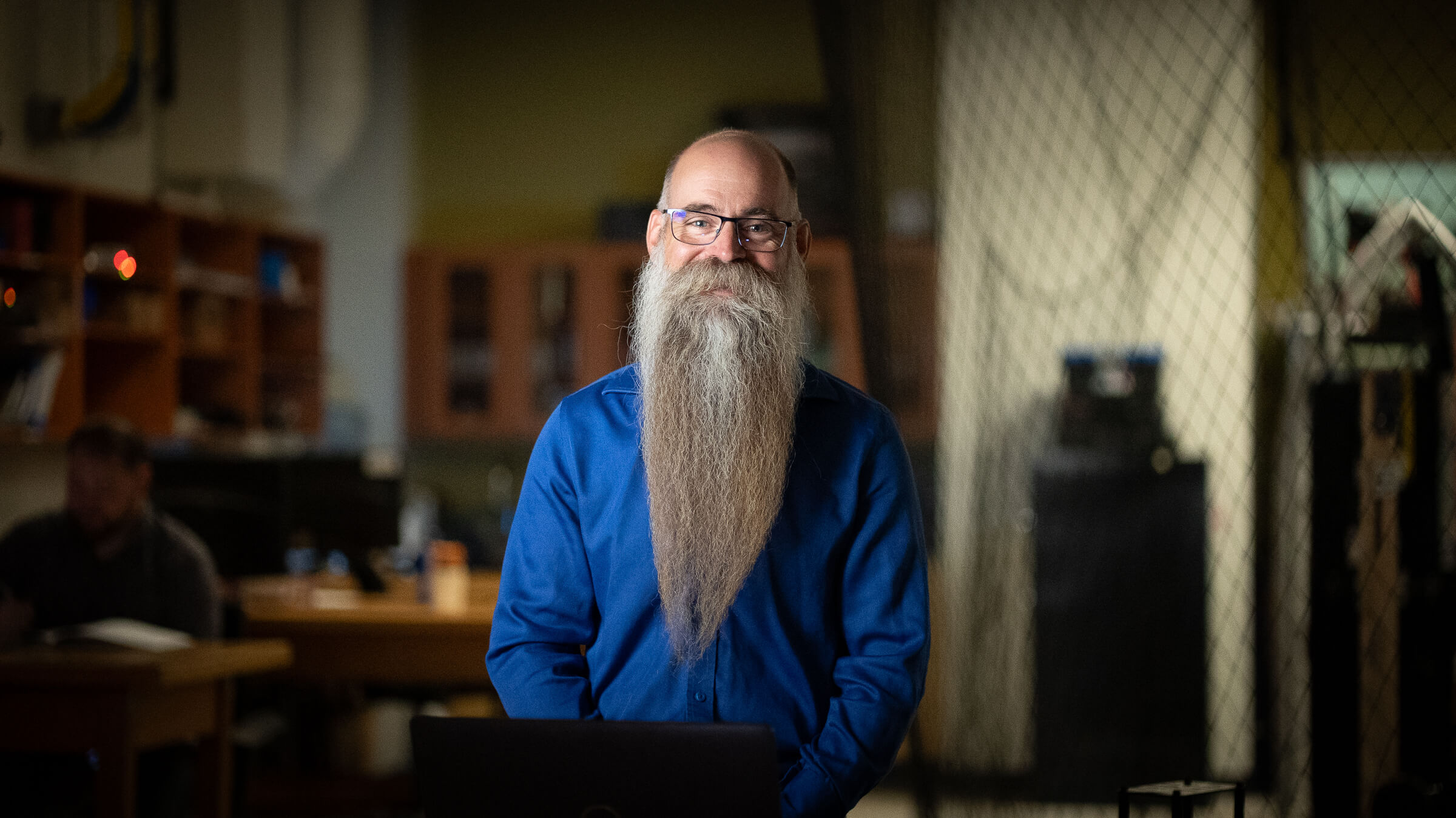
Phil Ferguson, Associate Professor of Mechanical Engineering at UM
Lifelines of communication
On a visit to Chesterfield Inlet, Ferguson learned how central the local radio station is to daily life. When its transmitter broke, the community went weeks without it. Teachers, doctors and parents all told him the same thing: without the radio, basic coordination became difficult.
“The community absolutely relied on that radio because it was the only way for them to talk to each other,” Ferguson says.
That’s why the ACCESS project (Arctic Community Connectivity for Equity, Sustainability, and Service) is so important. Ferguson’s team is working with northern partners to develop drone airships carrying satellite ground stations that can deliver Wi-Fi to communities. Instead of fragile, patchwork systems, people would have a dependable way to connect, and all they’d need is a smartphone.
With that kind of coverage, hunters stranded on thinning ice could reach rescue teams instantly. Patients could see doctors through telehealth appointments. And neighbours could better share the everyday messages that keep a community running.
Beyond the signal
On another visit to Chesterfield Inlet, a councillor pointed to a ship anchored in the bay and asked why her community didn’t know where it had come from, how long it would stay or what it was carrying.
Canada tracks ships from space, Ferguson says, but the information rarely reaches the people who live beside the harbour.
That gap is what drives his approach to connectivity. In projects like ArcticSat and ACCESS, local residents are collaborators, shaping how information is gathered and shared.
“They may not have the PhDs and masters,” Ferguson says, “but they’re researchers. They research the land, they research the climate, they research the wildlife.”
“Connectivity is the foundation for everything,” he adds. “We need to connect people to learn from one another. We need to connect people to stay secure in an increasingly uncertain geopolitical world. And we need to connect people to be resilient to climate change.”
WHAT THIS MEANS FOR THE REST OF MANITOBA
Wildfires
Ferguson’s drone airships could also sweep across the boreal forest, scanning for heat before a spark grows into disaster. The drones would carry sensors tuned to pick up faint signatures of fire and, unlike lookout towers or flyovers, they can stay in the sky for days at a time. UM researchers are already exploring how such systems could guide firefighting quadcopters and support water bombers.
Precision farming
On the Prairies, farming is becoming increasingly data-driven. Drones equipped with cameras and sensors can map soil moisture, monitor plant health and track pest pressure from the air. A drone can capture the images, but connectivity is what turns those snapshots into action. With fast, dependable Wi-Fi, farmers can upload data in real time, sync equipment across the field and apply seed or fertilizer exactly where it is needed.
Where most people see problems, Bisons see solutions. Explore and meet UM researchers—like Phil Ferguson —who are changing lives in Manitoba and beyond.
Philip Ferguson is an Associate Professor of Mechanical Engineering at the University of Manitoba and the founding Director of STARLab (Space Technology and Advanced Research Laboratory). He holds the NSERC / Magellan Aerospace Industrial Research Chair in Satellite Engineering. Ferguson’s work spans drone navigation, airships, CubeSats and remote sensing, with a focus on making aerospace technology accessible to northern and Indigenous communities. Check out his discussion with UM President Michael Benarroch on the What’s the Big Idea podcast.
Undergraduate researcher explores Arctic engineering innovation