






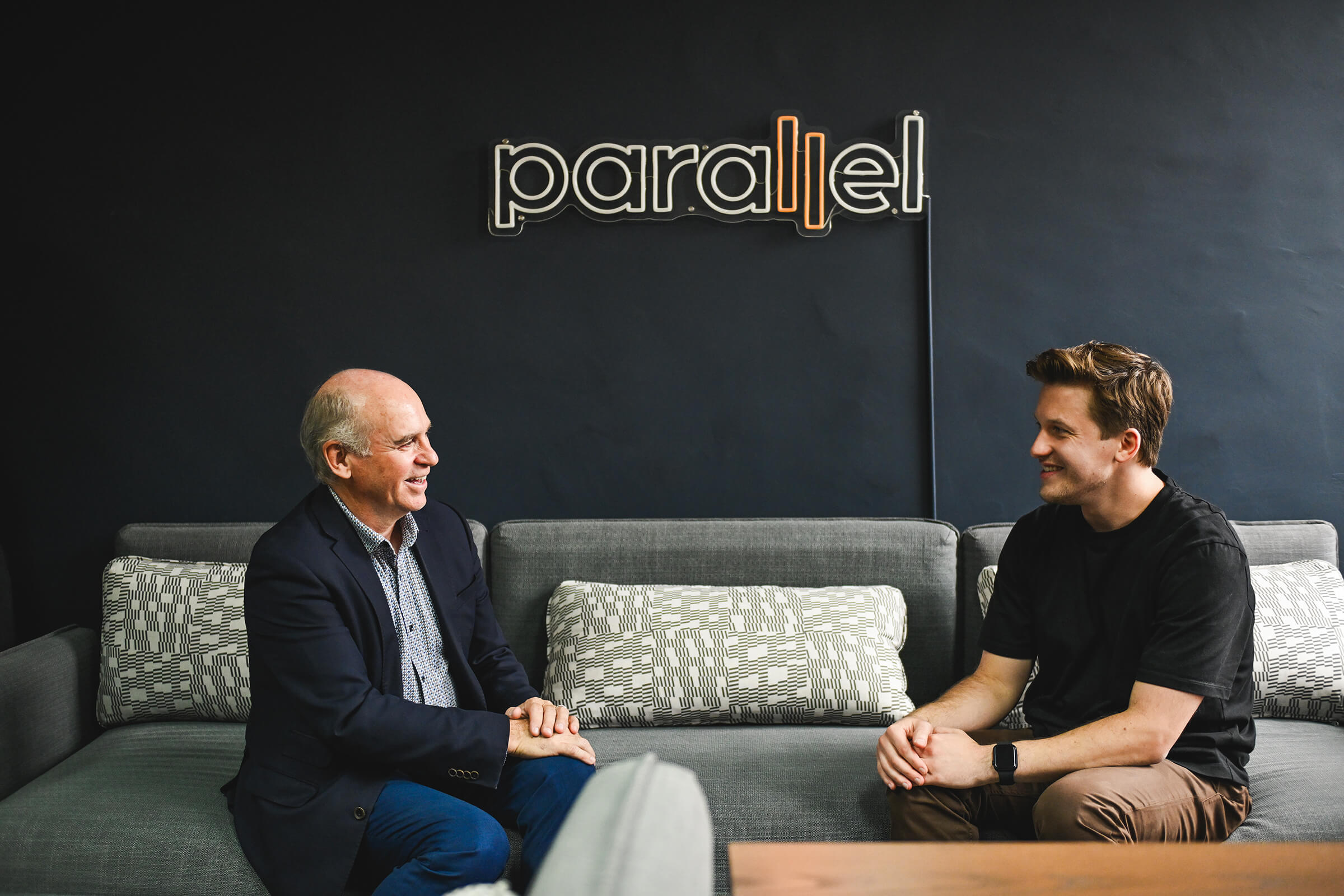
Chris Schmidt’s resume is impressive. By 10, he started a tree banding company that became so successful he didn’t sell it until last spring. By 26, Schmidt [BSc/16] developed Snapchat’s first custom filters and his company, Geofilter Studio, was the fastest growing in Canada, with 24,000 per cent growth in one year and clients like McDonald’s, Starbucks and Coca-Cola.
Today, the 31-year-old entrepreneur is creating AI technology to solve a global problem that has stumped the largest players in online clothing sales: how to better match consumers with their correct size and reduce costly returns piling up in landfills. Already, his solution—a social commerce platform called Parallel—has 4 million users across 194 countries.
On top of all this, the prolific entrepreneur is a new dad. One who has since cut back his hours to 80 a week.
UM Chancellor Dave Angus caught up with Schmidt at his Winnipeg office for an inside look at what’s next in data and AI for this first installment of Angus’ new Bisons in Business series showcasing alumni who are notable in their field.
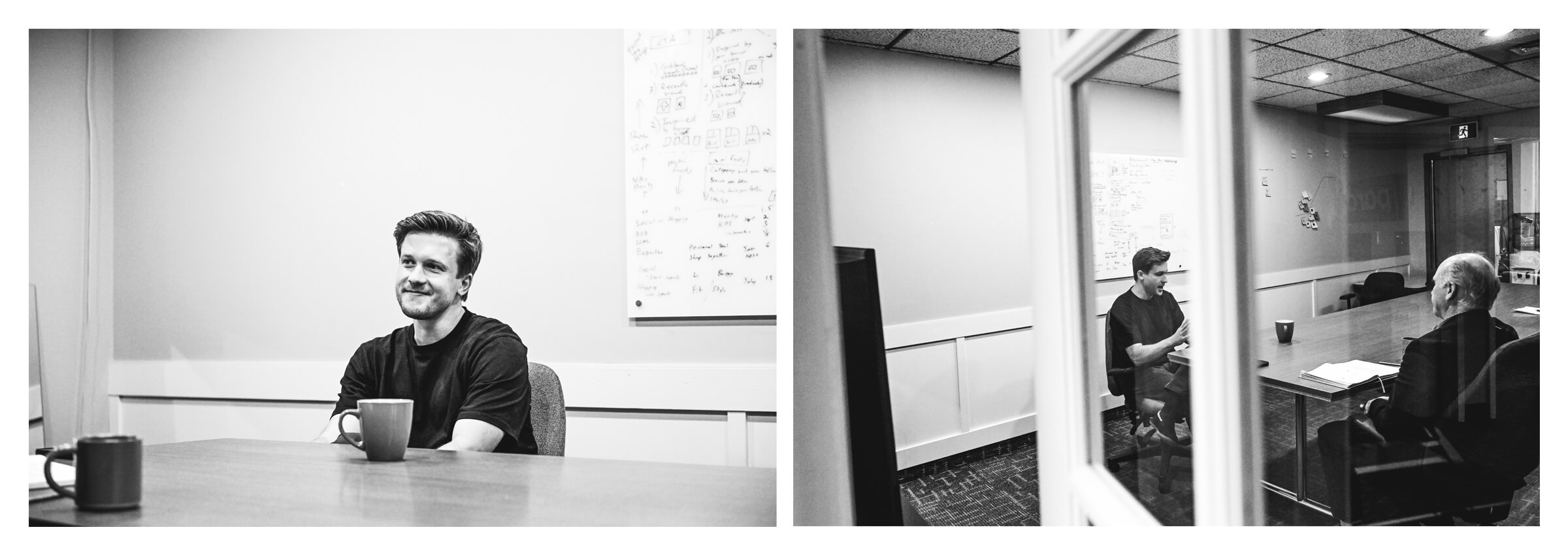
Chancellor Dave Angus: Can you paint a picture of what Chris Schmidt was like as a student at the University of Manitoba?
Chris Schmidt: I was driving my parent’s van to university, parking in Q lot. I’m one of the few kids who showed up in mid-January. I worked hard, studied hard, was part of different student councils and extracurricular activities. I started a business at university. This was before Facebook marketplace and before Kijiji was a staple. I built a company that helped facilitate the exchange of textbooks.
How early did the entrepreneurial bug hit?
It started young, working for my dad. He would pay five cents for every acorn that we picked up in our yard. We’d get a bucket, me and my brother. It was a win, win—we got $7, and my parents saved $70 from not having a lawn crew do it.
Let’s talk about your current business, Parallel. How did that start?
Back in 2017, I was running the Snapchat filter business and Google calls me one day and said, ‘You’ve built one of the best Google ad campaigns we’ve ever seen.’ It’s a case study today at Google, and that allowed me to work with Google’s advertising team, and I got to see behind the scenes of how Google serves you ads.
I was noticing that with all this data they have on you as a user, they’re missing a data point. So, in 2018, I had the idea of starting an AI company—long before it was sexy—and my thought was: How could I capture the human body dimensions from a photo? Because if you had that data point it was the final piece to tell someone: Hey, you should buy a large T-shirt. I thought it was going to take six months. It took us three and a half years to build that system. With that tool, with only two photos, we get your body dimensions in about four seconds.
Then the thought was: Well, what the heck do we do with this thing? Which is a terrible way to start a business. This is backwards. I don’t recommend this to anyone! But then I thought: Okay, let’s go solve the biggest problem with shopping online, which is not knowing what size to buy. And the initial plan was to take your body dimensions from our system and match you to a size guide. But that’s what everyone else in the world does. So option two, which I was hesitant to do because I understand the scale it needs, was to build Parallel.
Parallel is a combination of Pinterest, Instagram and Amazon. It allows you to discover fashion, to see people with your dimensions wearing outfits. If you like an item, you can click on the item and see what size they wear and buy the item right on Parallel. We are basically building a massive social shopping platform to solve the sizing problem.
And by solving the sizing problem, you’re reducing costly returns and reducing waste.
What most people don’t realize is when you return the item, it goes to a landfill. The cost to restock and put it back in the supply chain just doesn’t make sense. Forty per cent of online sales in apparel are returned, on average. And 60 per cent of the time it’s due to the wrong size. This is a massive problem, from sustainability to customer sentiment.
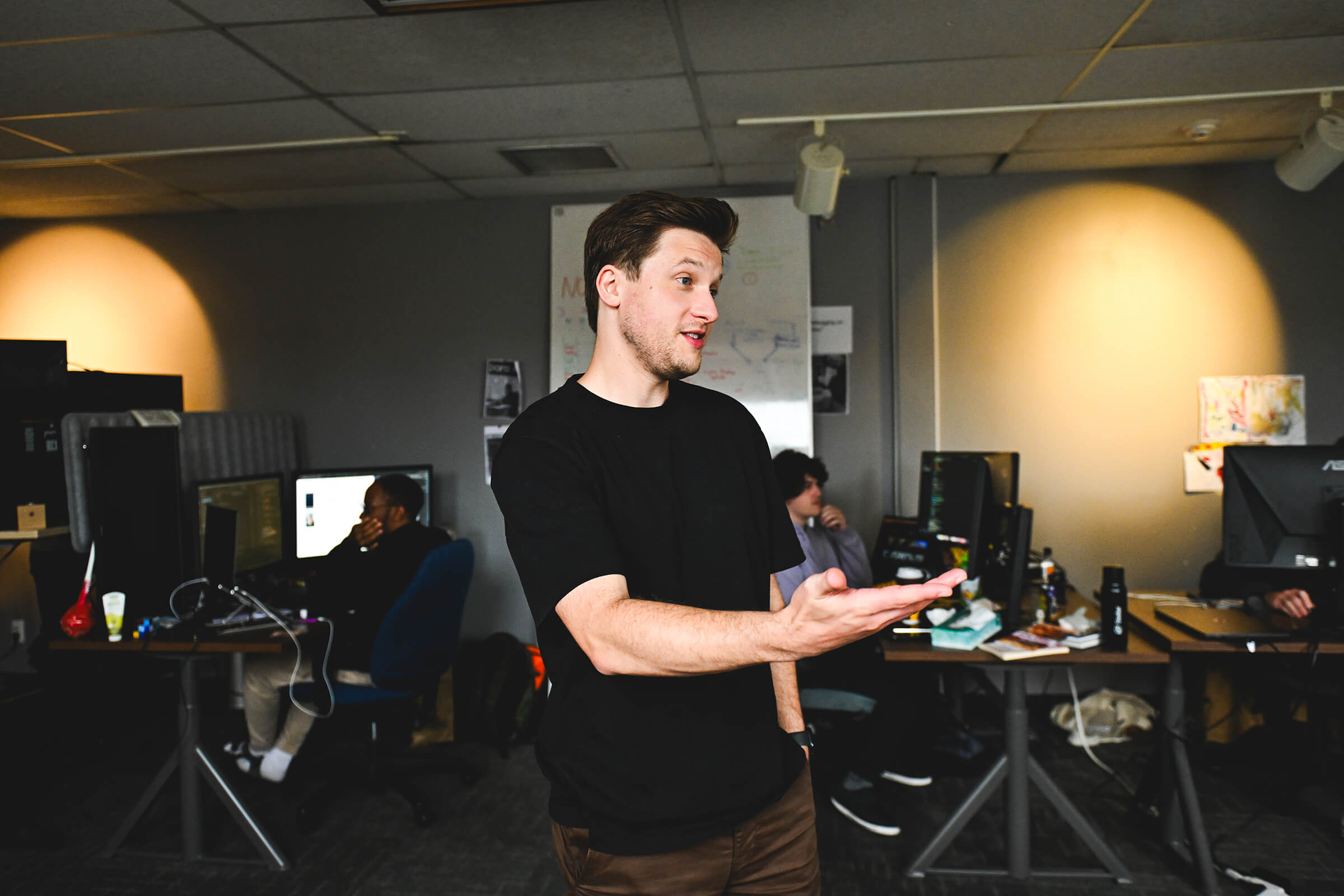
Parallel is a unique marketplace. “There’s three sides to it,” Chris Schmidt says. “There’s the creators posting content on the site, there’s the brands that you buy the content through, and then there’s the actual shopper. One of the biggest challenges we’ve had for four years is building a three-sided marketplace, not two.”
I was very excited to come talk to you about AI and your view about where things are going.
It’s been really interesting to see the evolution. I told investors in 2018 about AI and they couldn’t care less. It was NFTs. It was crypto. I had a prominent investor suggest we stop doing AI and do crypto instead, because that was the boom. And I respectfully said, ‘You know, I think we’re going to keep this path.’ A year later he apologized, after crypto crashed. We have built dozens and dozens of AI models and data sets. So we really understand the nuances of AI. We understand what OpenAI is doing in Gemini and all the AI platforms. We can circumvent the hype and understand where the value is, and we can really understand: Okay, we can use AI here for this part of the business, and don’t waste time here.
A recent MIT study said 95 per cent of AI projects being implemented have failed at corporations because people are still unsure how to implement AI. And Sam Altman, CEO of OpenAI, said AI is overhyped. I’ve been saying that for a long time. AI is overhyped in the short term until we understand how to use it, right? It’s been interesting to see how the world has been catching up to where we’ve been.
What would your advice be to businesses that have started up since the race to AI?
The hardest thing for employees and any businesses is accepting change, as you know. Employees have to be open to AI. They have to test it. You sign up for 20 bucks for all the different models and you have to be smart at how you implement it. And there might be times when you say: I don’t need AI for that, but I need it for this. And knowing that is the value, right? That’s the trick.
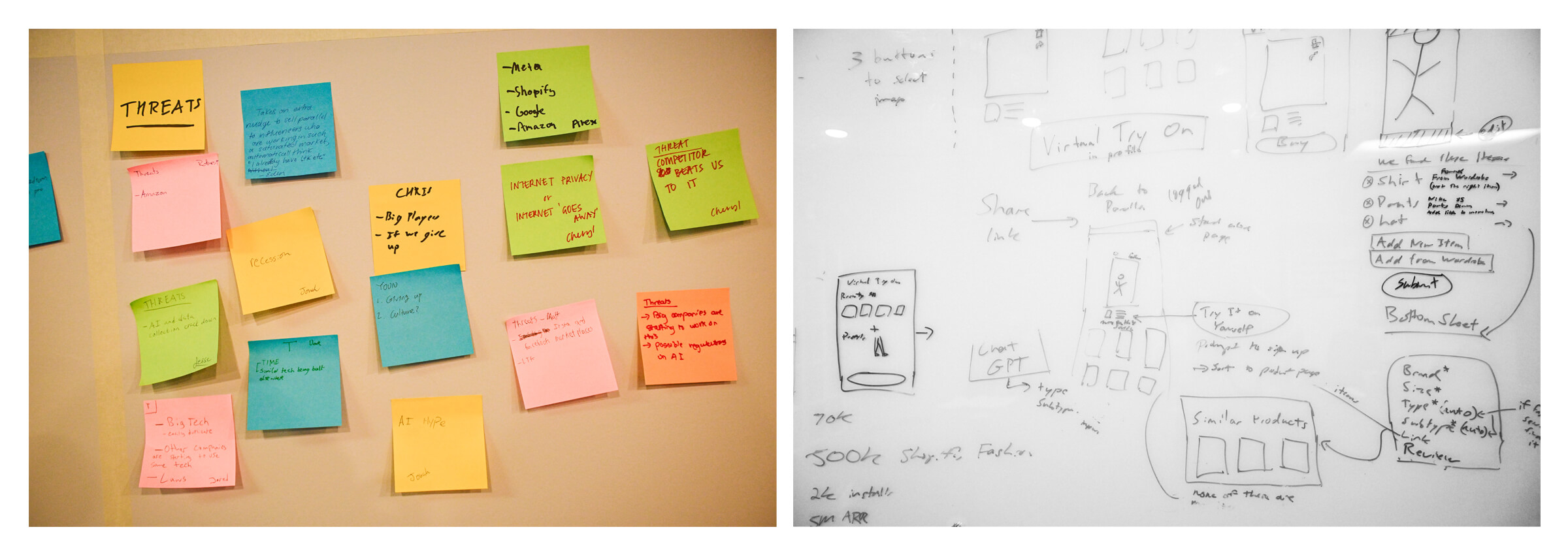
Sticky notes and whiteboard scribbles in Parallel’s boardroom reveal team brainstorming. Chris Schmidt describes his leadership style as “action-oriented.” He says you need to put people first. “If a developer is here until midnight, I’m here with them. I take out the garbage—I pay them too much money for them to be taking out garbage. They should be writing code. I’m here to serve them, to create an environment that they can do their best work in.”
What is your advice to universities on how they should approach this new technology?
Universities, very much like a corporation, must realize there’s a huge shift happening now and you have to be open to ‘Okay, this is the new norm.’ We’re going to have students using AI to write essays. How do we think we can change our education system to allow that, or to encourage that? I’ve always thought it’s funny when people will build AI to detect plagiarism from AI systems. People are building AI to battle AI. There’s this weird back and forth that’s happening. But the university has to be very much like an employee, open to change, right? And what we’ve been doing for the last 60-70 years is not the next 60-70 years.
Is there more work to do in terms of skill development around AI, too?
There are all these new jobs coming up. I’m getting calls from business owners in the city, looking for an AI intro, or an individual that can do this or that with AI, or can come into their organization. Do I know anyone? And I don’t know any person that could do that. There’s a fear of people losing jobs to AI, but the opportunity and the optimistic side of it is that there’s new jobs. And universities need to understand how they can fill that need.
Chris, you could do business anywhere. Why Winnipeg?
I like it here. I was born and raised here. Winnipeg has not had its shining moment yet. Ottawa had it with Shopify. Calgary is having it right now with some of their big companies. I want to be part of that change in Winnipeg. I feel like I can make an impact here. Before Covid, I had investors asking me when am I moving to the Valley. When am I moving to New York. Since Covid, no one’s asked. It took a world pandemic to show investors you don’t have to be in Silicon Valley to build a great business. Especially in the tech ecosystem, you can feel that there’s this momentum in Winnipeg and I want to be part of it.
What more can UM do to help support the startup community?
There are two things—and UM is starting to do a much better job at this—which is showcase the success here in Winnipeg. There are so many successful people here no one has ever known about. So, doing a better job showing that you can be in Winnipeg and be successful.
The second part, which is why I love the concept around UM’s Idea Start—and what I’ve been talking about for a long time is—the qualities and entrepreneurial skill set you can learn at Asper School of Business can translate to all the faculties. The students coming out of architecture and engineering, they have deep domain knowledge in those fields, but they don’t understand the business side, and they go to a firm, and over 20 to 30 years they become partner, and now they’re running a business, but they’re a trained architect, right? And they have no idea how to run a business. That’s what Idea Start is trying to help with.
Tell me about your relationship with the University of Manitoba today.
It’s funny, there are some buildings that I am in more now, after graduating, than I was when I was in school. I am constantly going back, doing talks, judging competitions. I’m part of the co-op programs. I’m on the advisory board of Idea Start. I’m almost more embedded now than when I was a student.
With all that you know, all the hills and valleys of entrepreneurship, what is your advice for students in terms of what’s most important?
Nothing’s going to substitute hard work, persistence and patience. I’m big on patience. I don’t believe in the quick wins. I believe in the long-term value.
Is it more about the journey than the destination for you?
I’ve gone to the end twice with two businesses, so I know what that feeling is like. But the moments in the journey… the valleys are so deep, the highs are so high. The challenge is how to be level through that, but I love it. For instance, we made a Snapchat filter for one of the sons of the Royal family in the Middle East and they sent a video back of their two-year-old with a birthday cake, and there was fire shooting out of the cake, this unbelievably huge cake, and our filter was in that moment. It was realizing that what we’re doing is being integrated into the most special moments of people’s lives. And that’s neat, yeah? More so than getting to the end and selling the company.
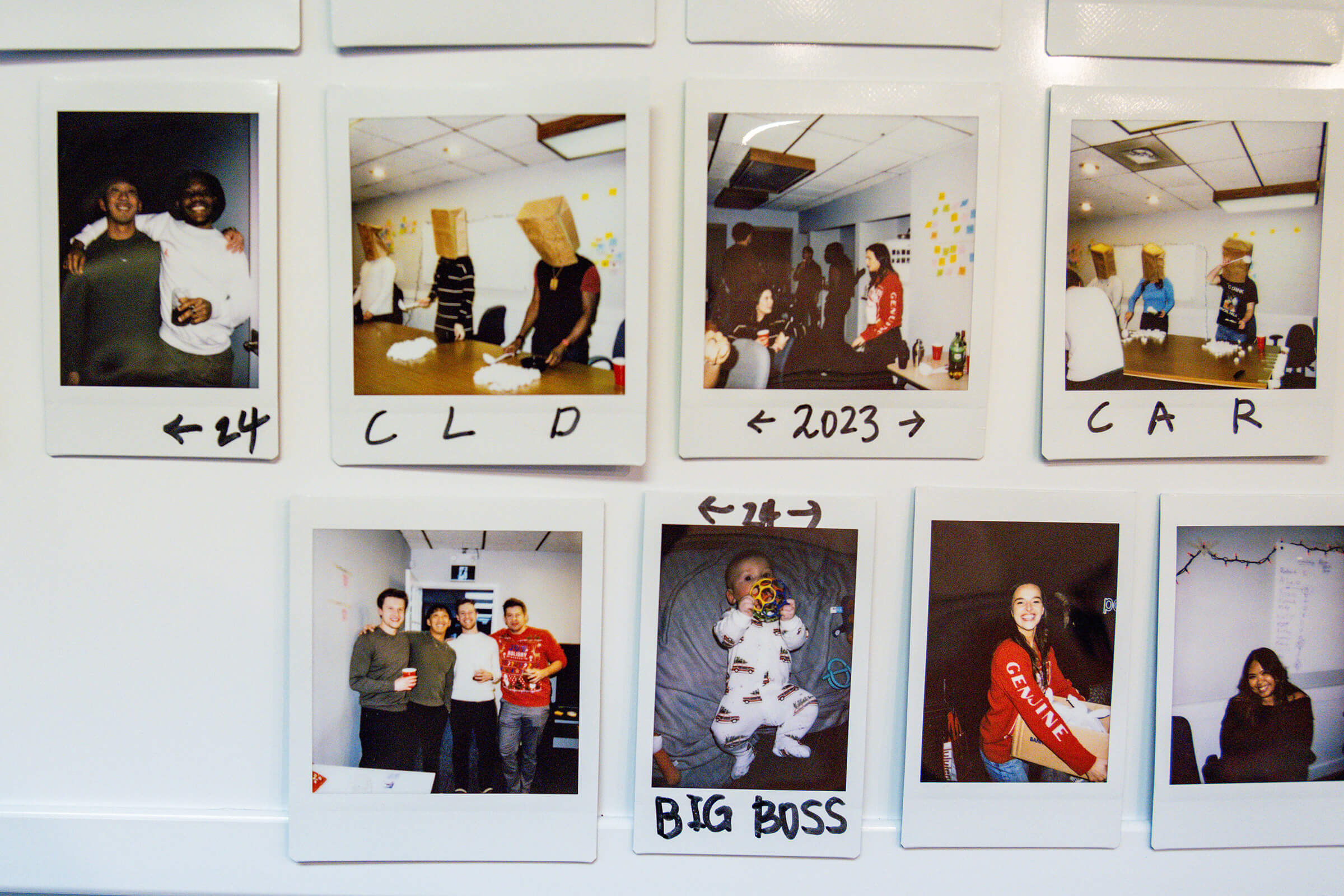
Polaroids of employees at their holiday party adorn Parallel’s boardroom fridge.
What is something that no one is talking about, but should be?
There are two things. This goes back to AI.
We’re starting to see this play out in an interesting way with all the large LLM (Large Language Models) of ChatGPT, Gemini, Perplexity. What I think about quite a bit, and what’s going to be happening over the next two or three years, is: You’re going to start to see more niche models come out, and you won’t just be using ChatGPT 5 to answer everything. One of our models, one of our data sets, is arguably the best and the largest to do a very specific thing in fashion. And so there’s more advantage to use our data, our system, for finding what size to buy online over ChatGPT.
And instead of asking ChatGPT 5 one question and then getting a result back from one LLM, ChatGPT 5 is probably going to go and ask 20 or 30 different individual niche models and get the results back. If you can be a business that’s become one of those niche models, there’s a lot of value in that.
The second thing is: MCP (Model Context Protocol), a brand-new technology. They’re what APIs (Application Programming Interfaces) were for the last 20 years, and they’re the new sort of protocol for AI agents. And the issue is: As these models become very generalized, whether you or I ask a question to ChatGPT, we’re going to get very similar results. This actually goes against the entire change of the internet for hyper personalization, where your results should be different than my results.
So MCPs are this middle layer that sits between the LLM model and then the user, and that allows you to insert a very personalized level of data. We can embed our fashion data sets so if you’re talking to ChatGP you actually have it ping your personalized profile on Parallel where you have your Wish List, the items you’ve been shopping for, what content you’ve been uploading, and it allows the answer back to you to be personalized. We’re now very broad with ChatGPT 5, and we’re going to see a hyper personalization happening. That’s my prediction.
And are you using that technology right now?
We are. It’s so cutting edge that I proposed to one of the largest commerce platforms in the world a few weeks ago, to do this idea and within 10 days we got the full green light from the AI team at that company to try it out. So right time, right place. We’ll see how it plays out.
What are your hopes for the company?
About 4 to 5 million people come to Parallel to shop. I’ve got to get that to about 100 million.
I’m playing against Pinterest, who has 700 million users. Amazon: billions. Meta has billions. So I’m playing in a world where 4 million users is cute. It’s a start. It’s so small and you got to get it to scale, right? We’re in 194 countries. We have paid $0 for marketing.
LIGHTNING ROUND
What is a standout moment from your time at UM? Meeting my wife, who was on the same travel study course through St. Paul’s College. The strategy to get her attention was off the chart.
How did you spend your first big pay day? I bought my wife’s engagement ring.
What do you do to relax? I actually find work super relaxing. I sometimes get anxious if I’m not working. But outside of that, spending time with my wife and my young son. I’m also a huge fan of home renovations.
What’s your favourite Manitoba gem? Clear Lake. We’ve been going up as a family since I was very young.
What’s your go-to hype song? “Yeah!” by Usher. I’m a millennial. In Grade 3, I went to my friend’s house and we burned a CD in his basement. It was track nine and I’d never heard of rap or hip hop until this point.
What’s your advice for students? Starting a business is really difficult. You have to decide if that’s the lifestyle you want. I’m never home by 5 p.m. It’s not for everyone. You can be the second or third in command at a company and have a nice, balanced lifestyle. I have a little bit more balance now with a son, but for the last 10 years, no balance.
How do you create a big impact? By working together. At UM, we collaborate with communities, forge partnerships locally and globally, and invite all to our campuses. By providing opportunities and spaces for people to connect and share knowledge, we can lead change together. Reimagining engagement is among the priorities you’ll find in MomentUM: Leading Change Together, the University of Manitoba’s 2024-2029 Strategic Plan.