







Their idea was born out of frustration.
Devon Bath and Naim Younes, then UM science students, faced the usual roadblocks when looking for a researcher to take them on as grad students. Scattered info. Ghosted applications. The daunting task of cold-emailing professors.
They thought: It would be so much easier if there was a centralized platform, one to connect ambitious students with the graduate studies supervisors who needed them.
So, they created GradFinder. But their first iteration required some work. They got the constructive criticism they needed during a UM pitch competition and took it as a challenge.
“You keep going because you believe in the idea,” says Bath.
They sought out coaching, refined their business model, and began to see rejection as a step forward rather than a stop sign. In the process, they got to know a burgeoning entrepreneurial ecosystem at UM.
The pace of progress
The Science Innovation Hub, where the pair got some initial tough love, is one example of a growing momentum to coax discovery out of the lab. This incubator offers workshops for students and scientists to make complex research more relatable to the public. And their 3K Pitch competition pushes participants to think about real-world impact.

This year’s 3K Pitch winner Rana Ahmed and her teammates showcased their out-of-the-box thinking by developing a probiotic—rather than an antibiotic—to treat a cholera outbreak.
Since its start five years ago, the Hub has naturally expanded to collaborations with other faculties—which was the whole point, says Daniel Heschuk, program development specialist.
“Everybody has unique skills that can be put together to create a much better idea.”
It’s this type of entrepreneurial mindset that gets scientists thinking about launching a cybersecurity firm or their own bioscience solutions company. They’re coming up with ideas that will benefit Manitobans, says Heschuk. He predicts a boom in the province in agricultural biotechnology, for one.
“There’s just so many new things coming out very quickly,” Heschuk says. “In the Department of Chemistry, for example, we’re seeing a few rapid diagnostic tests that are going to revolutionize diagnostics for antimicrobial resistance.”
We help them see that their research can become real-world solutions. —Daniel Heschuk
A university-wide shift
To bring ideas to life—campus-wide—UM created IDEA START, a centralized innovation hub, designed to be a one-stop shop for the entire university and its partners. IDEA START launched in 2024.
Over the last decade, Canada’s U15 research universities—a coveted list that includes the University of Manitoba—produced roughly 1,000 start-ups and spinoffs. But, as IDEA START Program Manager Rajeev Koyal points out, UM’s contributions were in the lower quartile. He’s determined to move the needle.
“We have the talent and the research. What is lacking is UM providing clear pathways and playbooks, making supports easily accessible to anyone who is interested in doing a start-up,” says Koyal.

UM students get an opportunity to compete for a spot at the Falling Walls competition in Berlin, Germany.
From IDEA START’s networking location on the main floor of UMSU University Centre, the UM community can access mentorship, funding opportunities, maker spaces and collaboration across faculties. Several disciplines are also devoting space for their own innovation hubs, including engineering, agriculture and health sciences, so far.
IDEA START unites campus partners to manage a community of 300-plus people who meet once a month to talk entrepreneurship and innovation—all are welcome. Emerging innovators are also invited to take part in the Falling Walls Lab, presenting their groundbreaking research or idea in a tight 3 minutes. The winner from Manitoba advances to the international finale in Berlin, Germany.
We have world-class research talent here. Our role is to make sure that talent has access to the right support and community to thrive.—Rajeev Koyal
Listen // the Idea Start Podcast
In the New Year, UM will launch a digital platform—IDEA START Innovate—for quick connection to their services and to other Winnipeg incubators, including North Forge Technology Exchange.
“There is economic uncertainty, challenges, headwinds—globally. It’s not unique to Manitoba. With the advent of AI and its widespread adoption among industries and professions, there is no job that’s taken for granted anymore,” says Koyal.
“Entrepreneurial skills teach you to take initiative and control of the situation. It teaches you how to network, how to create your own pathways for success.”
It’s this kind of initiative that undergrad and grad students also get at the Stu Clark Centre for Entrepreneurship at UM, through their free side-hustle course and one-on-one start-up coaching, along with two pitch competitions, including the Stu Clark New Venture Championships. It’s the largest of its kind in Canada, attracting students from across North America and globally.
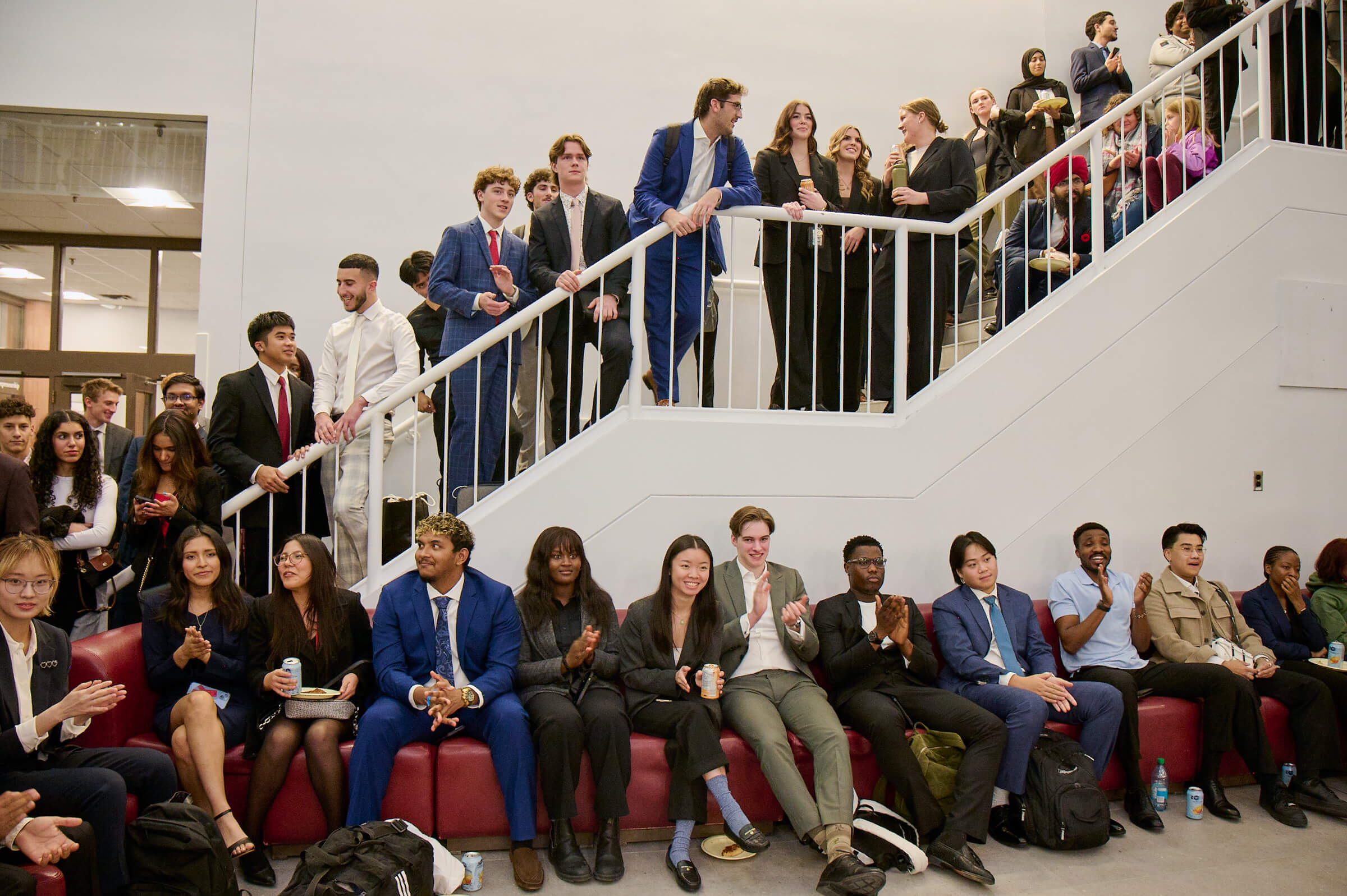
Students fill the atrium in the Drake Building for the CPHR pitch competition, hosted by the Stu Clark Centre for Entrepreneurship. // Photo by Tony Nardella
Teams present not just ideas but fleshed-out business plans, competing for more than $72,000 in prizes. The Centre, in its 27th year, even holds a pitch workshop to reach students while still in high school.
It’s about inspiring the next generation of entrepreneurs and preparing graduates for a new work reality, says Debra Jonasson-Young, Director of Entrepreneurship at the Asper School of Business.
“More students are going to have to consider entrepreneurship because other roles are going to shift and change so fast that entrepreneurship may be the easier choice going forward.”
Watch // the Stu Clark Centre Webinar Series
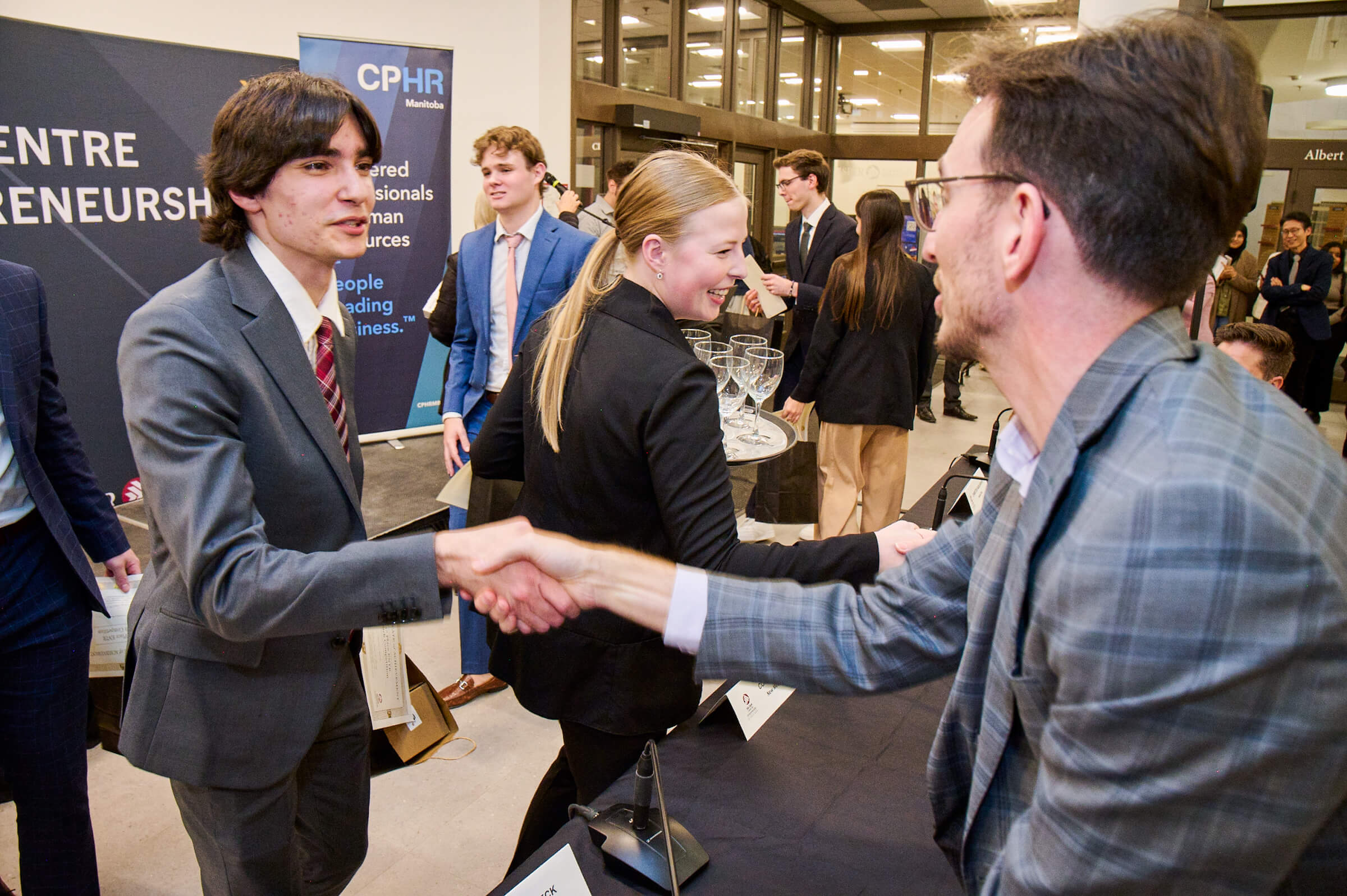
The winning student in the CPHR pitch competition shakes the hand of judge Matt Schaubroeck, a Manitoba entrepreneur and founder of Leverage Point Consulting. // Photo by Tony Nardella
Not business as usual
Three years ago, UM created a new position: Faculty Specialist for Entrepreneurship. It was a move to bring entrepreneurial thinking into classrooms, no matter the discipline.
Janine Carmichael, who took on the role at UM’s Centre for the Advancement of Teaching & Learning (CATL), says there’s growing demand from educators campus-wide. CATL has long worked with instructors to help them reimagine their teaching, build relationships with students, renew curriculum, incorporate new technology, and encourage more learning-by-doing.
Embedding entrepreneurship can take many forms, says Carmichael.
In the School of Art, she co-developed a series of workshops, dubbed Ignite, for the Master of Fine Art program, equipping artists with the skills to price and market their work with confidence.
For dental hygiene students, it meant exploring their own opportunities for entrepreneurship and learning small-business skills. The coursework also challenged students to think about a plan to tackle the unmet oral health care needs of Manitoba seniors.
“Starting businesses is amazing. It’s so good for Manitoba. It’s great for new products and services, new jobs. But it’s not the only way that entrepreneurship comes to life,” says Carmichael.
It’s about students stretching their curiosity, empathy and problem-solving skills. And bringing innovation into their thinking, asking them to ponder what is feasible, desirable, ethical and possible, she says.
“This kind of learning is happening in multiple disciplines in very nuanced ways that are specific to that discipline.”
In the Faculty of Social Work, students dove into social entrepreneurship, where business principles are used to address societal and environmental challenges. Students learn in the context of developing anti-racism practices within organizations and communities.
In fact, UM will be home to a new hub that has this type of social change at its core. Earlier this month, UM announced a $5.4 million gift from Drs. Wayne [BSc(ME)/80, LLD/23] and Eleanor Chiu to establish the Chiu Centre for Business Serving Community, within the Asper School of Business.
Entrepreneurship tends to come with the stereotype that it’s mostly technology and male-driven.
But entrepreneurship is for everyone, says Carmichael.
“Helping to shift that culture is important.”
Each partner at UM has a different lever that helped move our idea forward.—Naim Younes, co-founder of GradFinder
Global citizenship through innovation
UM has filed roughly 400 patent applications to date, and counting.
Now known as UM’s Partnerships, Knowledge Mobilization & Innovation (PKMI) office, this unit launched nearly 30 years ago to help individual inventors move their made-in-Manitoba ideas from academia to the world. PKMI ensures that the commercialization of the technologies born from UM research are supported through the licencing process, and with valuable industry relationships.
These new technologies help industry adapt and grow.
“We see between 30 and 50 new inventions come into our office in any given year,” says Loren Oschipok, Director of PKMI.
But invention to market is not always a straight line.
It wasn’t for the inventors behind a promising portable device for detecting chronic kidney disease, developed at UM in 2014. When the original licensee stepped away, the inventor team, led by researchers Francis Lin and Claudio Rigatto, refused to let their innovation sit on a shelf. With support from PKMI, they instead launched their own company—AssureCKD—to advance their diagnostic tool into clinical use.
“Our ultimate goal,” says Oschipok, “is to leverage these innovations for the betterment of society, to get them out into the community where they can be the most useful.”
Recap // Entrepreneurship at UM in ways
IDEA START — the centralized innovation hub for the University of Manitoba
Science Innovation Hub — an incubator based in the Faculty of Science that collaborates with faculties across campus
Stu Clark Centre for Entrepreneurship — a centre for applied entrepreneurship, including a premier business plan competition to turn ideas into successful ventures
The Centre for the Advancement of Teaching and Learning — a source for instructors to weave entrepreneurship pedagogy into their courses
Partnerships, Knowledge Mobilization and Innovation — the office that turns academic research into real-world solutions
At UM, we encourage life-long curiosity while providing tools – inside and outside the classroom – to succeed in a rapidly changing world. Empowering learners is among the priorities you’ll find in MomentUM: Leading Change Together, the University of Manitoba’s 2024-2029 Strategic Plan.