







It Takes a Village
As HIV spread through rural India in the 1990s, the global public health community grew increasingly concerned. Alarmed locals were facing a new deadly disease without any effective treatments. It was in this context that Dr. James Blanchard [BSc(Med)/86, MD/86] experienced a moment in Karnataka that has stayed with him, decades later.
During a chance meeting with teenage sisters, he could tell they didn’t yet understand the severity of the situation.
“They were giggling. They were twins and finished each other’s sentences and were full of life. They certainly didn’t have any sort of fear about the HIV epidemic at that point in time,” Blanchard says.
“Everybody else was feeling the panic and the peril, so that image stuck with me.”
Blanchard would see one of the girls again a few years later, at a public health meeting in a neighbouring community. She shared that her sister had died of AIDS and now she was advocating for better access to HIV prevention tools for young sex workers.
“She was never, sort of, bright and cheerful again. There was a deep sorrow there,” Blanchard says.
What we do is important but how we do it is as important as anything else.
How this epidemiologist approaches systemic change to public health policy and care in developing countries has not only garnered acclaim in his research field but also the attention of Bill and Melinda Gates. Their foundation supports UM’s Institute of Global Public Health—of which Blanchard is Executive Director. In fact, UM receives more funding from the Bill and Melinda Gates Foundation than any other university in Canada, $450 million to date.
Blanchard, who recently received a 2025 UM Distinguished Alumni Award for Academic Innovation, leads roughly 35 large-scale programs with robust teams in India, Kenya, Nigeria and Pakistan. They’re often in the poorest regions and home to some of the world’s highest rates of HIV, as well as maternal and child mortality.
These UM teams don’t swoop in and tell locals how to fix things. They take their cues from the community itself, with a grassroots approach that can then be upscaled for maximum reach and impact.
They provide evidence-based knowledge to help local governments design policy for medical protocols and infectious disease prevention. Their goals run the gamut, from developing peer support programs to reduce HIV in sex workers, to improving delivery care for expectant moms.
“Our role, really, in each of those projects is to understand what needs to be done, what are the best ways of doing that, and then try to implement it. Then we look at how well it’s working and, if it’s not working, we try to improve things.”
No small feat in logistics when working in remote villages or in hugely populated cities with underserved populations. Blanchard and his team’s successes in one country can then be applied to another. For example, their extensive portfolio of programs in India is now expanding into Africa.
Most recently, they’ve been doing detailed mapping to identify gaps and bottlenecks in care involving family planning for women—from pregnancy to delivery to postpartum—in Pakistan and West Africa, including Nigeria, Côte d’Ivoire and Senegal.
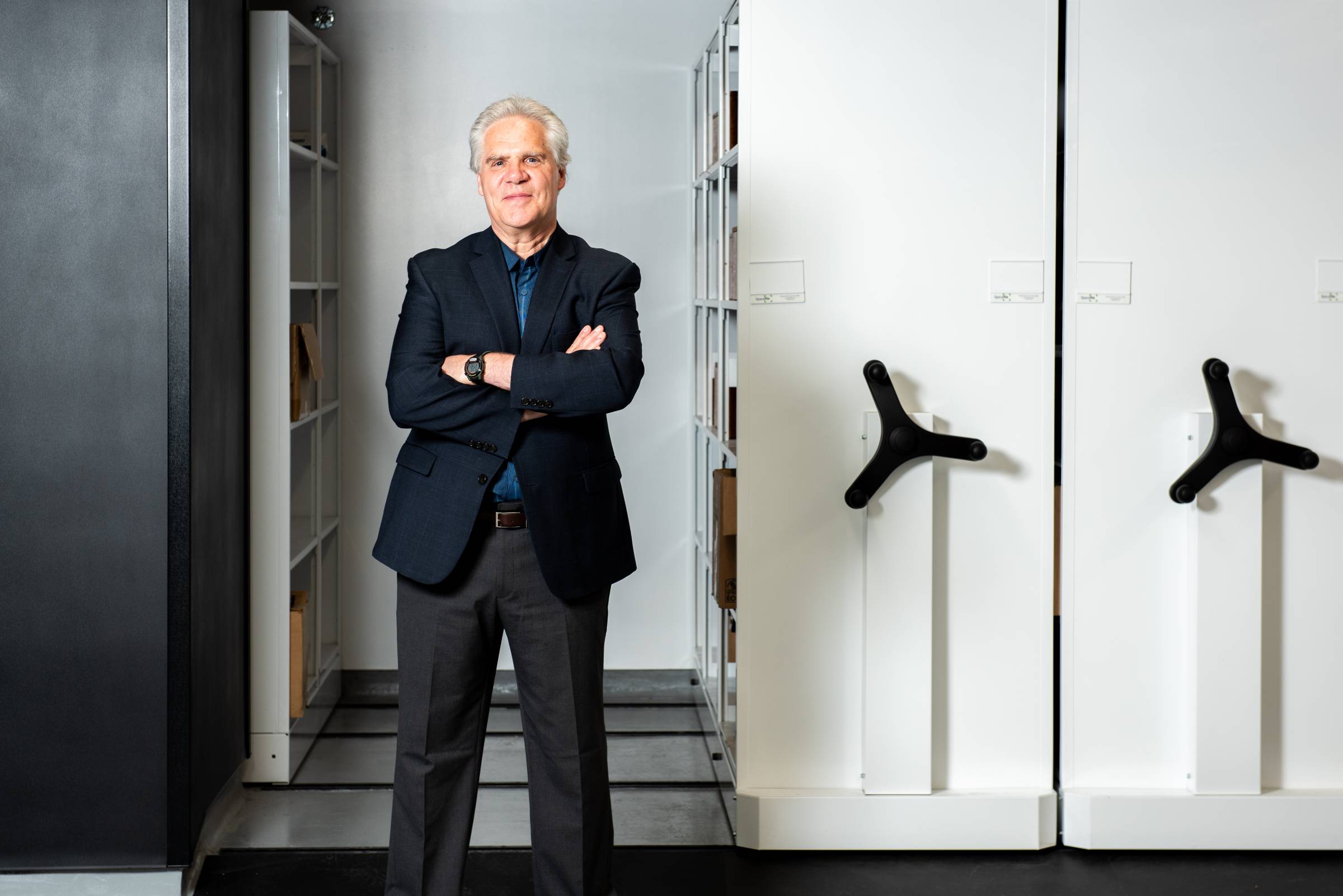
James Blanchard says his father, once a surgeon in an isolated region of Pakistan, inspired him to see possibilities in challenges. “Somebody from Pakistan, who I met years later, said my dad could see beauty in anything.”
How he found his path
Blanchard spent part of his childhood in northern, rural Pakistan, where his father was a surgeon for six years. The family moved to Winnipeg when Blanchard was in Grade 6. He says his original calling wasn’t medicine, but literature.
“That’s probably more my personality than science, research and medicine.”
But his creativity has helped to shape his problem solving in global public health in positive ways. He describes himself as a lateral thinker, not typical for a scientist but it helps when troubleshooting complex public health situations in an increasingly rocky landscape. Blanchard worries about U.S. funding cuts to aid, including for life-saving HIV treatment. He has seen the harm to communities first-hand.
“My concern now is that we’re going to go back to a situation where upper-income countries are going to start withdrawing support and we’re going to be putting a lot more people at risk in the coming decade,” Blanchard says.
Another growing concern: the effects of climate change on health in developing countries. Extreme temperatures mean more flooding and a spike in health issues in water-logged areas, including increases in mosquito-borne illnesses like malaria and dengue.
Globally, people are beginning to focus more on their own backyard and less about what’s happening further afield.
“We have enough to do both,” he says.
Putting global work in action for Manitobans
Blanchard began his career working in public health in Manitoba, in UM’s northern medical unit, what is now Ongomiizwin – Health Services. Working up north as a newly graduated physician in the late 1980s instilled in him early on that UM is not here to do research and teach in silos, but to be collaborative and apply knowledge to make a real-world difference.
“That has influenced the way that we do our global health programs,” he says.
And now he sees ways to leverage what they’ve learned globally to improve outcomes in underserved communities in Manitoba.
“We are, more and more, looking at how we can combine efforts to try to bring together this way of doing things and to interact more with what’s happening here as well.”
Inspiring future leaders
Blanchard’s approach to developing the next generation of public health experts bucks convention that students should come to North America or go to the United Kingdom or Europe for their training and then return home and put this knowledge into action.
“What we’ve tried to develop is training programs that allow people to train where they’re going to end up working.”
UM’s newly established College of Community and Global Health will offer this type of joint degree opportunity, particularly at the graduate level, by partnering with academic institutions in countries in need. Most of the mentorship will happen in the students’ home communities.
“It’s a very new way of thinking about training in global health, and it’s the way in which all global health training programs will need to move in the future,” says Blanchard.
“With the new college, we can take on some major health challenges as a university, and do it in a more coordinated and substantive kind of a way. We have the intellectual resources, the social resources and the students who are really enthusiastic about making a difference.”
Progress comes from being feet on the ground in a community. It was only through a public meeting that they were able to hear the story of the surviving twin sister, who became a Peer Leader for a Sex Worker Collective, supported by UM. She has since helped thousands of other women with literacy programs, access to housing and schooling for their kids.
“She is a force,” says Blanchard. “It’s what propels us to keep doing what we do.”
Point of View // JAMES BLANCHARD ON UNIVERSITIES THINKING BEYOND CAMPUS
Blanchard says post-secondary institutions as a whole need to shift their lens outward.
“I think universities, academia, have to stop worrying about themselves and thinking inwardly about all of the challenges they’re facing, and think more about what we can do outside of our walls,” he says.
“There can be way too much internal focus and dialogue within and not nearly enough focus on what our role is and what our responsibilities are out there, out in the community.”
UM is home to scientists, students and scholars who respond to emerging issues and lead innovation in our province and around the world. Creating knowledge that matters is among the priorities you’ll find in MomentUM: Leading Change Together, the University of Manitoba’s 2024-2029 Strategic Plan.