






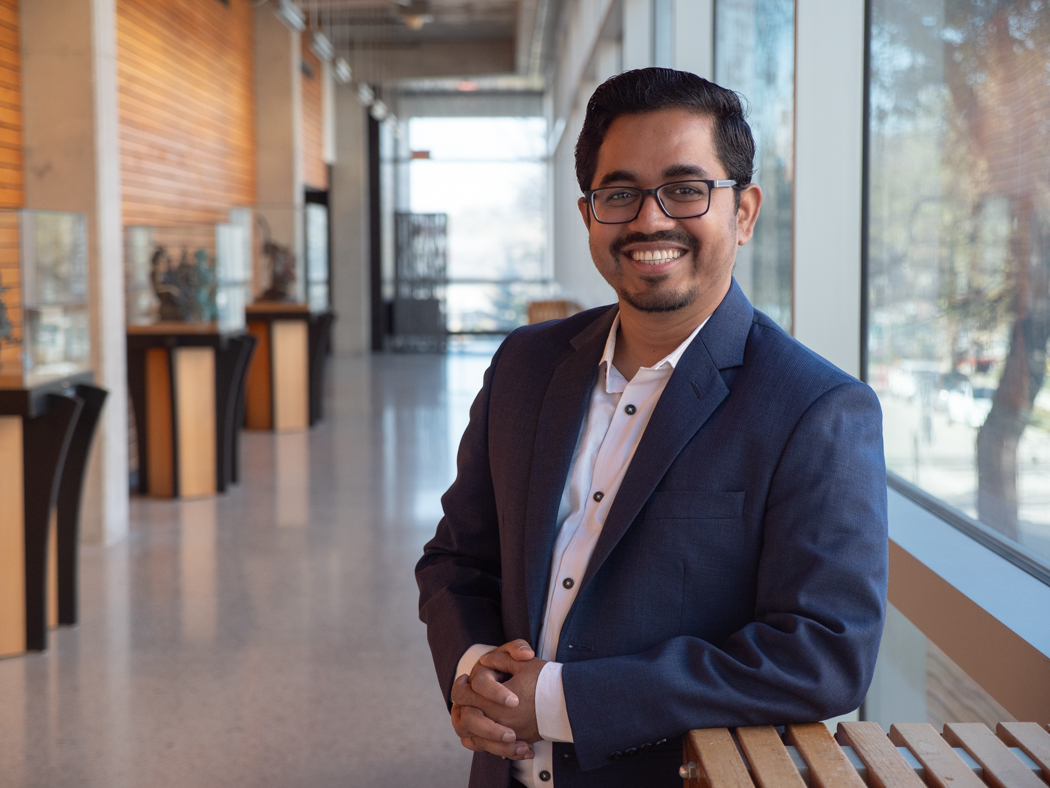
Md. Abdul Aziz, pictured at the Apotex Centre on the University of Manitoba’s Bannatyne campus.
Pharmacy PhD student awarded prestigious Vanier scholarship
While in Bangladesh, Md. Abdul Aziz searched online for top pharmacy schools in Canada.
He had just completed his master’s degree in clinical pharmacy and pharmacology at Noakhali Science and Technology University and was ready to begin a new chapter.
The University of Manitoba’s College of Pharmacy at the Rady Faculty of Health Sciences popped up in his search, and he was impressed by its graduate research opportunities. He was drawn to programs offering research in both pharmacoepidemiology (study of how medications are used and their effects in large populations) and pharmacogenomics (explores how a person’s genetic makeup influences their response to drugs).
Aziz joined the college as a master’s student and transferred to the PhD program a year later in 2023. He recently received a prestigious 2025 Vanier Canada Graduate Scholarship to fund his PhD.
We spoke with Aziz about his journey and research.
What inspired your interest in pharmacy research?
Back in my home country of Bangladesh, we don’t talk about mental health. People often ignore their symptoms, which can lead to serious consequences such as suicide and substance abuse. Seeing how these issues are overlooked inspired my passion for helping those affected.
I became curious about how real-life challenges related to mental health disorders affect individuals, and why these issues are rising globally.
Can you tell us about your research?
Millions of people in Canada and worldwide suffer from mental health issues each year, particularly mood and anxiety disorders. In Manitoba, these conditions are steadily increasing. Many patients may take antidepressants to manage their symptoms, but some stop using them — and we don’t know what factors lead to that decision. That’s what I’m trying to understand through my research.
I’m fortunate to work in both Dr. Christine Leong and Dr. Abdullah Maruf’s labs for my study. Dr. Leong, associate professor at the College of Pharmacy, is a pharmacist specializing in pharmacoepidemiology, analyzing drug effectiveness and long-term trends in mental health medication use. Dr. Maruf, assistant professor at the College of Pharmacy, works in clinical pharmacogenomics and is an expert and leader in the implementation of pharmacogenomic testing in Canada.
My project brings both of their disciplines together.
I am using the Rady Faculty’s Manitoba Centre for Health Policy database, which covers almost 1.5 million Manitobans. I analyze patterns of antidepressant use over a prolonged period — from 2015 to 2021 — and study how long people stay on their medication and why they stop, as well as what other antidepressant and non-antidepressant drugs are taken alongside them.
I’m also studying how commonly prescribed antidepressants are dispensed especially those affected by genetics, which can change how well the drugs work. These trends could inform the development of pharmacogenomic testing facilities for mental health care in Manitoba, where no publicly-funded service currently exists.
What impact do you hope your research will have?
Building on my research in Manitoba, I plan to expand to national data to inform health policy and improve service delivery across Canada.
Our findings aim to address gaps in current health-care guidelines and support the development of new strategies to manage and reduce the burden of mental health disorders.
My commitment to help those with mental health challenges extends beyond Canada. In the future, I intend to set up a research group in Bangladesh to raise awareness and help address concerns and stigma.
Most graduate students in the college have an undergraduate degree in science. What message do you have for those considering pursuing pharmacy research?
The College of Pharmacy provides cutting-edge facilities and fosters excellent research. We have exceptional mentorship programs that support students every step of the way.
Research allows you to help others and make a lasting impact. You will understand why they are suffering, find gaps in the health-care system, and look for solutions to better guide patients.
I also encourage Doctor of Pharmacy (PharmD) undergraduate students to become researchers and help make a broader impact on the community.